Last Updated: November 5, 2026
Quick Summary
Environmentally responsible demolition waste disposal means planning before work starts, sorting materials on site, and sending each stream to a licensed facility. Most demolition waste can be recovered rather than landfilled, so a written waste management plan based on a pre-demolition audit is the starting point.
- Run a pre-demolition audit with room-by-room walkthrough, hazardous materials check and salvage assessment.
- Keep concrete, masonry, timber, metal and general waste in separate bays from the start.
- Keep asbestos waste out of general waste and use licensed people and licensed disposal facilities only.
- Check each destination facility’s licence before work starts, not just after loads leave site.
- Keep weighbridge dockets and receipts for every load so diversion claims can be verified.
Table of Contents
- What Counts as Demolition Waste and Where It Comes From
- Building Your Demolition Waste Management Plan Before Work Starts
- Step-by-Step Sorting and Salvage on Site
- Handling Asbestos Waste Disposal Requirements Safely
- Demolition Waste Recycling and Landfill Diversion
- Keeping Records and Reporting Your Waste Outcomes
- Booking Responsible Demolition With Mission Demolition
- Frequently Asked Questions
Demolition waste is one of the largest waste streams in Australia, and most of it can be recovered rather than sent to landfill, so good demolition waste disposal starts with planning. For how materials are sorted, recovered and diverted from landfill on site, see Demolition Site Recycling in Australia. Getting demolition waste disposal right starts before the first wall comes down. This guide from Mission Demolition explains what counts as demolition waste, how to plan and sort it on site, how to handle asbestos safely, and how to keep records that prove the job was done properly.
What Counts as Demolition Waste and Where It Comes From
Demolition waste is the material left after a building, or part of one, is pulled down or stripped out. It includes concrete, bricks, timber, plasterboard, metals, glass, roofing and soil. Some of it is clean and easy to reuse. Some of it is mixed and harder to handle.
Most of the volume comes from full demolitions, but internal strip-outs produce a lot too. Old fit-outs, kitchens, bathrooms and flooring often send plenty of material to skips.
A common mistake is treating everything as general rubbish. Once materials are mixed in one skip, most of their value is lost. Keeping streams separate from the start is the cheapest way to cut disposal costs.
Building Your Demolition Waste Management Plan Before Work Starts
A demolition waste management plan sets out what material you expect, how it will be handled, and where it will go. It should be written before work begins, not after the skips arrive. A plan is only as good as the pre-demolition audit behind it, so treat the two as one exercise.
Run a pre-demolition audit first
Before writing the plan, walk the building and record what is actually there. A useful audit sequence is:
- Desktop review. Collect existing drawings, prior renovation approvals, asbestos registers and any hazardous materials reports. Older buildings often have undocumented alterations, so treat the drawings as a starting point rather than a complete record.
- Room-by-room walkthrough. Record the materials present in each area, concrete slabs and footings, brick and masonry walls, structural and non-structural timber, plasterboard, metals, glass, roofing, floor coverings and soil. Note approximate quantities so bin sizes and collection frequency can be estimated.
- Hazardous materials check. Identify suspected asbestos-containing materials, lead paint, synthetic mineral fibre, chemicals and contaminated soil. If asbestos is suspected, arrange identification and removal planning before any destructive work.
- Salvage assessment. Flag items with reuse value, doors, fixtures, heritage timbers, structural steel, and decide whether they will be salvaged, sold, donated or recycled.
- Access and logistics review. Confirm where bins can be placed, how trucks will enter and exit, and whether loads can be segregated on site or must be sorted at a transfer facility.
Turn the audit into a written plan
We recommend the plan covers:
- Materials expected: an inventory by stream, including quantities and any hazardous items
- Sorting method: which skips or bays hold each material stream, and who is responsible for keeping them clean
- Destinations: the licensed facilities that will take each stream, with licence details checked in advance
- Transport: who hauls the waste, which vehicles they use, and how loads are tracked
- Records: how each load is weighed, logged and confirmed, and who holds the paperwork
- Contingency: what happens if a load is rejected for contamination or a facility cannot accept a stream
Ask your demolition contractor how the plan will be followed on site and who checks it. A plan that sits in a folder helps nobody.
Watch out: if the audit is skipped and the plan is written from assumptions, contamination and unexpected hazardous materials usually show up mid-demolition, when options are limited and costs are highest.
The plan should cover the same core items on every project, so use this checklist to see what each part needs.
| Plan element | What it covers | Key check |
|---|---|---|
| Materials expected | Inventory by stream, with quantities and hazardous items | Quantities from the room-by-room walkthrough |
| Sorting method | Which skip or bay holds each stream | Who keeps each bay clean |
| Destinations | Licensed facilities for each stream | Licence details checked in advance |
| Transport | Who hauls the waste and which vehicles | How loads are tracked |
| Records | How loads are weighed, logged and confirmed | Who holds the paperwork |
| Contingency | What happens if a load is rejected | Plan for contamination or a facility refusing a stream |
Step-by-Step Sorting and Salvage on Site
Sorting on site is where most of the recovery happens. Work through the building roughly in the order it comes apart, and separate materials as they come out.
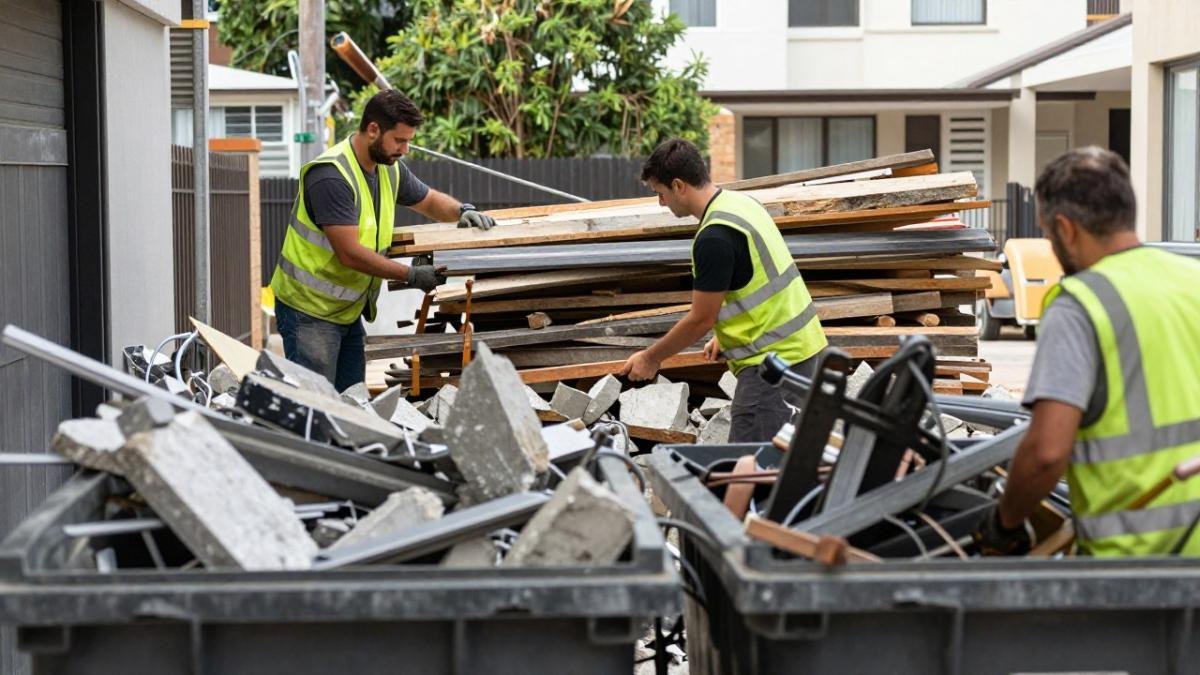
- Remove fittings and salvageable items first, such as doors, fixtures and good timber.
- Strip out hazardous items and handle them under the correct procedure.
- Set up separate bays for concrete, masonry, timber, metal and general waste.
- Keep each bay clean. A bit of plasterboard in the concrete pile can contaminate the whole load. For the full sorting and salvage steps, see strip-out waste recycling.
- Check each load before it leaves site and record what went where.
Concrete, Masonry and Timber
Clean concrete and masonry can be crushed and reused as road base or fill. Keep it free of timber, plaster and soil, because contamination lowers its value and can push it into landfill.
Sound timber can often be reused or recovered for fuel or mulch. Remove nails and fixings where practical, and keep painted or treated timber apart from untreated stock, since many facilities accept them differently.
Metal and Other Recoverable Materials
Scrap metal is one of the most valuable streams on any site. Steel, copper, aluminium and cast iron each have their own buyers, so keep them separate rather than mixing them into one bin.
Glass, plasterboard and some roofing can also be recovered where local facilities accept them. Check with the receiving facility before loading, because acceptance rules vary.
Handling Asbestos Waste Disposal Requirements Safely
Asbestos is one of the most serious hazards in demolition work, and it is commonly found in older buildings. Asbestos waste must never be mixed with general waste, and it must never be broken up, dumped or left uncovered.
Get a Free Demolition And Asbestos Removal Quote →
Under Australian work health and safety rules, asbestos removal and disposal must be carried out by licensed people, using approved methods and taken to a facility licensed to accept it. Waste must be packaged, labelled and transported in line with those rules.
Mission Demolition holds an asbestos licence (No: AD213684) and a demolition licence (No: AD213693). Before any asbestos work starts, ask to see the licences, the removal plan and the disposal destination. Our guide to what an environmental demolition plan must cover in Australia explains what that plan should include. Keep copies of the disposal documentation. If a contractor cannot show you where the asbestos went, treat that as a warning sign. You can check how legal asbestos waste disposal is verified in Sydney before work starts.
Demolition Waste Recycling and Landfill Diversion
Landfill diversion means keeping materials out of landfill by reusing, recycling or recovering them. It is a core goal of responsible demolition, and it often lowers project costs as well.
The main ways to divert waste are:
- Reuse: salvaged doors, fixtures and timber go back into other projects
- Recycling: crushed concrete, masonry and scrap metal go to processors
- Recovery: suitable timber and other materials are used for energy or products
The share of waste diverted depends on how well the site is sorted and how much value each stream holds. Pricing for disposal depends on quantity, dates, the materials involved and delivery, so ask for a written quote that breaks these out.
Keeping Records and Reporting Your Waste Outcomes
Good records are how you prove the waste went where it should. For every load, keep a note of the material type, the weight or volume, the date, the vehicle, and the destination facility. Keep weighbridge tickets and disposal receipts where available.
Verify the destination, not just the claim
A disposal receipt proves a load was tipped somewhere; it does not prove the facility was licensed to accept that material. Before work starts, check each destination facility’s licence and the materials it is permitted to receive. Environmental regulators publish registers of licensed waste facilities, so the check can be done through a short online search.
A practical chain-of-custody process looks like this:
- Pre-approve facilities. Record the facility name, licence number and accepted streams in the waste management plan.
- Weigh every load. Use a public weighbridge where possible and retain the docket. Volume-based estimates are weaker evidence if a question arises later.
- Match dockets to loads. Each weighbridge ticket should be traceable to a specific skip, vehicle and date, so a load can be followed from site to destination.
- Retain receipts. Keep disposal receipts and recycling or recovery confirmations alongside the dockets.
- Reconcile at project end. Compare the total waste removed against the quantities estimated in the pre-demolition audit. A large gap usually points to unrecorded loads or misclassified streams.
Report outcomes in a form that can be checked
Ask for a summary at the end of the project showing total waste, the amount diverted, and the destinations used. The summary should reconcile to the underlying dockets, not just state a diversion figure. Where a project has sustainability reporting obligations, the dockets and receipts are the evidence behind the number.
These records do three jobs. They show regulators that you met your obligations. They support any project reporting on waste outcomes. And they protect you if a question comes up later about where a load ended up.
Watch out: a contractor who can produce a diversion percentage but cannot produce the matching weighbridge dockets and facility receipts is giving you a claim, not a record.
Booking Responsible Demolition With Mission Demolition
Responsible disposal starts with the right plan and the right crew. Mission Demolition handles residential, commercial and industrial demolition, asbestos removal, strip-outs and site clearance in Sydney. We are licensed and insured.
If you are planning a demolition, contact Mission Demolition for a free demolition and asbestos removal quote. We will walk through the materials on your site, the disposal plan and what it will cost, so you know what to expect before we start.
Frequently Asked Questions
How can demolition waste be disposed of responsibly?
Responsible disposal starts before the first wall comes down. Plan which materials can be salvaged, separate waste streams on site, and send each stream to a licensed facility that accepts it. Keep the chain of custody clear by retaining weighbridge tickets, transport records and facility receipts. Ask your demolition contractor for a written waste management plan that names each destination, so you can confirm where every load ends up.
What materials from demolition can be recycled?
Concrete and masonry can be crushed into recycled aggregate for road base and fill. Timber can be salvaged for reuse or processed into mulch and engineered products. Scrap metal such as steel, copper, aluminium and steel reinforcing is widely recycled. Clean bricks, tiles, fixtures and doors can often be resold or donated. Materials contaminated with hazardous substances, including asbestos, cannot be recycled and must follow separate disposal rules.
How should asbestos-containing demolition waste be handled?
Asbestos waste must be handled by licensed removalists and wrapped, labelled and transported according to the requirements of your state or territory work health and safety regulator. It should be taken only to a landfill licensed to accept asbestos, and the transport and disposal must be documented. Never break up asbestos sheeting or dispose of it in general skips. Confirm your contractor holds the correct asbestos licence before work begins.
What records should a contractor keep for demolition waste disposal?
A good contractor keeps weighbridge tickets or volume records for each load, transport documentation, facility receipts showing the waste was accepted, and details of any materials salvaged or recycled. For asbestos, records should also cover removal certificates and the licensed disposal site. Ask for copies of these documents at the end of the project so you can verify the waste went where it was declared.