Strip-out waste recycling works when you decide the recovery plan before the first ceiling tile comes down: hazardous materials identified and removed first, everything else separated at source into clearly signed areas, and every load backed by paperwork showing where it ended up. Skip any of those three and most of a fitout ends up in a general skip.
This guide is for property managers, developers, builders and business owners who are about to strip out an office, shop or warehouse in New South Wales or elsewhere in Australia. It covers what a strip-out recycling plan includes, which materials can be recovered, what targets are realistic, and how to verify the result.
TL;DR
- Test for asbestos and other hazardous materials first. Asbestos waste can never be reused or recycled in NSW, so it needs its own lawful disposal route.
- Separate materials at the source and give each stream a clearly signed storage area. Plan for at least two days of waste storage.
- A sensible benchmark is the Better Buildings Partnership’s 60% minimum resource recovery target for office strip-outs. Sydney fitouts currently average about 21% diversion.
- Ask for evidence before waste leaves site, and tie payment milestones to receipts showing lawful reuse, recycling or disposal.
- Put recovery targets into the contract with your strip-out contractor, not into a sustainability statement that nobody checks.
Table of Contents
- What strip-out waste recycling actually involves
- Which strip-out materials can be reused or recycled
- Deal with asbestos before anything else
- How to separate and store materials on site
- Recovery targets: what the numbers mean
- How to verify the waste was really recycled
- Contracting for recycling: what to put in the brief
- Our perspective on strip-out recycling
- Plan your strip-out with us
- FAQ
- Sources
What strip-out waste recycling actually involves
A strip-out removes the non-structural fabric of a building: ceilings, partitions, floor finishes, joinery, services, fixtures and fittings. It is fast, and it produces a very mixed pile of waste. Plasterboard, carpet tiles, glazing, timber, cabling, ductwork, steel framing and furniture all come out in days. If they leave in one bin, nearly nothing can be recovered.
Recycling in this setting is mostly a sorting problem. The NSW EPA describes the logic in its deconstruction guidance: take a building apart so the maximum amount of material can be sold, reused or recycled, which minimises disposal and landfill charges. That guide is written for houses, but the principle carries straight into commercial interiors. The more carefully a material comes out, the more value it keeps.
There are three layers of recovery, in order of preference:
- Reuse. Workstations, doors, glazed partitions, light fittings, raised floor tiles and kitchen equipment can often be resold or donated intact.
- Recycling. Metals, clean timber, concrete, brick, glass and plasterboard go to processors that turn them back into raw material.
- Lawful disposal. What cannot be recovered, including asbestos and contaminated material, goes to a facility licensed to take it.
Good planning decides which layer each material falls into before work begins, and puts it in writing.
Which strip-out materials can be reused or recycled
The most useful list comes from a US EPA guide on construction and demolition recycling. It names metals, concrete, brick, asphalt, wood, glass and gypsum wallboard as recyclable, and warns that some insulation and contaminated or hazardous materials are difficult to recycle or need special handling. It is an American document, but the material categories are the same ones Australian processors work with.
Here is how that looks on a typical commercial strip-out:
| Material | Typical route | What affects recovery |
|---|---|---|
| Steel, copper, aluminium (framing, ducts, cabling) | Scrap metal recycler | Easy to recover if kept out of mixed bins |
| Concrete, brick, tiles | Crushing and screening for reuse as aggregate | Needs to be free of timber and plastics |
| Glass and glazing | Glass recycler or crushing facility | Keep separate from ceramics and mirrors |
| Timber and joinery | Reuse, mulching or timber recycling | Treated or painted timber may need a different stream |
| Plasterboard | Plasterboard recycler | Must be kept dry and free of other waste |
| Carpet tiles, furniture, fittings | Resale, donation or specialist take-back | Removed whole, not smashed |
| Asbestos-containing material | Licensed removal and licensed landfill only | Never recycled or reused |
| Mixed residual waste | Sorting facility or landfill | Aim to keep this stream as small as possible |
Asphalt turns up less often inside a building, but it appears in car parks, loading docks and external works that sit alongside a commercial refit. If you want to see how a recovered material becomes a new product, asphalt recycling explained walks through the process in plain terms.
Processing capacity matters too. A planning document for a proposed facility at Wetherill Park in western Sydney describes a plant that would separate, crush and screen soil, glass, masonry, tiles and bricks for further processing and reuse. That is the kind of downstream operation your sorted loads need to reach. Mixed loads can only go to mixed-load facilities, which recover less.
Deal with asbestos before anything else
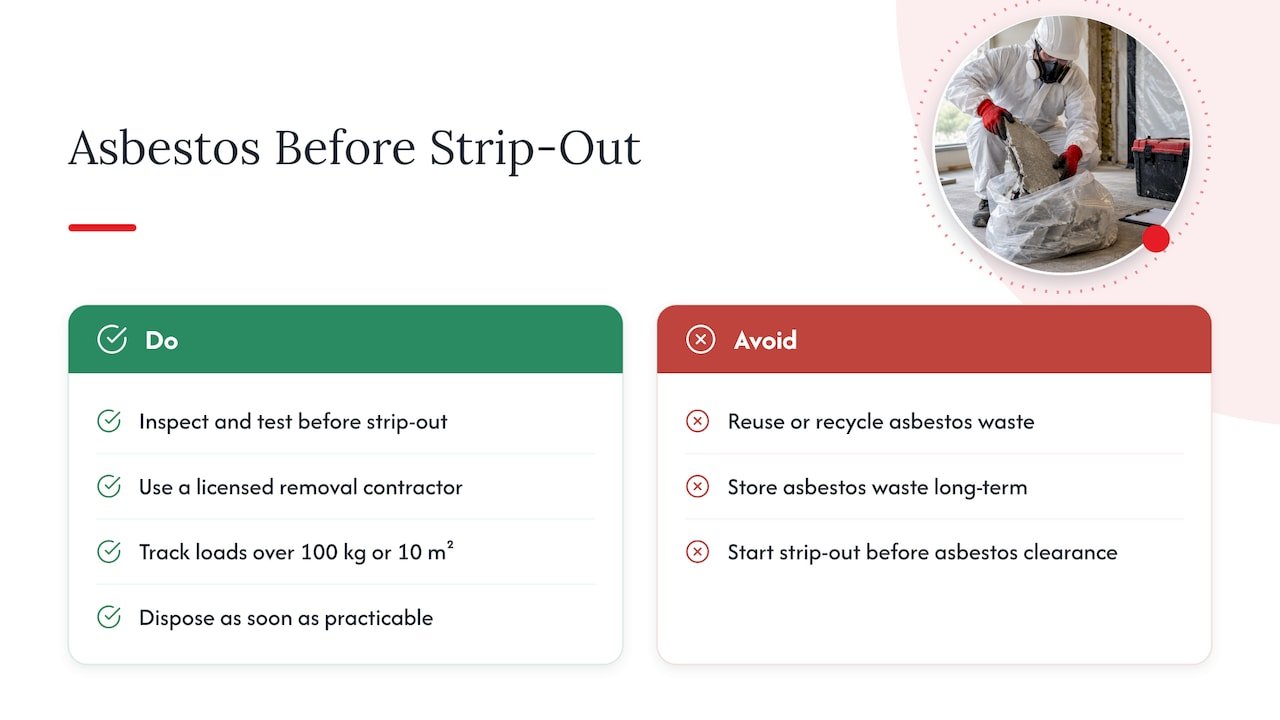
Any building built before the late 1980s can contain asbestos in ceiling tiles, wall sheeting, vinyl flooring, pipe lagging, fire doors and electrical boards. Disturb it during a strip-out and you contaminate every other waste stream, which turns a recyclable load into a hazardous one.
That is why the order of work matters. Inspect and test first, remove and clear any asbestos with a licensed contractor, then start the general strip-out. Our guide to the Australian process for removing asbestos before demolition sets out the sequence, and our asbestos inspection and testing service is where most strip-out projects start.
The rules on what happens to asbestos waste are strict. NSW’s asbestos blueprint document states that re-use and recycling of asbestos waste is prohibited under the Waste Regulation. It also says long-term storage is not encouraged and disposal should happen as soon as practicable. So asbestos belongs outside your recycling percentage entirely, and it should never sit on site waiting for a convenient skip.
Transport rules apply as well. In NSW, asbestos waste transport is regulated under the POEO Act and the Waste Regulation 2014. Loads must be covered and leak-proof, and loads over 100 kg or 10 square metres must be tracked in WasteLocate. We explain the tracking rule and penalties in 100 kg or 10 m2: tracking asbestos waste in NSW, and the wider legal picture in our NSW asbestos removal regulations guide.
Small quantities are treated differently for householders. Lake Macquarie City Council, for example, says small amounts can go to a licensed facility if they are wrapped, kept separate from other waste and carried in a covered, leak-proof vehicle, but it still recommends a licensed removal contractor. On a commercial strip-out, use the licensed contractor every time.
If your site has other unknowns such as contaminated soil behind a slab or old chemical stores, the NSW EPA toolkit advises keeping a sufficient contingency budget and a plan for unearthed contamination. Our article on NSW’s hazardous by default rule explains why untested waste can be classed as hazardous when it reaches a facility.
How to separate and store materials on site
Separation is where recovery rates are won or lost. Victorian better practice guidance for commercial and industrial facilities recommends separating materials at source and providing sufficient, clearly defined and signed storage areas. It was written for permanent buildings, but the same discipline applies to a temporary strip-out site.
The same guidance recommends storage space for at least two days’ worth of waste and recyclable materials. On a busy strip-out that means you need to know where the bins go before the crew arrives, not after the first morning of demolition.
A workable site layout looks like this:
- One stream per bin, labelled. Metal, plasterboard, timber, glass, concrete and masonry, general waste. Signs should use words and colours that every trade on site understands.
- A route for each bin. Trucks need access, and crews need a short path from the work area to the right container.
- Cover for plasterboard. Wet plasterboard is much harder to recycle, so keep it dry.
- A reuse zone. A separate area for items being kept for resale or donation, protected from damage.
- Contaminated material quarantined. Anything suspected of containing asbestos stops work in that area until it is tested.
Site planning can feel mundane, but easy-to-use systems are what make crews follow the plan. For ideas on practical storage planning for bulky items and recyclable materials during a clear-out, that article covers the thinking from a household angle, and the same principles scale up to a commercial floor.
Recovery targets: what the numbers mean
Targets are easy to quote and easy to misread, so look at what each figure measures.
The Better Buildings Partnership (BBP) stripout waste guidelines set a minimum resource recovery target of 60% during office strip-out and refurbishment. The same page notes that an average of just 21% of fitout waste across Sydney is currently diverted from landfill. The gap between 21% and 60% is the opportunity, and it is mostly closed by sorting at source, not by buying new equipment.
Other figures tell you about the wider industry. In South Australia in 2020–21, construction and demolition waste made up 60% of recovered materials and had an 88.6% recovery rate. That number covers the whole sector, including heavy materials like concrete and soil, which recover far more easily than mixed interior fitout waste. It is not a fair benchmark for an office strip-out, and it shows why a project target must say what it measures.
When you set a target, define three things in the contract:
- The basis. Weight or volume. Weight is the usual choice because it is verifiable from weighbridge dockets.
- The scope. Whether asbestos, soil and reused items count in the numerator or are excluded.
- The evidence. Which documents prove the number, covered below.
A contractor who quotes “up to 90% recycled” without answering those three questions is giving you a hope, not a commitment.
How to verify the waste was really recycled
This is the part most project owners skip, and the part that protects you if something goes wrong. The NSW EPA’s construction and demolition waste toolkit recommends requiring evidence of lawful disposal, recycling or reuse before waste is removed from site, such as the receiving facility’s environment protection licence or development consent, and a WasteLocate consignment number where tracking applies. It also recommends linking payment milestones to that evidence.
In practice, ask for the following for every stream:
- The name and address of the receiving facility, and proof it is allowed to take that material.
- Weighbridge dockets or tip receipts, tied to your site and date.
- A running waste register that totals each stream by weight.
- Photos of sorted bins before collection, particularly for the first week.
- WasteLocate consignment numbers for any load where tracking is required.
Build these into your milestone payments. If a progress claim arrives without the register and dockets, it waits. That single clause does more for recovery rates than any green pledge in a tender response.
Waste responsibility also stays with you as the owner or manager in several respects, so a contractor’s verbal assurance is not enough. Our page on demolition waste removal in Sydney covers how we handle collection and disposal on our own projects.
Contracting for recycling: what to put in the brief
The cheapest way to get a poor recovery result is to ask for “strip-out and removal” with a single price. Contractors respond to what you measure. A tender brief for a recycling-minded strip-out should include:
- A hazardous materials register and the name of the licensed contractor who will remove anything on it.
- A minimum recovery target, with its basis and scope, and a reporting format.
- A requirement to separate named streams on site.
- A reuse schedule listing items the owner wants salvaged, resold or donated.
- A rule that evidence of lawful disposal or recycling is delivered with each claim.
- A contingency allowance for the unexpected, such as concealed asbestos or contamination.
For retail fit-outs, the logic is identical but the programme is tighter, because leases and trading dates drive the schedule. See our notes on retail store demolition in Sydney and commercial demolition for how that affects sequencing. For large industrial sites, warehouse demolition brings in heavier streams such as steel and concrete, where recovery is typically easier.
Our perspective on strip-out recycling
Most of the waste we see on strip-outs is not hard to recycle. It is hard to recycle because it arrives mixed. The decision that determines your recovery rate is made in the first week, when someone chooses where the bins go and who is told to use them.
We start every strip-out with the hazardous materials question. Asbestos has to come out first, under licence, with its own disposal route, because one contaminated ceiling void can turn a whole floor of recyclable material into a problem. Once the building is clear, the work is about discipline: separating at source, keeping streams clean, and recording where each load goes.
We would rather give an owner a straight account of what was recovered and where it went than a large percentage with nothing behind it. Our approach combines licensed asbestos work, strip-out crews and waste handling under one project, so the paperwork follows the material from the first inspection to the final site clean.
If you are planning a strip-out, bring us in before the tender goes out. A recovery plan written at that stage costs almost nothing, and it shapes everything that follows.
Tarek
Plan your strip-out with us
Mission Demolition handles interior strip-outs, site clearance, licensed asbestos inspection and removal, hazardous waste handling and final site cleaning, for residential, commercial and industrial clients. We manage approvals, utility disconnections and waste so that you deal with one team from the first inspection to the last clean. If you are scoping a refit, tell us the floor area, the building’s age and your timeline, and we will help you work out the sequence and the recovery plan.
See our interior strip-out services in Sydney, or contact Mission Demolition to discuss your project.
FAQ
What is a good recycling rate for an office strip-out?
The Better Buildings Partnership guidelines set a minimum resource recovery target of 60% for office strip-out and refurbishment, against a Sydney average of around 21% for fitout waste. Treat 60% as the floor for a well-managed project. Whatever target you choose, define whether it is measured by weight and which materials are included.
Can asbestos from a strip-out be recycled?
No. Under the NSW Waste Regulation, reuse and recycling of asbestos waste is prohibited. It must be removed by a licensed contractor, transported in covered, leak-proof vehicles, tracked in WasteLocate where the 100 kg or 10 square metre threshold applies, and taken to a facility licensed to receive it.
How do I know my contractor actually recycled the waste?
Require documents, not assurances. The NSW EPA toolkit recommends evidence of lawful disposal, recycling or reuse before waste leaves site, and payment milestones linked to that evidence. Ask for tip receipts, weighbridge dockets, a running waste register and consignment numbers where tracking applies.
What should be separated on site during a strip-out?
At minimum, metals, plasterboard, timber, glass, concrete and masonry, reusable fittings and general waste, each in its own signed area. Guidance from Sustainability Victoria recommends separating at source and providing clearly defined storage with room for at least two days of waste.
Do I need to test for asbestos before a strip-out?
For older buildings, testing before work starts is the safe approach, because disturbing asbestos-containing material contaminates other waste and creates legal obligations. A licensed inspector can identify what is present, and a licensed contractor can remove it before the general strip-out begins.
Sources
- Plan and conduct a house deconstruction (NSW EPA)
- Recycling construction and demolition wastes (US EPA)
- Wetherill Park facility planning document (NSW Planning Portal)
- Asbestos blueprint: roles and responsibilities of government (SafeWork NSW)
- Asbestos management council policy template (Wollongong City Council)
- A-Z waste and recycling guide (Lake Macquarie City Council)
- Construction and demolition waste: a management toolkit (NSW EPA)
- Waste and recycling for commercial and industrial land use (Sustainability Victoria)
- Stripout waste guidelines (Better Buildings Partnership)
- Resource Recovery Report 2020-21 (Green Industries SA)
- Asphalt recycling explained
- Curbside furniture pickup options