
Expect to pay roughly $6,000 to $40,000 to demolish a typical house, with most straightforward jobs landing between $12,000 and $25,000. The final figure comes down to four things: how big the house is, whether asbestos is present, whether you’re pulling out a slab or basement, and how easy the site is to access for trucks and machinery. A small fibro cottage on a wide block costs a fraction of what a double-storey brick home on a tight inner-city lot will run. SafeWork NSW requires testing and licensed removal wherever asbestos is suspected, and that single factor can move your quote more than any other line item. Disposal fees, governed in NSW by the EPA’s waste rules, are usually the second-biggest cost after labour.
- Small fibro cottage (roughly 90–120m²): costs typically start at a few thousand dollars
- Standard brick veneer home (150–200m²): moderate demolition costs
- Large or multi-storey house (250m²+): tends toward the higher end of demolition costs
Quick stat: a comprehensive cost analysis puts full-house demolition nationally between $6,000 and $40,000, with size and complexity driving nearly all of that spread.
Key Takeaways
Demolition costs are driven primarily by house size, asbestos presence, foundation type and site access, and a defensible budget needs all four factored in before you compare quotes.
| Point | Details |
|---|---|
| Typical cost range | Expect $6,000 to $40,000 for a full house, with most jobs falling between $12,000 and $25,000. |
| Asbestos changes everything | Pre-1990 homes need licensed testing under SafeWork rules before any quote is final. |
| Disposal is the hidden cost | Skip bins and tipping fees often rank as the second-largest line item after labour. |
| Access affects price more than size | Tight urban sites can add 10 to 40% to labour and plant hire costs. |
| Choose a licensed full-service provider | Mission Demolition combines structural demolition with licensed asbestos removal and permit coordination in one contract. |
Table of Contents
- Home demolition cost breakdown by house size
- What’s actually in a demolition quote?
- What pushes demolition costs higher?
- How do you calculate your own demolition cost?
- How long do permits and approvals take?
- Are there cheaper alternatives to full demolition?
- What should you ask before hiring a demolition contractor?
- What conventional cost guides get wrong
- Get a fixed, itemised demolition quote
- Where to check current rules and rates
- Frequently asked questions
- Sources
Home demolition cost breakdown by house size
Squaring away your budget starts with matching your floor area to a realistic price band. The ranges below assume standard residential construction (timber frame or brick veneer) with no major hazards or access problems.
| House size | Approx. floor area | Typical cost range | Per m² equivalent |
|---|---|---|---|
| Small (cottage/unit) | 90–120m² | $6,000–$12,000 | $65–$160/m² |
| Medium (family home) | 150–200m² | $12,000–$25,000 | $85–$160/m² |
| Large (double storey) | 250m²+ | $25,000–$40,000 | $110–$160/m² |
To turn your own floor plan into a ballpark figure, multiply your house’s footprint by the relevant per-m² rate, then add fixed costs like permits and hazardous material testing separately. A 120m² weatherboard house at $100/m² sits around $12,000 before extras. A 250m² brick home at $130/m² lands closer to $32,500 before you’ve even added slab removal or asbestos abatement.
- Timber and fibro structures generally demolish cheaper per m² than masonry or concrete, a pattern SmartConstructs attributes to the extra plant time and disposal weight concrete demands.
- Per-square-foot figures from HomeGuide translate to a similar $65–$160/m² band once converted, though regional pricing data shows real quotes swing further depending on local tip fees and contractor demand.
Treat these numbers as a starting point, not a quote. Local disposal fees and labour rates in your suburb will shift the final figure, sometimes by a few thousand dollars either way.
What’s actually in a demolition quote?
A demolition quote isn’t one number. It’s a stack of line items, and knowing what each one covers helps you spot a quote that’s missing something important.
- Site mobilisation and fencing – setting up hoarding, safety signage and temporary fencing before work starts.
- Labour – the crew operating machinery and doing manual work, typically 30 to 50% of the total cost.
- Plant and equipment hire – excavators, skid steers and specialised attachments, priced by day or job.
- Skip bins and disposal – often the second-largest cost after labour, governed by EPA waste classification rules for construction and demolition material.
- Permits and inspections – council approval fees and mandatory site inspections.
- Asbestos and hazardous material testing/removal – a separate, licensed process if your home was built before 1990.
- Utility disconnection – power, gas and water isolation, usually arranged with the relevant provider before demolition begins.
- Slab or basement removal – concrete breaking and extraction, priced separately from above-ground demolition.
- Site remediation and regrading – levelling the block once the structure is gone.
- Contingency – a buffer for unknowns, usually built into a properly scoped quote.
Our guide on house demolition costs breaks these components down further for Sydney-specific pricing.
Pro Tip: Ask your contractor about salvage credits before signing. Reusable timber, fixtures, and scrap metal can offset disposal fees by hundreds or even thousands of dollars, and a contractor who’s already factored this into your quote is usually more transparent about their full cost structure.
What pushes demolition costs higher?
Some jobs blow the budget, and it’s rarely a mystery why. These are the factors that consistently do it:
- Asbestos or lead-based materials – testing plus licensed abatement can add anywhere from a few thousand dollars to tens of thousands, depending on the extent and location of the material.
- Restricted site access – narrow driveways, shared walls or no truck access often push labour and plant hire costs up by 10 to 40%.
- Heritage listing or planning overlays – these can trigger additional council review, sometimes requiring partial retention of facades or features.
- Deep foundations or basements – extra excavation and concrete removal that standard above-ground pricing doesn’t cover.
- Multi-storey structures – more material, more time, and often specialised equipment for controlled collapse or floor-by-floor removal.
- Unexpected soil contamination – found only once demolition begins, requiring separate remediation.
Regulator note: SafeWork NSW treats asbestos as one of the most serious demolition hazards on any residential site, which is exactly why pre-demolition testing is non-negotiable rather than optional.
How do you calculate your own demolition cost?
You don’t need a quantity surveyor to get a workable estimate. Follow these steps with a tape measure, your council’s fee schedule, and a calculator.
- Measure your footprint. Get the total floor area in square metres, including any second storey.
- Select a base rate. Use $85–$160/m² depending on construction type (timber and fibro sit at the lower end, brick and concrete at the higher end).
- Add foundation removal if applicable. Slab or basement extraction is priced separately and can add several thousand dollars.
- Add a hazardous-material allowance if your home predates 1990. Budget a testing fee plus a contingency for abatement if asbestos turns up.
- Estimate disposal volume and tipping fees. Larger, denser homes generate more waste weight, which directly affects skip and landfill costs.
- Add permits and utility disconnection fees. These are usually fixed costs regardless of house size.
- Add 10 to 15% contingency. Unknowns like buried debris or access issues are common enough to plan for.
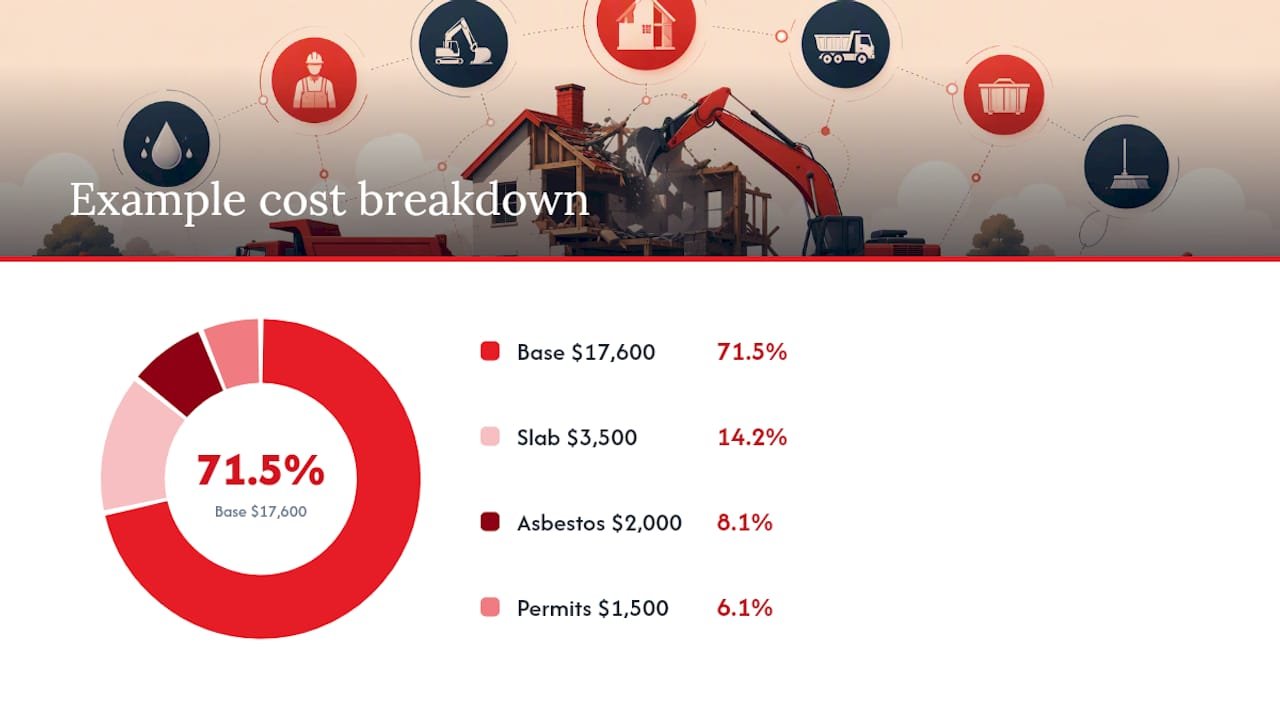
Worked example: a 160m² brick veneer home at $110/m² comes to $17,600 base. Add $3,500 for slab removal, $2,000 for asbestos testing and minor removal, and $1,500 for permits and disconnections.
Pro Tip: When comparing quotes, ask for disposal and abatement costs itemised separately rather than folded into one lump sum. A contractor hiding these figures inside a single number makes it impossible to compare apples with apples across bids.
How long do permits and approvals take?
Budgeting time matters as much as budgeting money, because a stalled approval delays everything downstream.
- Asbestos survey – typically 1 to 2 weeks from booking to written report.
- Council demolition permit or development approval – usually 2 to 6 weeks, depending on your local government area and whether the site sits within a heritage or environmental overlay.
- Utility disconnection confirmations – can take 1 to 3 weeks depending on the provider.
- Actual demolition works – 2 to 14 days on-site, depending on house size, access and whether hazardous material removal is involved.
Heritage listings or known contaminated land almost always extend both the approval timeline and the final cost, since these sites usually require specialist assessment before council will sign off. Our guide to demolition permits in Sydney covers the local approval process in more detail.
Are there cheaper alternatives to full demolition?
Mechanical demolition isn’t the only path, and for some properties it isn’t even the cheapest.
- Mechanical demolition – fastest option, lowest labour cost, but little to no salvage value recovered.
- Selective deconstruction (salvage) – slower and more labour-intensive, but recovers timber, fixtures and scrap metal that can offset part of the disposal bill; sometimes eligible for donation-related tax considerations depending on your accountant’s advice.
- Partial or interior demolition – strips fittings and non-structural elements while retaining the shell, useful when only part of a property needs clearing.
Salvage only pays off when there’s genuine reusable material and a buyer for it. Structural timber, roof tiles and copper piping tend to have the best resale value. Whatever route you choose, hazardous materials still need a licensed specialist. SafeWork NSW and the EPA both require this regardless of whether the rest of the job is DIY-adjacent or fully contracted out.
What should you ask before hiring a demolition contractor?
Before you sign anything, run every quote through this checklist:
- Do they hold a current demolition licence and asbestos removal accreditation?
- Can they provide proof of public liability and workers’ compensation insurance?
- Is the quote itemised, showing disposal, permits and abatement as separate lines?
- Can they show waste transfer documentation proving lawful disposal?
- Is there a clear timeline with a contingency allowance built in?
Walk away if: the quote is vague on disposal costs, the contractor wants cash-only payment, there’s no waste transfer proof offered, or there’s no written asbestos management plan for a pre-1990 property.
The safest option is a licensed contractor who handles both structural demolition and asbestos removal under one roof, so nothing falls through the gap between separate tradespeople. Mission Demolition coordinates both, along with permits and site cleanup, as a single accountable service.
What conventional cost guides get wrong
Most cost breakdowns treat demolition as a single number you multiply by floor area, and that’s where homeowners get burned. The real variable isn’t size, it’s what’s underneath and around the house. A 90m² fibro cottage with buried asbestos sheeting can cost more to demolish safely than a 200m² clean brick home with easy truck access.
The industry also underplays how much site access matters. Two identical houses, one on a wide suburban block and one wedged between neighbouring fences, can differ by thousands of dollars purely because of how machinery gets in and waste gets out. That’s not a footnote, it’s often the single biggest swing factor after asbestos.
If there’s one thing worth prioritising over everything else in this guide, it’s getting a proper asbestos assessment before you request quotes, not after. A contractor pricing blind on hazardous material risk either overcharges to cover their own exposure or underquotes and hits you with a variation later. Neither serves your budget.
Get a fixed, itemised demolition quote
If you’ve read this far, you already know the risk isn’t the demolition itself, it’s the surprises: undisclosed asbestos, vague disposal fees, or a contractor who can’t produce waste transfer documentation when council asks for it. Mission Demolition removes that guesswork by handling structural demolition and licensed asbestos removal under one contract, with disposal, permits and site cleanup itemised upfront rather than bundled into a mystery total.
That matters most for older homes, where hazardous material risk and approval delays are the two things that blow out both budget and timeline. With thousands of completed projects and full asbestos licensing, Mission Demolition manages the compliance side while you focus on what comes next for the block. If you’re ready to see where your property sits, request a quote through our residential demolition service page or check pricing specific to your suburb via our Sydney demolition services page.
Where to check current rules and rates
For hazardous material rules, check SafeWork NSW’s asbestos guidance directly. For waste classification and disposal requirements, the EPA’s waste page covers what’s legally required before material leaves your site. Both are mandatory reading before you accept any quote, since disposal and abatement rules are set by regulation, not by what a contractor tells you.
Frequently asked questions
What is the average home demolition cost breakdown for a typical Australian house?
Does asbestos always increase demolition costs?
Not always, but it usually does. Testing is mandatory for pre-1990 homes under SafeWork rules, and if asbestos is found, licensed removal adds a separate cost on top of standard demolition.
How much does site access affect the final price?
Is deconstruction cheaper than full demolition?
Not usually upfront, since it’s more labour-intensive, but salvaged timber, fixtures and scrap metal can offset part of the cost, making the net price competitive on the right property.
How long does the whole demolition process take from approval to a cleared site?
Allow 1 to 2 weeks for asbestos testing, 2 to 6 weeks for council approval, and 2 to 14 days for the physical demolition, depending on house size and complexity.
This article is general information, not a substitute for advice from a qualified financial advisor. Consult a qualified financial professional about your own circumstances before acting on anything here.
Sources
- Safework
- Epa
- How Much to Demolish a House? Home Demolition Costs – HomeGuide
- Demolition Cost Estimate Guide: How Demolition Costs Are Calculated – SmartConstructs
