
Protecting a retained tree during clearing comes down to five things: mark out the Tree Protection Zone (TPZ), fence it off before anyone swings an excavator, get an arborist to write a Tree Protection Plan (TPP), ban machinery and material storage inside the exclusion zone, and inspect the site regularly until the works finish. Miss any one of these and you risk root damage that doesn’t show up for years, plus a council fine if the tree was protected in the first place.
Here’s what needs to happen on site, in order:
- Mark and fence the TPZ before any clearing, demolition, or excavation starts
- Install signage on the fencing at regular intervals so every contractor sees it
- Commission an arborist report and TPP before lodging your development application
- Ban vehicle access, material storage, and cement mixing inside the fenced zone
- Apply mulch or geotextile matting over exposed root zones needing temporary access
- Schedule pre-start and periodic inspections through to project completion
Pro Tip: Don’t assume the canopy drip line marks the safe boundary. Root systems commonly extend well beyond the canopy, and compacting soil outside the drip line still crushes fine roots that keep the tree alive.
Key Takeaways
Retained trees survive clearing when TPZ fencing goes up before work starts, a qualified arborist’s TPP governs site access, and inspections continue through to project completion.
| Point | Details |
|---|---|
| Fence before clearing | Install TPZ fencing and signage before any demolition or excavation vehicle enters the site. |
| Commission the TPP early | Arborist reports and Tree Protection Plans should accompany the development application, not follow it. |
| Follow AS 4970-2009 | Reference the Australian standard directly in your TPP to align with council and assessor expectations. |
| Monitor for years, not weeks | Root damage can surface two to five years later, so schedule seasonal checks well past project handover. |
| Use a coordinated contractor | Missiondemolition integrates TPP compliance and arborist coordination into site clearance and demolition works. |
Where to check the rules before you apply
Consult the NSW Planning Portal, your local council’s tree pages, and AS 4970-2009 before lodging any application involving retained trees.
- Attach the exact council guidance page you relied on to your TPP appendix
- Cross-check state exemptions before assuming a permit isn’t required
Table of Contents
- How do you know which trees are protected during clearing?
- How is the tree protection zone calculated on site?
- What does an arborist report and tree protection plan need to include?
- What are the day-to-day site rules for protecting trees during clearing?
- How long do retained trees need monitoring after clearing finishes?
- What standard governs tree protection on Australian development sites?
- What separates a compliant site from one that actually protects its trees?
- Frequently asked questions
- Sources
How do you know which trees are protected during clearing?
Not every tree on a block carries legal protection, but plenty do, and the categories vary by council. Local planning schemes generally protect trees through one of a few mechanisms: species-based listings (particular native or significant species named in a local plan), size or age thresholds (trunk diameter or height triggers), designated or registered significant trees marked on a council map, or blanket vegetation controls that catch anything above a certain canopy size on a given lot.
Redland City Council, for example, sets out specific rules and exemptions for trees on private property, where protection can come from planning controls, covenants, or development envelopes rather than a single blanket rule. Moreton Bay Regional Council goes further, warning that partial works like thinning or understory removal can still count as clearing and require approval, even when no tree is actually felled.
Approvals are commonly triggered by:
- Removing a tree listed on a council’s protected or significant tree register
- Pruning beyond a minor threshold (often more than 10 to 30% of the canopy)
- Any works, including excavation or grading, inside a mapped TPZ
- Development requiring a Complying Development Certificate (CDC) or full DA
The NSW Planning Portal states plainly that protected trees cannot be removed under a CDC pathway and must be protected during works regardless of what else the certificate approves. Noosa Shire Council reinforces this at a local level too, noting that damaging or removing a protected tree without a permit is an offence carrying real penalties, not just a slap on the wrist. At the state level, Queensland’s protected plants framework also carves out specific exemptions, such as maintaining existing infrastructure, so it pays to check whether your works genuinely qualify before assuming an exemption applies.
Councils typically want three things attached to any application involving retained trees: an arborist report, a Tree Protection Plan, and a site plan showing TPZ boundaries against proposed works.
How is the tree protection zone calculated on site?
The Tree Protection Zone (TPZ) is the area around a tree that must stay undisturbed during clearing and construction. The Critical Root Zone (CRZ) is a smaller, non-negotiable inner boundary where almost any disturbance risks killing the tree outright. Arborists commonly calculate the radius using trunk diameter at breast height (DBH), with a widely used rule of thumb setting the TPZ radius at roughly one foot for every inch of trunk diameter. High-value, veteran, or sensitive species often need a wider buffer than the formula suggests, so an arborist’s judgement should always override a mechanical calculation.
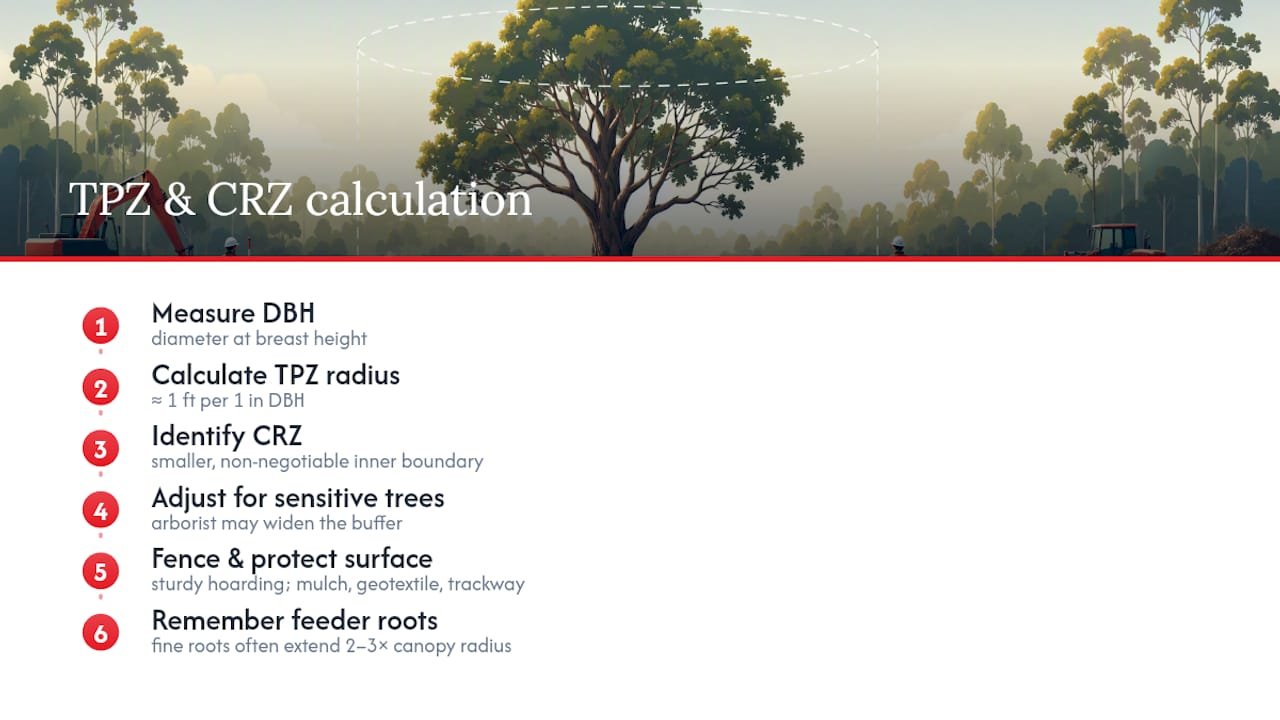
Fencing has to actually stop people, not just mark a line. On higher-risk sites, sturdy plywood hoarding around 2.4 metres tall or rigid mesh on solid posts holds up far better than lightweight orange webbing, which crews routinely step over or drag equipment past. Whatever barrier you choose, sign it at regular intervals so nobody on site can claim they didn’t know the zone was off limits.
Inside the fence, surface protection matters just as much as the fence itself. A layer of organic mulch, generally recommended at an appropriate depth, cushions the root zone and retains moisture. Where vehicle access through the zone is unavoidable, permeable geotextile matting topped with wood chips or timber trackway spreads the load and limits compaction, a far better option than laying bare timber mats straight onto exposed roots.
Excavation near roots calls for trenchless methods wherever possible. Directional boring lets utilities cross a root zone without trenching through it, and where roots must be exposed, air spade or hydraulic excavation clears soil without tearing through structural roots the way a bucket does. Root pruning, when genuinely unavoidable, needs a lead time of several months ahead of construction so the tree has a chance to compartmentalise the wound before nearby soil is disturbed.
Pro Tip: Roots don’t respect the drip line. Fine feeder roots responsible for most water and nutrient uptake often extend two to three times the canopy radius, so fence to the calculated TPZ, not to where the branches happen to end.
What does an arborist report and tree protection plan need to include?
A proper arborist report inventories every tree affected, records trunk diameter, canopy spread, health and structural condition, and calculates the TPZ and CRZ for each specimen. The Tree Protection Plan (TPP) then turns that data into site instructions: fencing locations, access routes, root pruning specifications, monitoring schedule, and any mitigation needed where the CRZ must be encroached.
A TPP isn’t a standalone document filed away and forgotten. It needs to sit inside your development application, your construction management plan, and your contractor’s scope of works, so the same fencing and access rules that satisfy council also bind whoever’s driving the excavator. Specifications should show existing trees, TPZ extents, staging of works, and exact locations for any approved root pruning or tunnelling.
Timing matters more than most owners expect. Commissioning an arborist report typically needs to happen weeks before a DA is lodged, not after, because councils increasingly expect the report and TPP submitted together with the application rather than as a follow-up condition.
- Commission arborist assessment 4 to 8 weeks before DA lodgement
- Submit arborist report and TPP as part of the application package
- Finalise fencing and signage specifications before any approval conditions are issued
- Confirm TPZ boundaries on site against the approved plan before mobilising equipment
What are the day-to-day site rules for protecting trees during clearing?
Fencing goes up before a single truck enters the site, not after clearing starts and certainly not once demolition is underway. Every contractor and subcontractor needs a site induction covering exactly where the TPZs sit, what the signage means, and who to call if a boundary gets breached.
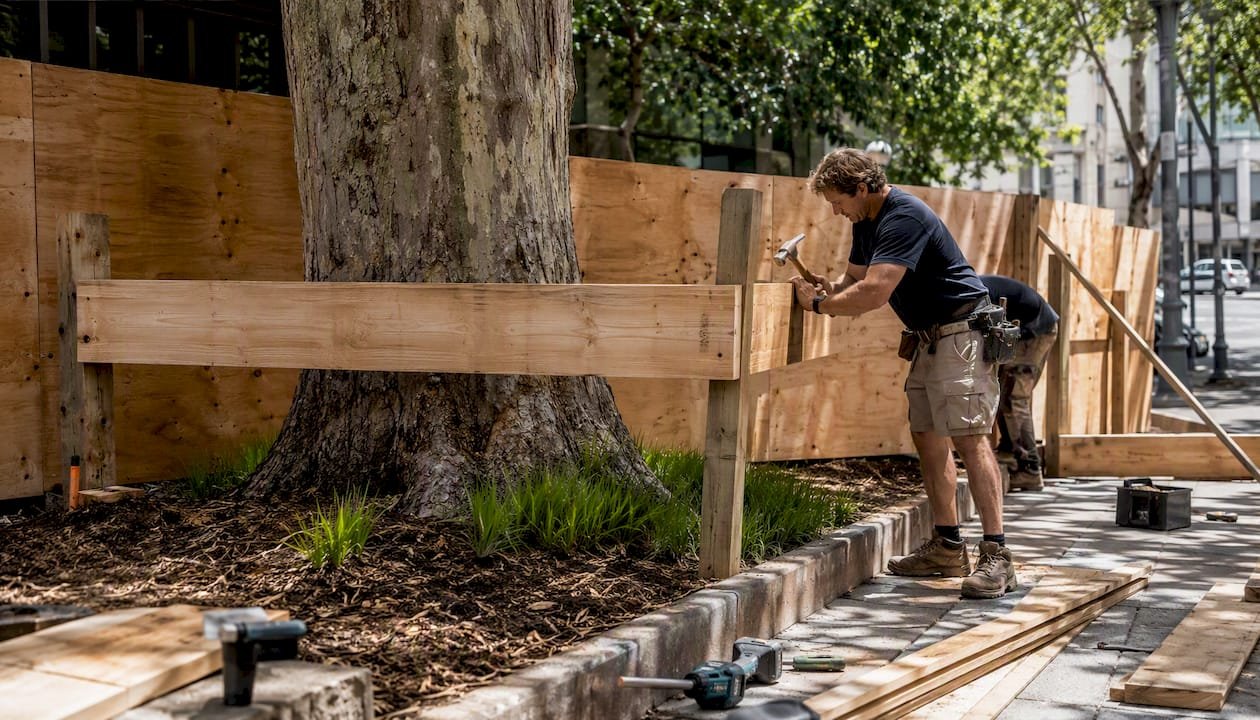
Inside a fenced TPZ, the rules are blunt: no vehicle access, no material or spoil storage, no cement mixing or washout, and no change in ground level, unless an arborist has signed off on a specific, documented exception. These aren’t guidelines open to site-manager discretion. Northern Beaches Council’s guidance on protecting trees on development sites stresses that the wider root system, not just the visible trunk, is what actually needs protecting from compaction, which is exactly the zone these restrictions cover.
The inspection regime has three layers: a pre-start check confirming fencing matches the approved TPP, regular monitoring visits from a consulting arborist through the works program, and photographic records logged at each visit to prove compliance if a dispute arises later.
Pro Tip: Name one person on site, not a rotating supervisor, as the tree protection manager. Briefing every subcontractor individually and giving them a single point of contact for TPZ questions stops more breaches than any amount of signage.
How long do retained trees need monitoring after clearing finishes?
Tree damage from construction rarely shows up straight away. Compacted roots or severed structural roots can take two to five years to manifest as canopy dieback or, in the worst cases, sudden limb or whole-tree failure, which is exactly why aftercare has to continue well past practical completion.
Post-works care includes a consistent watering schedule through the first dry season, renewing mulch inside the former TPZ, and having any pruning done only by a qualified arborist rather than a general landscaper. Where soil compaction is suspected, decompaction treatments can restore some root zone function, though results vary depending on how much damage occurred during works.
- Immediate (0 to 3 months): confirm fencing removal doesn’t disturb settled root zones, renew mulch
- Medium term (6 to 24 months): seasonal canopy health checks, targeted watering in dry periods
- Long term (2 to 5 years): annual structural assessment, particularly for trees with any documented CRZ encroachment
What standard governs tree protection on Australian development sites?
AS 4970-2009 (Protection of Trees on Development Sites) is the Australian standard arborists and councils reference when setting TPZ and CRZ boundaries, fencing specifications, and root protection requirements. Citing it directly in your TPP and development application signals to assessing officers that your protection measures meet an established benchmark, not an ad hoc guess.
The standard’s TPZ calculation (roughly a metre of radius per 10 mm of DBH, adjusted for species sensitivity) underpins the numbers most Australian arborist reports use. Councils apply this consistently but layer their own local variations on top, so always cross-check your TPP against the specific planning portal or council guidance for your area before submission.
- Reference AS 4970-2009 explicitly in the TPP and any application cover letter
- Attach the relevant council or state planning portal guidance page as a supporting document
- Confirm whether your council applies the standard TPZ formula or a locally modified version
What separates a compliant site from one that actually protects its trees?
Plenty of sites tick the fencing box and still lose mature trees within three years of practical completion. The difference usually comes down to when the arborist gets involved. Bringing one in at design and scoping stage, rather than after the DA is drafted, means the TPP shapes where driveways, services, and building footprints sit, instead of trying to retrofit protection around decisions already locked in.
The stronger operators go further than the minimum fence-and-sign approach. They schedule root pruning months ahead of excavation, insist on trenchless installation for any utility crossing a root zone, and lay root protection matting as standard on any access route through a TPZ, not just where council demands it. Some contract documents even include liquidated damages clauses tied specifically to TPZ breaches, which turns tree protection from a vague expectation into a costed risk both parties take seriously.
The business case is straightforward: the cost of upfront protection is consistently lower than replacement planting, remediation works, or the fines and reputational damage that follow a breached protection order. A mature tree lost to careless excavation doesn’t come back with a replacement sapling, and councils increasingly know it.
- Involve an arborist at design stage, not just before demolition
- Root prune months ahead of excavation, never on the day works start
- Specify trenchless utility installation wherever a service crosses a CRZ
- Build liquidated damages for TPZ breaches into contractor agreements
Pro Tip: Put a dollar figure on TPZ compliance in the tender documents. Contractors who know a breach costs them money treat the fencing very differently to contractors who see it as a suggestion.
Why retained trees are assets, not obstacles
Retained trees add long-term landscape value, reduce heat and stormwater load, and shape how a finished development is perceived by the community around it. Treating protection as a line item to minimise, rather than an asset to preserve, is a false economy. Include tree protection obligations directly in your tender brief so every contractor prices the job with compliance built in, not bolted on afterwards.
How Missiondemolition builds tree protection into every clearing job
Missiondemolition is the alternative to piecing together your own compliance team for a project involving retained trees: instead of separately sourcing an arborist, a demolition crew, and a project manager to keep them coordinated, one team handles site clearance, TPP integration, and qualified arborist coordination under a single scope of works. That matters most on sites where a fencing mistake or a missed inspection isn’t just a compliance risk, it’s a mature tree you can’t get back.
Our site clearance services build TPZ fencing, signage, and access controls into the site setup from day one, and our team works alongside the arborist you’ve engaged (or helps you find one) so the protection plan actually reflects how the site will be worked, not just how it looks on paper. If you’re vetting contractors for a project with retained trees, our guide on tree and vegetation site prep covers what to put in the brief before you sign anyone.
Get in touch for a compliance-led site assessment through our demolition services page, and we’ll walk through what your specific site needs before a single fence post goes in.
Frequently asked questions
Do I need council approval to prune a retained tree, not just remove it?
Often, yes.
What happens if machinery damages a tree inside the TPZ?
Depending on the council and the extent of damage, you can face fines, a stop-work order, or a requirement to fund remedial treatment or replacement planting, on top of the arborist and legal costs of resolving the breach.
Can I move the TPZ fencing temporarily for access?
Only with written arborist sign off documenting a specific, time-limited exception. Moving fencing without approval breaches most development conditions and voids your compliance record if council inspects the site.
Is a Tree Protection Plan the same as an arborist report?
No. The arborist report assesses tree health and calculates TPZ/CRZ boundaries. The TPP translates that assessment into site instructions, fencing plans, and a monitoring schedule that contractors actually follow.
How soon before demolition should I engage an arborist?
Ideally at design stage, but no later than 4 to 8 weeks before lodging your development application, since most councils expect the arborist report submitted with the application rather than added afterward.
Sources
- Tree removal and protection – NSW Planning Portal
- Protecting trees on development sites – Northern Beaches Council / ESC NSW
- Trees on private property – Redland City Council
- Clearing trees and vegetation on private property – Moreton Bay Regional Council
- Protected plants legislation and the native timber industry – Queensland Government

One Response