
Noise and vibration monitoring protects people, structures, and project timelines by measuring sound and ground movement against limits set in standards such as BS 5228 and BS 7385. Missiondemolition treats it as standard practice on demolition and asbestos jobs, not an optional extra. Instrument classes span handheld sound level metres, triaxial vibration monitors, and permanent cloud-connected stations, and the payoff is straightforward: fewer disputes, documented compliance, and structures next door that stay intact.
TL;DR:
- Using Class 1 sound level metres and triaxial vibration monitors ensures accurate data during short-term checks and real-time alerts, especially in demolition or blasting.
- Always calibrate instruments annually and before deployment, with documented certificates, to ensure compliance reports are legally defensible.
- Deploy sensors on rigid structures and set trigger action levels at 75% of alarm limits to prevent false alarms and enable timely work modifications.
- Integrated monitoring platforms with automated alerts, event capture, and weather data improve dispute resolution and regulatory reporting accuracy.
- Proper installation, baseline surveys, and adherence to standards like BS 5228 and BS 7385 are critical to reliable data collection and effective project management.
Table of Contents
- Types of instruments used for noise and vibration monitoring
- What metrics and standards matter for noise and vibration monitoring
- Which real-time monitoring platforms and features actually matter?
- How to deploy sensors and set trigger action levels correctly
- What to check before hiring or buying a monitoring system
- How does Missiondemolition apply monitoring on real projects?
- How do you read and interpret monitoring data correctly?
- How often should monitoring instruments be calibrated?
- What regulatory standards govern noise and vibration compliance?
- How do weather and environmental conditions affect monitoring accuracy?
- Can noise and vibration monitoring integrate with other environmental systems?
- A pragmatic checklist for site owners and project managers
- Sources
Types of instruments used for noise and vibration monitoring
Choosing the right instrument starts with matching the device class to the job, not buying the most expensive box on the shelf.
Handheld Class 1 sound level metres are the workhorse for short-term environmental checks and occupational exposure surveys. Dosimeters, worn by workers, log personal noise dose over a shift, which matters on sites where plant noise fluctuates all day. For vibration, geophones remain the standard sensor. Triaxial units measure movement across three axes simultaneously and pick up the dominant horizontal component that a single-axis unit can miss entirely, according to demolition monitoring practice notes.
Permanent or outdoor monitoring stations sit at the top of the range. These combine noise, vibration, and often weather sensors into one multisensor package, running unattended for weeks or months on a boundary fence or a nearby structure. Acoustic cameras add a niche capability: they localise a noise source visually, useful when a client disputes which piece of plant caused an exceedance.
Typical deployments look like this:
- Demolition and structural collapse work: triaxial geophones on adjacent footings plus a boundary noise station.
- Piling and vibratory compaction: continuous vibration monitors with real-time alerting, since PPV can spike in seconds.
- Blasting: dedicated blast monitors capturing both airblast overpressure and ground vibration together.
- Transport corridors and rail-adjacent sites: permanent stations logging months of trend data for regulatory reporting.
- Hospitals, schools, and other sensitive receivers: multisensor stations with automated alerting to catch problems before complaints land.
What metrics and standards matter for noise and vibration monitoring
Numbers only mean something once you know which scale they sit on.
Noise is measured in dB(A), the A-weighted decibel scale that approximates how the human ear perceives loudness. Leq gives the equivalent continuous level over a period. Lmax captures the single loudest moment, and spectral (frequency band) data helps distinguish tonal noise from broadband plant hum. Most projects log at 1 to 15-minute intervals, tightening to 1 second during active monitoring near sensitive receivers.
Vibration uses different units entirely. Peak Particle Velocity (PPV), in mm/s, is the standard damage-risk metric for structures. Vibration Dose Value (VDV), in m/s², measures cumulative human exposure over time, and frequency weighting matters because low-frequency vibration damages buildings at lower amplitudes than high-frequency vibration does.
Standards to specify:
- BS 7385 for building vibration damage criteria
- BS 5228 for construction and open-site noise and vibration control
- ISO 2631 for human exposure to whole-body vibration
- Class 1 instrument accuracy (or an equivalent XL3-class device) for anything used in compliance reporting
Pro Tip: Always request the instrument’s current calibration certificate before it goes on site, and insist on a written reporting format that timestamps every logged exceedance. A monitoring report without traceable calibration is close to useless if a claim goes to dispute.
Trigger Action Levels are commonly set at roughly 75% of the regulatory alarm limit, giving site teams a warning stage before they hit a genuine breach.
Which real-time monitoring platforms and features actually matter?
Cloud connectivity turned monitoring from a data-collection chore into a live risk-management tool, and the feature list is now fairly standardised across the market.
A capable platform gives you a live dashboard, historical trend graphs, and automated SMS or email alerts the moment a threshold is crossed. The Svantek SV 258 PRO runs 24/7 cloud tracking with exactly this kind of automated alerting, so a site manager finds out about a breach in minutes rather than at the next site visit. Acoem ORION takes a different design approach, packing multiple vibration channels and a dedicated overpressure microphone channel into one hyperconnected terminal with configurable alarm thresholds, well suited to demolition and blasting scenarios.
Core features worth checking before you sign a hire agreement:
- Live dashboard with historical data export
- Automated alerts by SMS or email, tied to configurable thresholds
- Event capture with audio snippets for playback and dispute resolution
- State of Health (SOH) monitoring for battery, storage, GPS, and network signal
- Flexible comms (cellular SIM, Wi-Fi, or ethernet) and power (mains, battery, solar)
SOH reporting matters more than it sounds. Larson Davis builds SOH checks into its environmental systems precisely because a flat battery discovered after the fact wrecks a compliance record. Platforms like Measureye go a step further with second-by-second updates and optional AI noise classification, which sorts genuine plant noise from traffic or wind interference automatically.
The trade-off is cost against autonomy: solar-powered stations with cellular data cost more upfront but need far fewer site visits than a mains-powered unit needing manual downloads.
How to deploy sensors and set trigger action levels correctly
Getting the physics right on installation day determines whether the data you collect six weeks from now is defensible.
- Mount vibration sensors on rigid structural surfaces, never on soft ground beside a building. Accurate PPV readings depend entirely on this, since geophones on loose soil return unreliable, dampened values that understate real risk.
- Use triaxial geophones as the default for demolition work, taking the maximum of the three axes for PPV reporting rather than relying on a single-axis unit that could miss the dominant horizontal component.
- Set Trigger Action Levels at roughly 75% of the alarm limit. A TAL breach means investigate and adjust method; an alarm breach means stop work.
- Run a baseline survey and schedule of condition on adjacent properties before work starts, so any later crack or complaint has a documented “before” state to compare against.
- Log every exceedance with timestamp, measured value, likely cause, who was notified, and what mitigation followed.
- Have mitigation options ready in advance: substituting a smaller excavator, pausing or modifying the operation, or sending someone to visually inspect the nearest structure.
What to check before hiring or buying a monitoring system
Procurement mistakes usually show up months later, when a report gets challenged and the calibration paperwork is missing.
Before committing, confirm the instrument class (Class 1 or equivalent XL3-grade), its measurement range, logging interval, and current calibration certificate. Check power and comms: is it solar-capable, what does the SIM data plan cost monthly, and does it report its own SOH so you are not driving to site just to check a battery?
- Instrument class, range, logging interval, and calibration evidence
- Power autonomy (solar vs mains) and comms cost (SIM/data plan)
- Service response time, warranty terms, and local calibration support
- Data export formats, alert configuration, and retention policy
- Full cost breakdown: hire vs purchase, installation, data plan, ongoing servicing
For guidance on vetting the contractor running the monitoring alongside the demolition works, see Missiondemolition’s contractor vetting criteria.
How does Missiondemolition apply monitoring on real projects?
Missiondemolition runs baseline surveys and continuous vibration and noise monitoring on demolition and asbestos removal projects as standard, not as an add-on billed separately. With thousands of completed projects and licensed asbestos removal credentials behind that process, monitoring data feeds directly into client reporting, the site diary, and the compliance record a client can hand to a regulator or an insurer. On asbestos jobs specifically, that documented record matters as much as the removal itself, as outlined in Missiondemolition’s asbestos abatement guidance. Case studies and specific project outcomes will be added here as they are documented.
How do you read and interpret monitoring data correctly?
Raw numbers on a dashboard mean little without context, and misreading them is where most disputes start.
Start by separating a genuine trend from a single spike. A one-off Lmax reading during a truck reversing past the sensor is not the same finding as a Leq that climbs steadily over an hour, and treating them the same way leads to either false alarms or missed problems. Overlay vibration events against the site’s plant schedule and diary. If a PPV spike lines up exactly with a specific piece of equipment starting up, you have your cause; if it does not, look at wind, traffic, or an unrelated source nearby.
Frequency data matters here too. A low-frequency vibration event carries more damage risk at the same PPV reading than a high-frequency one, so two exceedances with identical peak values can represent very different levels of actual risk to a structure. Multisensor stations that log weather alongside noise and vibration make this analysis far easier, since wind speed data can explain a sudden noise exceedance that would otherwise look like a plant breach. Cross-referencing that against the site diary turns a raw number into evidence a regulator or a neighbour can actually accept.
How often should monitoring instruments be calibrated?
Calibration is the part of monitoring that gets skipped under deadline pressure, and it is exactly the part that makes a report defensible.
Instruments used for compliance reporting need a current calibration certificate, typically renewed annually through an accredited laboratory, alongside a field calibration check before and after each significant deployment. Most Class 1 sound level metres and vibration monitors also carry an on-board self-check function, but that internal check is not a substitute for laboratory calibration. Store every certificate alongside the project file, because a regulator or opposing party in a dispute will ask for it specifically.
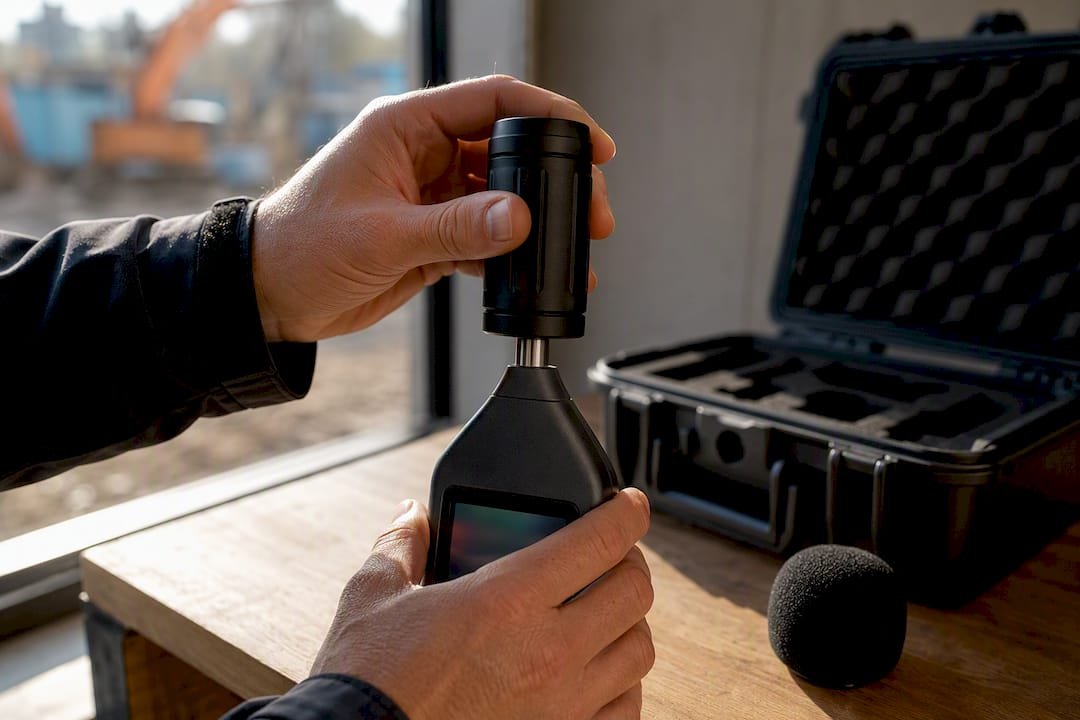
Maintenance beyond calibration is mostly about power and connectivity, not the sensor itself. Battery contacts corrode, solar panels get dusty, and SIM data allowances run out mid-project, all of which State of Health reporting is designed to flag before it becomes a gap in the record. A practical rule: schedule a physical site visit whenever SOH flags an issue, and treat any gap in logged data as something to explain in the report, not something to quietly ignore.
What regulatory standards govern noise and vibration compliance?
Compliance obligations come from a mix of construction management standards and building damage criteria, and mixing them up is a common error.
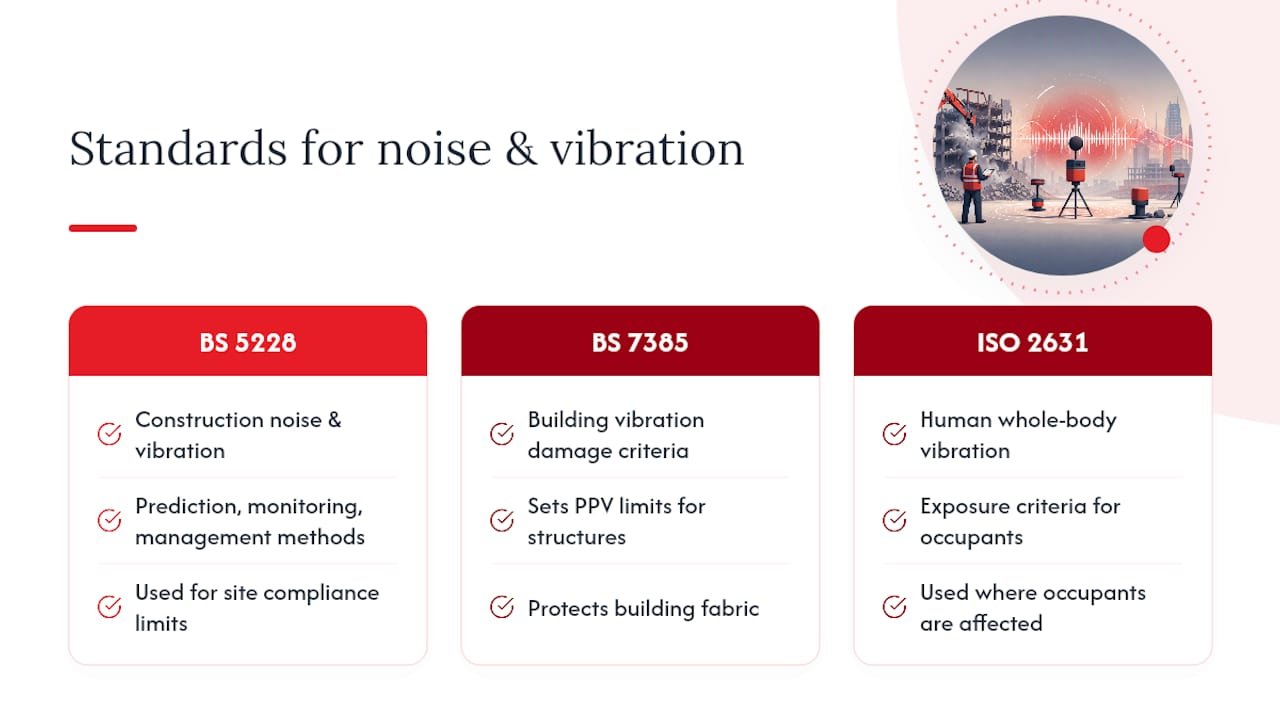
BS 5228 governs noise and vibration control specifically for construction and open sites, setting out methodology for prediction, monitoring, and management during works. BS 7385 addresses building vibration damage criteria, the standard practitioners reference when setting a PPV limit meant to protect a specific structure type rather than just meeting a generic noise limit. ISO 2631 covers human exposure to whole-body vibration, relevant where vibration affects occupants rather than the building fabric itself.
Acoem Australasia frames the purpose of all this succinctly: monitoring exists to protect people, communities, and built assets across construction, transport, and industrial sites, and the standards are the mechanism for proving that protection actually happened. A monitoring plan should name the specific limits taken from these standards up front, define TALs and alarm levels against them, and document every exceedance in the site diary as detailed earlier. Regulators increasingly expect this documentation as a matter of course on urban projects, where automated monitoring is becoming close to standard practice for managing community relations before complaints escalate.
How do weather and environmental conditions affect monitoring accuracy?
A perfectly calibrated instrument can still return a misleading reading if the conditions around it are ignored.
Wind is the biggest culprit for noise measurements. Gusts hitting a microphone windshield create low-frequency noise that can register as a false exceedance, which is why outdoor stations use windshields and why some platforms flag high wind speed automatically alongside the acoustic data. Temperature and humidity affect sound propagation over distance, meaning a measurement taken 50 metres from a source on a cold, still morning will not match one taken on a warm, humid afternoon even if the source itself hasn’t changed.
Ground conditions matter just as much for vibration as wind does for noise. Wet or frozen ground transmits vibration differently to dry compacted soil, which is one more reason mounting sensors on rigid structural surfaces, rather than adjacent soil, produces more consistent readings across changing seasons. Sensor placement close to unrelated vibration sources, like a nearby road or rail line, also contaminates readings unless the monitoring plan accounts for background levels in a pre-works baseline survey.
Can noise and vibration monitoring integrate with other environmental systems?
Isolated noise or vibration data tells only part of the story on most active sites.
Multisensor stations that log weather, dust, and air quality alongside acoustic and vibration data give a far more complete picture when something goes wrong, because a single event, say a spike in both noise and airborne particulate, points clearly to one source rather than two unrelated problems. This matters directly on asbestos removal work, where dust monitoring and noise or vibration data both feed into the same compliance file for the same project. Platforms with webhook or HTTP command support can also push alerts into a broader site management system, so a vibration exceedance automatically flags in the same dashboard a project manager already checks for site attendance or plant hours.
The practical benefit shows up at report time. Rather than reconciling three separate logs from three separate instruments, an integrated system exports one timestamped dataset that lines noise, vibration, and weather up against each other, which is exactly the kind of record a regulator or an insurer wants to see after a disputed exceedance.
A pragmatic checklist for site owners and project managers
If you take one thing from this, take it as a sequence, not a shopping list. Start with a baseline survey before any plant moves, because without it you have no defensible comparison point later.
When you engage a monitoring provider, insist on three things: current calibration evidence, a written response protocol for exceedances, and a data format that timestamps everything cleanly enough to sit in a compliance file unedited. Anyone who can’t produce a calibration certificate on request shouldn’t be on your site. The next practical step is simple: book a baseline survey and lock in a monitored hire or purchase option before the first piece of plant arrives, not after a neighbour has already called to complain.
— Tarek
Whether you’re planning a demolition, a strip-out, or licensed asbestos removal, Missiondemolition builds baseline surveys and continuous monitoring into the project scope rather than treating it as an afterthought. If you’re scoping a project that needs documented compliance from day one, get in touch about residential demolition services or asbestos removal in Sydney to see how monitoring fits into the plan before work starts.
