An office strip out removes the interior fitout of a commercial space (ceilings, partitions, floor coverings, joinery, cabling and services) and leaves the building’s structure standing. In Australia the process runs in a set order: scope and lease review, asbestos identification, approvals and safe work documents, services isolation, removal, waste sorting and disposal, then a clean and handover. Skipping or reordering those steps is where delays, fines and blown budgets come from.
This guide walks through each stage as it happens on site, who is responsible for what, and the questions to put to any contractor before you sign.
TL;DR
- A strip out removes non-structural interior elements and keeps the structure intact. Once load-bearing or structurally integral parts are touched, the work counts as demolition under WHS rules.
- Asbestos comes first. Any workplace built or installed before 31 December 2003 needs its asbestos register reviewed before work starts.
- Paperwork runs alongside the physical work: a SWMS where the work is high risk, a job-specific asbestos removal control plan for licensed removal, and regulator notification where your state requires it.
- Sort waste at source into clean streams. Contaminated loads can be rejected at the facility gate and diverted to landfill.
- Get strip out and make good priced as separate items, because the scope often changes once walls and ceilings are opened.
Table of Contents
- What an office strip out is, and where it stops being one
- Why offices get stripped out
- Stage 1: Scope, lease review and site inspection
- Stage 2: Asbestos identification comes before anything else
- Stage 3: Approvals, notifications and safe work documents
- Stage 4: Site setup and services isolation
- Stage 5: The strip out itself
- Stage 6: Waste sorting, recycling and disposal
- Stage 7: Clean, inspection and handover
- How to compare strip out contractors
- Our perspective: where office strip outs go wrong
- Planning an office strip out?
- FAQ
- Sources
What an office strip out is, and where it stops being one
A strip out (also called a soft strip or internal demolition) clears out what is inside the shell: carpet and floor finishes, suspended ceilings, non-structural partitions, kitchens, joinery, data and power runs, signage and loose fixtures. The base building (columns, slabs, load-bearing walls, façade) stays.
The line between strip out and demolition matters because the regulations change at that line. WorkSafe Queensland defines demolition work as demolishing, deconstructing or dismantling a structure, or a part of it that is load-bearing or related to the structure’s physical integrity. A plasterboard partition is a strip out item. Removing a section of a load-bearing wall or a structural slab is not, and it brings in demolition rules, specialist planning and sometimes notification to the regulator.
In practice, many office projects mix both: a full soft strip plus a few structural openings for a new stair, a lift void or a slab penetration. If that is your project, tell your contractor at the quote stage so the right documents are prepared from day one. Our team handles both under one program through our interior strip out services and our commercial demolition work.
Why offices get stripped out
The process is similar whatever the trigger, but the trigger shapes the scope:
- Lease end and make good. The tenant removes its fitout and returns the space to the condition the lease requires. Read the make good clause word for word and book a joint inspection with the landlord or their agent before any wall comes down.
- Refurbishment. A new fitout needs the old one gone. The strip out is the first package on the program.
- Relocation or consolidation. A fast, clean clear-out of a floor or building before it is handed back or sold.
- Redevelopment. The strip out sits ahead of structural demolition or a major base-build upgrade.
Stage 1: Scope, lease review and site inspection
Good strip outs are decided before anyone arrives with tools. The first stage answers four questions.
- What exactly has to come out? For lease-end work, this is dictated by the lease and any fitout approvals, not by what looks neat. For a refurbishment, it is dictated by the new design.
- What stays? Base-building services, fire systems, landlord’s ceilings or shared risers are often off-limits or need isolation by building management.
- What are the building rules? Many towers limit noisy work to after hours, require booked loading dock slots and lift protection, and ask for insurance certificates and induction records before a contractor enters.
- What is behind the finishes? Ceiling voids, old riser cupboards and plant rooms are where surprises sit.
A site inspection with the contractor, ideally with the building manager present, turns those answers into a written scope, a program and a quote. Ask for strip out and make good to be priced as separate line items. Make good scope is often provisional until the strip out exposes what is actually behind the plasterboard and ceiling tiles.
Stage 2: Asbestos identification comes before anything else
Office buildings are not exempt from asbestos. Safe Work Australia’s model code says that where a workplace built or installed before 31 December 2003 is being demolished or refurbished, the asbestos register must be reviewed, provided to the person conducting the business doing the work, and asbestos likely to be disturbed must be identified and, where reasonably practicable, removed before work starts.
In practice that means:
- Ask the building owner or manager for the asbestos register and read it for the areas you will disturb, not just the summary page.
- If there is no register, Safe Work Australia’s demolition guidance says to have a competent person inspect the structure.
- Where the register is thin, or the work will go into areas it did not sample, arrange sampling and testing before the strip out begins. Our asbestos inspection and testing service exists for exactly this gap.
Typical office suspects include old ceiling tiles and sprayed finishes, vinyl floor tiles and the adhesive beneath them, fire doors, lagging on pipework, and sheeting around risers and plant. Do not guess by appearance, and do not let trades start “just on the quiet corner” while results are pending.
If asbestos is found
Asbestos likely to be disturbed is dealt with before the general strip out starts. What follows depends on the material and the amount. Queensland’s demolition code notes that more than 10 m² of non-friable asbestos requires an appropriately licensed business, and friable asbestos requires a Class A licence. Thresholds and notification rules differ by state and territory, so check yours. In NSW, for instance, licensed removers must give notice, as we explain in our guide to the SafeWork asbestos notification.
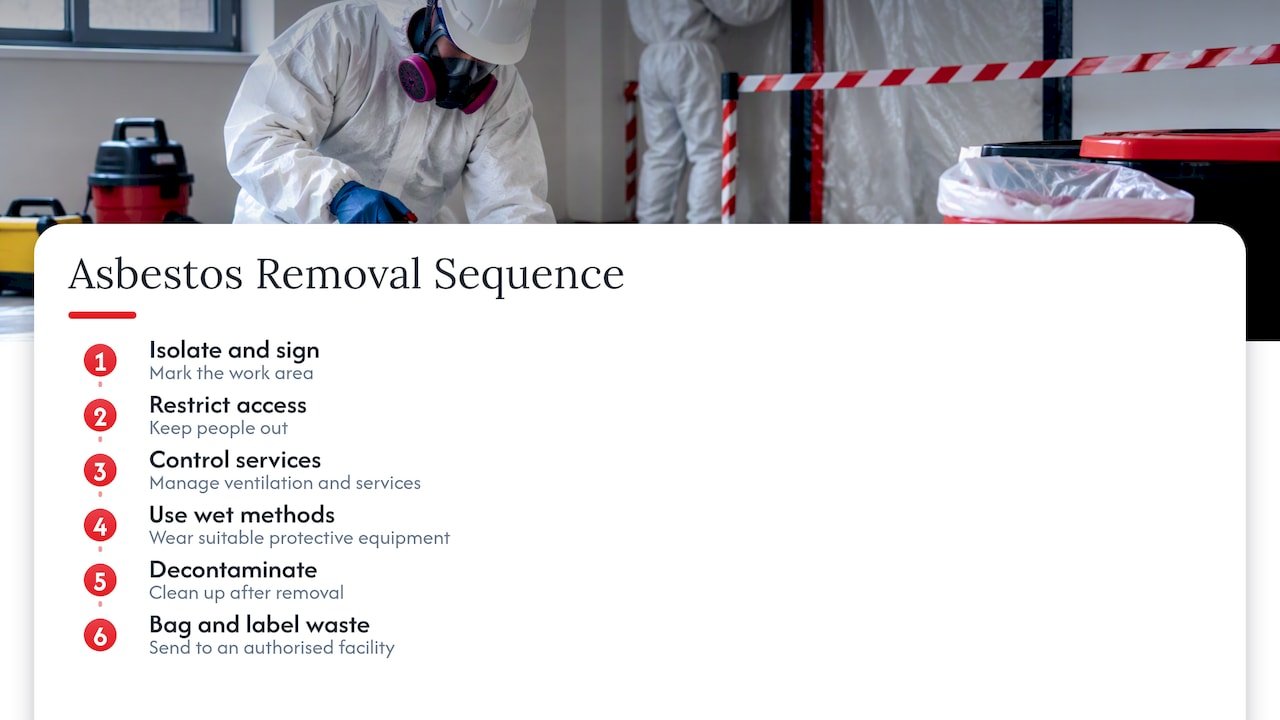
Licensed removal needs a job-specific asbestos removal control plan before it starts. The work then follows a well-established pattern described in Safe Work Australia’s removal code and asbestos safety guidance for trades: isolate and sign the area, restrict access, control ventilation and services, use wet methods and suitable protective equipment, decontaminate, and bag and label the waste for an authorised facility. For a closer look at the commercial side, see our commercial asbestos removal guide.
Stage 3: Approvals, notifications and safe work documents
The paperwork depends on how far the project goes beyond a soft strip.
Safe work method statement (SWMS). Under the model WHS framework, demolition that involves a load-bearing or structurally integral element is high-risk construction work and needs a SWMS before it starts. The SWMS identifies the work, the hazards, the controls and how those controls will be implemented, monitored and reviewed. Even where a strip out is below that threshold, a competent contractor will still write a task-specific method statement. Our article on the demolition method statement shows what regulators and principal contractors expect to see.
Regulator notification. In NSW, SafeWork NSW requires notice at least five calendar days before notifiable demolition: work involving a load-bearing or physically integral structure or part at least 6 metres high, load-shifting machinery on a suspended floor, or explosives. The same page makes clear that notification is not an approval. A typical office soft strip does not trigger it, but a strip out combined with structural demolition in a tall building may.
Licences and council. Queensland’s guidance says demolition may require a demolition licence and local council approval. Other states have their own regimes, so ask your contractor which licences apply to your scope and state.
Consultation. Safe Work Australia says demolition risks must be managed before work starts through hazard identification, risk assessment where necessary, effective controls, review and consultation with the people doing the work. Building managers and neighbouring tenants should also be told when noisy or dusty work will happen.
Stage 4: Site setup and services isolation
Before the first ceiling tile comes down, the site is made safe and the building protected.
- Isolate services. Electrical, data, water, gas and fire detection are disconnected or made safe by licensed trades, in coordination with building management. Live fire systems and sprinklers are only taken offline with the manager’s approval and an agreed plan.
- Protect the building. Lifts, lobbies, loading docks and common corridors get floor and wall protection. Dust barriers and sticky mats keep debris out of neighbouring tenancies.
- Set up waste logistics. Bins, trolleys, chutes or hoists are positioned and the route to the dock is agreed, including loading dock bookings.
- Signage and access control. Work areas are barricaded and signed, and only inducted workers enter.
- Salvage. Anything the client or landlord wants kept (furniture, glazing, equipment) is tagged and removed before demolition starts.
Stage 5: The strip out itself
Work normally runs from the top down and from the finishes inward, so nothing falls onto work already done and services stay accessible as long as possible.
- Loose items and furniture. Workstations, storage, appliances and IT equipment go first. Salvageable items are separated.
- Ceilings and bulkheads. Tiles, grids, lighting and air-conditioning outlets come down. This is where the ceiling void is opened and any undocumented hazards show up. If suspect material appears, work stops in that area until it is assessed.
- Partitions and doors. Non-structural walls, glazing and joinery are dismantled. Anything uncertain about whether it is structural is confirmed by an engineer before it is touched.
- Services removal. Redundant cabling, conduits, ductwork and pipework are removed back to agreed points, usually the riser or distribution board, and capped safely.
- Floor coverings. Carpet and tiles are lifted and adhesive scraped or ground off as the scope requires. On older buildings, floor adhesives are one of the materials worth checking against the register.
- Concrete work, if any. Penetrations and openings in slabs use sawing or coring, which is a separate discipline with its own dust and noise controls. See our notes on concrete cutting methods.
Dust control, hearing protection, manual handling and working-at-height controls apply throughout. Daily toolbox talks and end-of-shift housekeeping keep the site predictable for the building manager.
Stage 6: Waste sorting, recycling and disposal
Strip outs generate a lot of mixed waste in a short time, which makes sorting the biggest cost lever after labour. The scale of the problem is national: DCCEEW’s national waste reporting puts construction and demolition at 29.2 million tonnes, or 39% of Australia’s source-stream waste, in 2022–23.
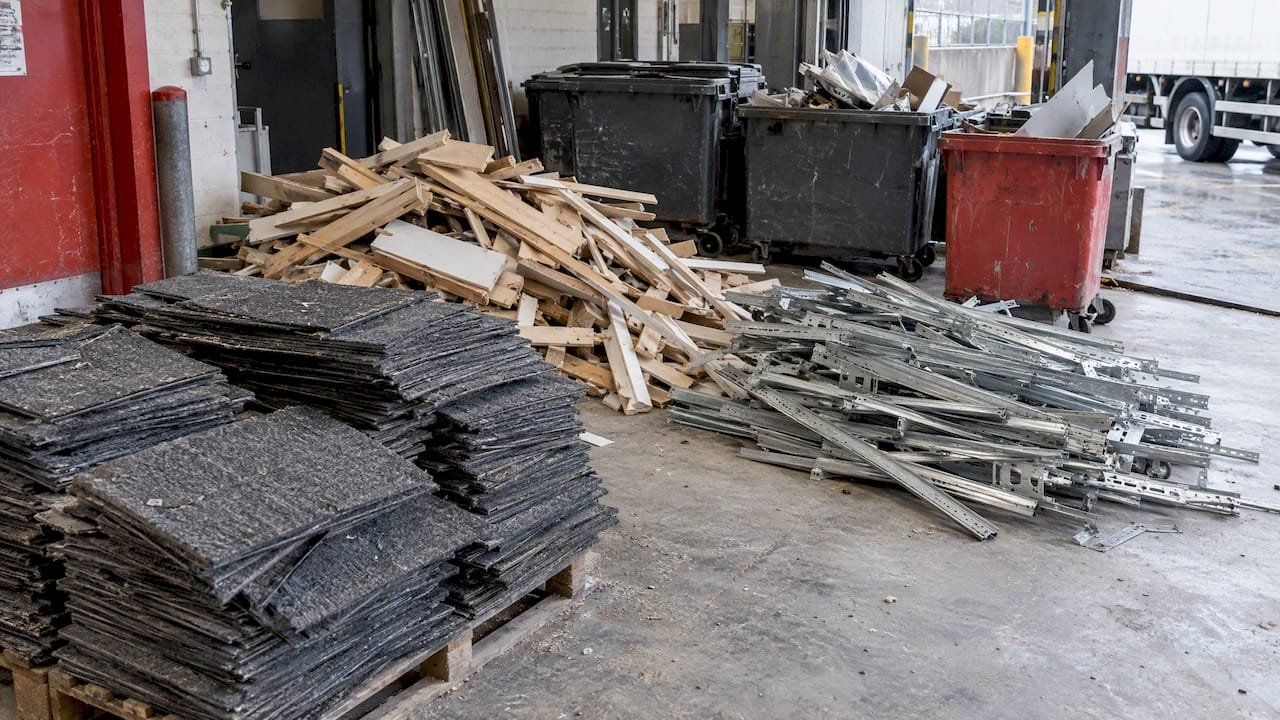
Australian strip out waste guidelines recommend separating materials at source into clean streams: metals, timber, plasterboard, concrete and other inert material, cardboard and e-waste. The reason is practical. A contaminated load can fail a facility’s gate checks and be diverted to landfill, which costs more and wastes the effort. The same guidance says to prevent contamination, keep disposal and recovery records, and keep hazardous materials such as asbestos completely segregated.
Two rules of thumb follow:
- Know where each stream goes before load-out. NSW Environment guidance says waste owners and transporters must ensure construction waste goes only to a place legally able to accept it.
- Never mix asbestos into general bins. Asbestos waste, contaminated protective equipment and rags are contained, labelled and taken to an authorised facility. Our guides to disposing of asbestos waste legally and what an asbestos disposal site is cover this in detail.
Ask your contractor for waste dockets or a recovery summary. If you are a tenant with sustainability commitments, those records are also your evidence.
Stage 7: Clean, inspection and handover
The job ends with a clean and a sign-off, not when the last bin leaves.
- Final clean. Floors, ledges and voids are cleaned so the space is ready for the next stage or the landlord’s inspection.
- Clearance and records. Where asbestos was removed, decontamination and visual inspection for dust are part of the process, and clearance documentation goes into the asbestos register for the building.
- Joint inspection. For lease-end work, walk the space with the landlord or agent against the make good clause. Photographs and a written handover list prevent disputes later.
- Make good or next package. Reinstatement items such as patching, repainting or ceiling reinstatement, or the incoming fitout, then start on a clean base.
- Close-out documents. Keep the SWMS, waste records, test results and any notification confirmations in your project file.
How to compare strip out contractors
Price matters, but these questions tell you far more:
| Question | What a good answer looks like |
|---|---|
| How do you handle asbestos? | Register review first, testing where gaps exist, licensed removal where required, job-specific control plan |
| What documents do you provide before starting? | SWMS or method statement, insurance certificates, waste plan, program |
| Who disconnects services? | Licensed trades, coordinated with building management |
| What happens to the waste? | Sorted streams, named facilities, dockets available |
| How is scope change handled? | Provisional items and a clear variation process for revealed conditions |
| Can you do both strip out and structural work? | One team, one program, one point of contact |
Be wary of a quote that is a single lump sum with no scope, or one that does not mention asbestos in a pre-2004 building.
Our perspective: where office strip outs go wrong
Most problems we see are not in the removal. They are in the first week. Clients assume the building is clean because the lobby looks modern, so asbestos is raised late. Lease clauses are skimmed. Strip out and make good get lumped into one number, then argue over what “revealed” conditions were worth.
Our approach is to treat the strip out as a managed project, not a labour job. We start with the register, test where it is thin, line up approvals and services isolation, and sort waste at source so the clean streams stay clean. We run licensed asbestos work and general demolition under one roof, so a surprise in the ceiling void becomes a program adjustment rather than a stop-work argument between trades.
If you remember one thing: ask about asbestos before you ask about price.
— Tarek
Planning an office strip out?
We plan and carry out commercial strip outs, from soft strips to combined strip out and structural demolition, with asbestos inspection and licensed removal available when the register calls for it. Tell us about the space, the lease or program deadline and any building rules, and we will scope it with you. Start with our interior strip out services or contact us through Mission Demolition.
FAQ
What is the difference between a strip out and demolition?
A strip out removes non-structural interior elements and keeps the building’s structure. Demolition involves dismantling a load-bearing or structurally integral part, and that triggers stricter WHS requirements such as a SWMS. Many projects include both.
Do I need to test for asbestos before an office strip out?
If the building was built or installed before 31 December 2003, the asbestos register must be reviewed before refurbishment or demolition, and asbestos likely to be disturbed must be identified. Where there is no register or it does not cover your work area, a competent person should inspect and sample first.
Is demolition high-risk work?
Yes, where it involves a load-bearing or structurally integral part of a structure. Under the model WHS framework that is high-risk construction work and needs a SWMS before it begins. Some demolition is also notifiable to the regulator, for example in NSW when it involves a structure at least 6 metres high.
Who is responsible for the waste from a strip out?
The waste owner and the transporter share responsibility for making sure waste goes only to a facility legally able to accept it. Ask your contractor for dockets showing where each stream was taken.
How long does an office strip out take?
It depends on floor area, building access hours, asbestos findings and how much waste must be sorted and removed. A contractor can only give a reliable program after inspecting the site and reviewing the register, so treat any estimate given without a visit with caution.
Sources
- Demolition | WorkSafe Queensland
- Demolition | Safe Work Australia
- Model Code of Practice: Demolition Work | Safe Work Australia
- Demolition notifications | SafeWork NSW
- Demolition work Code of Practice 2021 | WorkSafe Queensland
- How to manage and control asbestos in the workplace | Safe Work Australia
- How to safely remove asbestos | Safe Work Australia
- Trades and construction workers | Asbestos Safety
- Strip out waste guidelines | Better Buildings Partnership
- Know your responsibilities: managing waste from building work | NSW Environment
- National waste reporting 2024 at a glance | DCCEEW