You cannot tell if your popcorn ceiling contains asbestos just by looking at it. The only reliable answer comes from a licensed asbestos assessor taking a sample and sending it to a NATA-accredited laboratory. If the ceiling is intact and undisturbed, careful management in place is often the safest option; if you’re planning to renovate, patch, or scrape it, arrange licensed removal with clearance testing first.
TL;DR:
- Testing by a licensed asbestos assessor with laboratory analysis is essential before disturbing any popcorn ceiling, as visual inspection alone cannot confirm asbestos presence.
- If tested positive, a stable, undamaged ceiling can often be safely managed in place with documented regular inspections, avoiding unnecessary removal costs.
- Licensed removal involves specific containment, wet methods, proper waste disposal, and clearance inspections, which are critical for safety and legal compliance.
- DIY sampling is unsafe and should only be performed by professionals using proper wet suppression techniques and sealed sample containers.
- Homeowners should maintain ongoing condition logs and get annual visual inspections to ensure continued safety when choosing management over removal.
Table of Contents
- What is popcorn ceiling asbestos, and why does it turn up in Australian homes?
- How to test popcorn ceiling for asbestos: the checklist Australians should follow
- Your ceiling tested positive. What now?
- What licensed asbestos removal looks like in Australia
- Why hire a licensed Australian contractor
- How to safely collect a popcorn ceiling sample for testing
- Choosing a testing laboratory and reading your results properly
- Common scams and misleading practices to watch for
- What to do the moment you suspect asbestos in your ceiling
- Living with it: monitoring a ceiling you’ve chosen to leave in place
- The gap between “technically legal” and actually safe
- Get a licensed asbestos quote from Missiondemolition
- Sources
What is popcorn ceiling asbestos, and why does it turn up in Australian homes?
Popcorn ceilings, sometimes called textured or stipple ceilings, get their bumpy look from a sprayed coating that often used vermiculite, a naturally occurring mineral valued for its lightweight, fire-resistant properties. The problem isn’t vermiculite itself. It’s where a lot of the world’s vermiculite came from. The Libby, Montana mine supplied vermiculite globally for decades and was heavily contaminated with asbestos, meaning vermiculite-based sprayed coatings can carry asbestos fibres even when the product wasn’t marketed as an asbestos material.
Australian homes and commercial fitouts built up to the late 1980s are the ones most likely to carry these textured finishes, though some tradespeople kept using leftover stock into the early 1990s. If your property falls in that build window, the ceiling texture is worth flagging regardless of how tidy or “recently painted” it looks.
Here’s what most homeowners miss: the ceiling surface you can see is rarely the only place the material ended up. Sprayed coatings were applied generously, and overspray settled into ceiling cavities, onto structural beams, and inside roof spaces above suspended ceiling panels. Contamination in these hidden zones can persist long after the visible surface has been painted over or partially removed, which is exactly why a proper assessment looks beyond the obvious texture and checks roof voids, external eaves, and covered outdoor areas too.
How to test popcorn ceiling for asbestos: the checklist Australians should follow
Testing is not a DIY job, and this is one area where cutting corners genuinely backfires. Only a licensed asbestos assessor, combined with analysis from a NATA-accredited laboratory, gives you a result you can actually rely on. Visual inspection, no matter how experienced the inspector’s eye, cannot distinguish asbestos-contaminated vermiculite from the asbestos-free version. They look identical.
Here’s the practical sequence to follow:
- Contact a licensed asbestos assessor rather than a general handyman or painter.
- Do not scrape, brush, vacuum, or sand the ceiling before the assessor arrives; disturbance is what turns a manageable situation into an exposure risk.
- The assessor takes a small bulk sample using wet methods and proper containment, then seals and labels it for transport.
- The sample goes to a NATA-accredited lab, typically analysed using polarised light microscopy (PLM).
- Your report will state the sample location, the material type, and whether asbestos was detected, along with a recommendation for management or removal.
Pro Tip: Keep the lab report with your property file permanently. If you sell the house or bring in contractors years later, that single document saves everyone a repeat inspection and proves the ceiling’s status at a point in time.
Turnaround for lab results is usually a matter of days, not weeks. Act with more urgency if the ceiling is flaking, has visible water staining, or if demolition or renovation work is already scheduled. Testing before you touch anything is a small cost against the risk of disturbing contaminated material unknowingly.
Your ceiling tested positive. What now?
A positive result doesn’t automatically mean you need a full removal crew tomorrow. It means you have a decision to make, and that decision depends on the ceiling’s condition, what work you’re planning, and who occupies the space.
- Assess the condition first. Intact, undisturbed textured coating generally carries lower short-term risk than material that’s cracked, peeling, or water-damaged. If it’s stable and nobody is planning to touch it, leaving it in place with documented management is often the most sensible, cost-effective path.
- Think twice before painting over it. Encapsulation with paint can seem like an easy fix, but it complicates matters later. A painted, sealed surface resists the wet methods used for safe removal, which can force a riskier dry removal down the track.
- Plan for licensed removal if you’re renovating. Any work that will drill, scrape, sand, or demolish the ceiling means the material has to come out properly, under licensed conditions, before the trades start.
- Run through the decision checklist: Is the material currently damaged? Are you renovating within the next 12 months? Is the space occupied daily by children, tenants, or vulnerable people? What’s the budget for removal versus ongoing management?
Pro Tip: If you’re on the fence, get a written management plan from your assessor even if you choose to leave the ceiling alone. It documents your due diligence and gives future buyers, tenants, or contractors clear instructions.
What licensed asbestos removal looks like in Australia
Once removal is the right call, the process follows a defined sequence, not a quick scrape-and-bin job. It starts with a pre-job assessment confirming the extent and location of contaminated material, followed by the notifications and waste manifest documentation required for legal disposal.
On site, licensed crews rely on containment. That means sealing off the work area, using wet methods to keep fibres from becoming airborne, and running HEPA filtration where the scope calls for it. Wetting is central to safe removal, and it’s also where painted ceilings cause trouble, because a sealed surface won’t absorb moisture the way raw textured coating does. Professionals sometimes run a quick wet test on a small patch first. If water won’t soak in after a minute or two, that’s the signal to bring in a licensed abatement contractor rather than attempt standard wet removal.
Once the material is out:
- Waste gets bagged, labelled, and tracked through a proper asbestos waste manifest for disposal at an approved facility.
- The contractor arranges independent clearance testing and, where required, air monitoring before anyone re-enters the space.
- A clearance inspection confirms the area is safe and produces the certificate you’ll want on file.
- Timeframes and cost depend on ceiling area, accessibility, whether cavities and beams need attention, and how much containment the job demands.
A construction environmental management plan covering site controls and waste procedures is worth having ready if the removal sits within a larger renovation or demolition project.
Why hire a licensed Australian contractor
Missiondemolition specialises in safe, fast asbestos removal across residential, commercial, and industrial properties in Australia, and that scope matters when a popcorn ceiling job turns out to involve more than the visible surface.
A properly licensed provider brings current licensing, air monitoring where the job requires it, an independent clearance inspection, and disposal through approved waste channels. That’s the difference between a job that protects your property’s legal record and one that creates problems the next time you sell or renovate. Our editorial contributor Tarek has drawn on these standards throughout this guide, and you can review Missiondemolition’s asbestos testing methods and clearance inspection process for more detail on what a compliant job actually involves.
How to safely collect a popcorn ceiling sample for testing
This is the one part of the process best left to a licensed assessor, but understanding the method helps you judge whether a contractor is doing it properly.
A correct sample collection starts with wetting the target area lightly using a spray bottle with water and a drop of dish detergent. This suppresses dust before any disturbance happens. The assessor then uses a clean tool, often a small blade or corer, to cut a piece roughly the size of a coin from an inconspicuous section of ceiling, ideally near a corner or an area already showing wear.
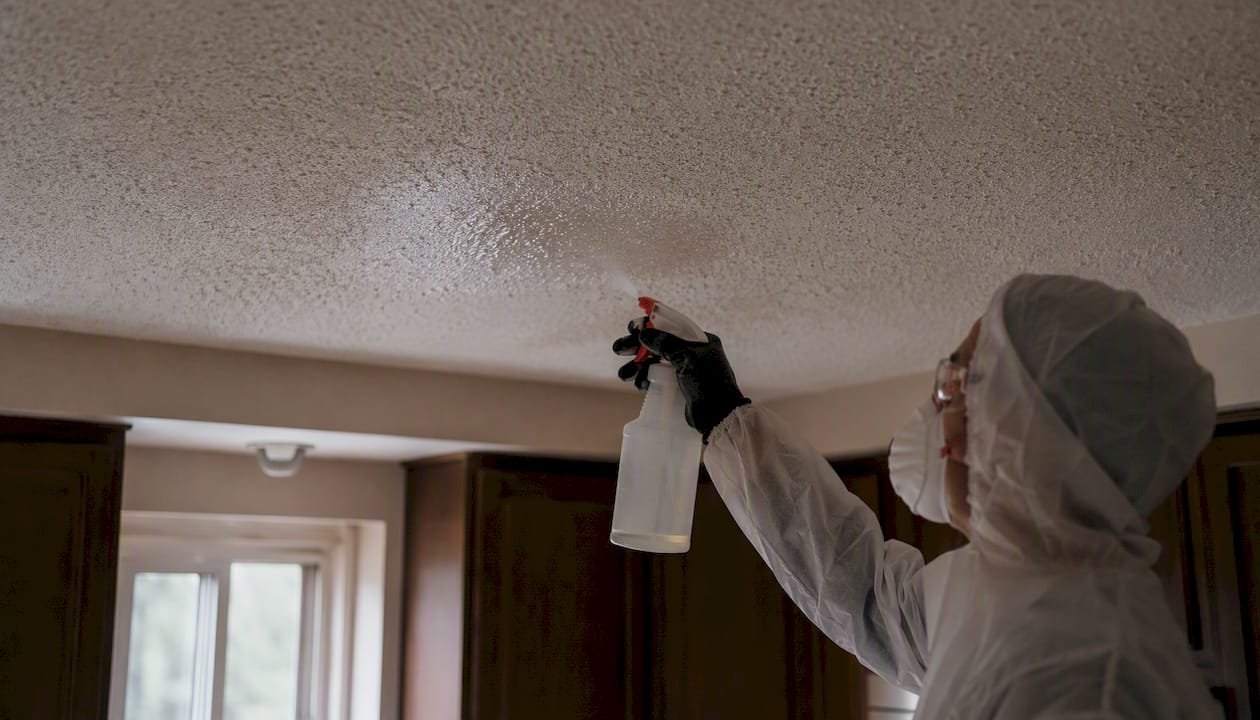
The sample goes straight into a sealable bag or container, which is labelled with the exact location, date, and a reference number tied to a site diagram. Good practice means taking multiple samples from different rooms or ceiling sections if the property has more than one type of texture or if renovations happened at different times, since one room’s ceiling might be a different product entirely from another’s.
The immediate work area gets wiped down afterwards, never dry swept or vacuumed with a standard household vacuum, both of which can spread fibres rather than contain them. The patch left behind should be small enough that it doesn’t visibly compromise the ceiling, and it’s standard for the assessor to photograph the sample location for the file.
If you’re arranging this yourself before calling a contractor, don’t. The risk of doing it without wet suppression and proper PPE outweighs any convenience.
Choosing a testing laboratory and reading your results properly
Not every lab that offers asbestos testing is equal, and the accreditation detail is the one thing you should never skip past. In Australia, the laboratory analysing your sample needs NATA accreditation specifically for asbestos identification, not just accreditation for other testing categories. Ask directly for their NATA scope document if you’re unsure, a legitimate lab will hand it over without hesitation.
Most labs use polarised light microscopy for bulk samples, which identifies both the presence of asbestos fibres and, often, an estimated percentage within the material. Your report should clearly state the sample reference number matching the assessor’s site notes, the material description, the analysis method used, and a plain-language result: detected, not detected, or trace.
Watch for vague language. A results letter that says something like “consistent with historical building materials” without a clear positive or negative determination isn’t a usable result. Push back and ask for clarification, or use a different lab.
Turnaround typically runs a few business days for standard bulk sampling, faster for urgent jobs where a premium may apply. Keep the original report, not just a summary email, because it’s the document that carries legal weight if a dispute or property sale ever hinges on the ceiling’s asbestos status.
Common scams and misleading practices to watch for
Asbestos testing and removal has its share of operators who cut corners, and knowing the warning signs protects both your wallet and your health.
The biggest red flag is a contractor offering to “test and remove in the same visit” without ever sending a sample to an independent lab. Genuine testing requires third-party laboratory analysis. Anyone who claims they can identify asbestos on-site by eye or with a handheld device is not giving you a real result.
Watch for quotes that seem unusually cheap compared to others for the same scope of work. Removal that skips containment, wetting, or proper waste disposal costs less because it’s cutting the exact steps that keep fibres out of the air and off the books legally. That saving gets passed to you as risk, not value.
Be wary too of anyone pushing encapsulation or overpainting as a “permanent fix” without mentioning that it can prevent proper wet removal later. It’s a legitimate option in some circumstances, but it should be presented with its trade-offs, not sold as a one-time solution that avoids the issue forever.
Finally, ask for the contractor’s specific asbestos removal licence class and check it matches the size of the job. A general demolition licence doesn’t cover certain classes of asbestos work, and a legitimate operator will show you the licence without being asked twice.
What to do the moment you suspect asbestos in your ceiling
Finding out your popcorn ceiling might contain asbestos is unsettling, but the right immediate response is calm containment, not panic.
Stop touching the ceiling. No scraping, no sanding, no vacuuming, and no letting kids or pets treat the room as normal play space if the material shows any visible damage. Close the door if practical, and limit foot traffic through the room until you’ve had it assessed.
Avoid running ceiling fans or air conditioning vents directly beneath a damaged section, since airflow can help spread loose fibres further than they’d otherwise travel. If there’s visible flaking or you’ve already disturbed part of the ceiling before reading this, dampen the area very lightly with a fine water mist, this isn’t a fix, but it helps settle any loose material until a professional arrives.
Don’t attempt to patch, cover, or clean the area yourself, even with good intentions. A quick DIY patch job is one of the more common ways people unknowingly spread contamination into a wider area of the room.
Call a licensed asbestos assessor promptly rather than waiting. If you’re a landlord or property manager, notify affected tenants about the restricted area and the reason for it. Document the date you noticed the issue and any photos you take from a distance, this record helps the assessor and protects you if questions come up later about how quickly you acted.
Living with it: monitoring a ceiling you’ve chosen to leave in place
Plenty of Australian homeowners land on management in place rather than removal, and that’s a legitimate, professionally supported choice when the material is intact. It’s not a “set and forget” decision, though.
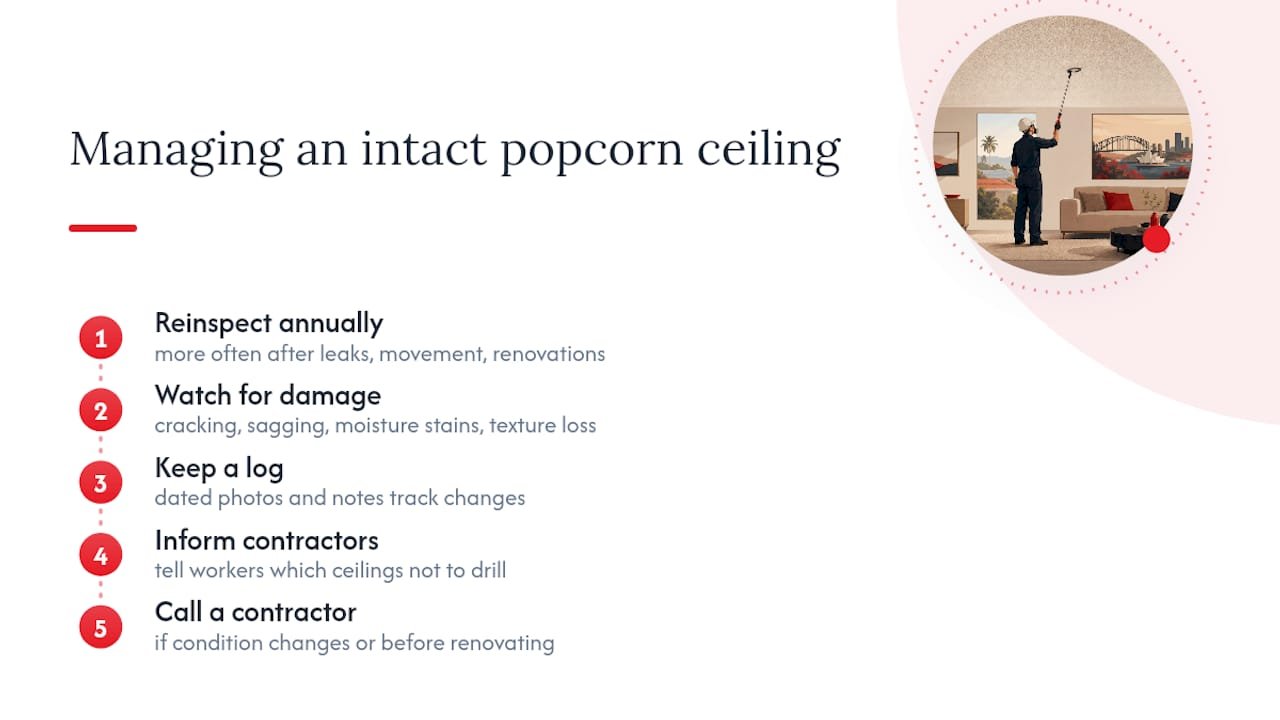
Get the ceiling visually reinspected at least once a year, more often if the property has had any roof leaks, structural movement, or renovation activity nearby. Look specifically for new cracking, sagging, discolouration from moisture, or any area where the texture has come loose from the substrate.
Keep a simple log, even a note on your phone with dated photos works, tracking the ceiling’s condition over time. This becomes valuable if you ever sell the property, since buyers and their inspectors will want evidence the material has been actively managed rather than ignored.
Brief anyone doing work in the home, painters, electricians running new cabling, air conditioning installers, before they start. A five-minute conversation about which ceilings are off-limits for drilling or sanding prevents an accidental disturbance that turns a manageable situation into an urgent removal job.
If the ceiling’s condition changes noticeably between inspections, or if you’re finally ready to renovate, that’s the trigger to call a licensed contractor again rather than assume the original test result still applies indefinitely to a now-damaged surface.
The gap between “technically legal” and actually safe
Most advice on this topic focuses on ticking the compliance boxes: test it, get a report, hire a licensed remover if needed. That’s necessary, but it’s not the full picture. The real gap I see is homeowners treating a clean-looking ceiling as low priority simply because it hasn’t been disturbed yet, then forgetting about it entirely once the test result comes back “manage in place.”
Management in place is a decision with an expiry date, not a permanent solution. Conventional advice tends to stop at the test result and skip the ongoing responsibility that comes with living alongside contaminated material. The homeowners who get this right are the ones who treat the annual visual check as seriously as they’d treat a smoke alarm test, not a formality, but a habit that catches problems before they become emergencies.
If you take one thing from this guide, prioritise documentation over intuition. A gut feeling that “it looks fine” has no legal or practical weight next to a dated report and a photo log. That paperwork is what protects you, your tenants, and your resale value when it actually matters.
— Tarek
Get a licensed asbestos quote from Missiondemolition
Missiondemolition is the practical next step once your popcorn ceiling has been tested, whether the result means careful management or full licensed removal. Where a general contractor might hesitate at hidden overspray in a ceiling cavity or a painted surface that won’t wet properly, our licensed teams handle containment, disposal, and clearance testing as standard, not as an upsell.
Before you request a quote, have a few details ready: the property’s approximate build year, the size of the affected room or roof area, the ceiling’s current condition (intact, cracked, water damaged), and whether you’re planning renovation work alongside the removal. That lets us scope containment and disposal accurately from the first call rather than adjusting the price on site.
Every job includes proper waste manifest handling and a post-removal clearance inspection, so you walk away with documentation, not just an empty room. If you’re ready to move from test result to action, get in touch through our asbestos removal Sydney page for a quote, or browse our full demolition and asbestos services if the ceiling work is part of a bigger renovation or strip-out.
This article is general information, not a substitute for advice from a qualified doctor. Consult a qualified healthcare professional about your own circumstances before acting on anything here.
Sources
- Sprayed coatings of asbestos contaminated vermiculite – Asbestos product guide
- Vermiculite and asbestos | Asbestos NSW
- Popcorn ceiling asbestos: Test before you scrape | Peerless Environmental
- How to properly remove spray-on ‘popcorn’ ceilings (Puget Sound Clean Air Agency guidance)
