In Australia there is no single “post-demolition clean” standard. The standard is a chain of duties: remove debris progressively, control dust and hazardous materials, dispose of waste lawfully, and prove the site is safe before anyone uses it again. If asbestos was present, a clearance certificate sits at the end of that chain. We manage demolition, asbestos removal and final site cleaning as one job, so the chain stays unbroken and the site you receive is ready for your next stage.
TL;DR
- Post-demolition cleaning is a safety and waste-compliance process, not a cosmetic builders clean. It starts while demolition is still under way.
- Safe Work Australia’s model code expects debris to be removed progressively, and hazards eliminated or minimised using the hierarchy of controls.
- Where asbestos was removed, a competent person or licensed assessor must carry out a clearance inspection and issue a certificate before re-occupation.
- In NSW, asbestos waste over 100 kg or 10 square metres must be tracked with WasteLocate and taken to a facility that accepts it.
- Your handover file should hold the clearance certificate, waste disposal evidence and confirmation that dust and spillage are cleaned up.
Table of Contents
- What post-demolition cleaning actually covers
- The rules behind the standard
- The stages of a compliant post-demolition clean
- Asbestos: the clean is not finished until it is cleared
- What your final inspection and handover should confirm
- Differences by reader
- Handing the whole job to one team
- FAQ
- Sources
What post-demolition cleaning actually covers
Most pages that rank for this topic describe post-construction cleaning: wiping surfaces, vacuuming, polishing floors and removing adhesive marks so a finished building looks presentable. That is a builders clean. It happens at the end of a build, inside a structure, and its test is appearance.
Post-demolition cleaning has a different job. The structure is gone or stripped, and the question is whether the land or the remaining building is safe and lawful to use next. Its test is risk. It covers four things:
- Debris removal, including concrete, masonry, timber, metals, and fixtures, so that nothing builds up into a hazard.
- Hazardous material control, mainly asbestos, but also hazardous chemicals found in the structure.
- Dust, spillage and contamination cleanup on the site and on neighbouring land.
- Verification and paperwork, meaning inspections, certificates and waste records that prove the first three were done.
A strip-out inside a commercial tenancy sits between the two. You may still need a builders clean at the very end, but only after the demolition-side standards below are met. A fine clean over a surface that still carries asbestos fibres or unrecorded waste is not a finished job.
The rules behind the standard
The duty is to eliminate, then minimise
Safe Work Australia’s Model Code of Practice: Demolition work says risks must be eliminated so far as is reasonably practicable. Where that cannot be done, they must be minimised using the hierarchy of controls: substitution, isolation, engineering controls, administrative controls, and personal protective equipment, in that descending order. Cleaning is one of the ways a site meets this duty. Dust left to settle and re-circulate is a risk that should be controlled, not ignored.

A model code is not law by itself. States and territories adopt it into their own work health and safety frameworks, so the details differ by jurisdiction. The principles are the same everywhere, and the examples below name the state when a rule is state-specific.
Who is allowed to do the work
In NSW, from 1 March 2025, demolition licence holders must make sure workers doing licensed demolition work have completed the SafeWork NSW-approved course CPCCDE3016. SafeWork NSW’s demolition page notes that this course has since been superseded by CPCCDE3030. For an owner or project manager, the practical point is to confirm that the crew clearing your site holds current licences and training, not just a truck and a broom.
The stages of a compliant post-demolition clean
1. Identify what is on site before demolition starts
Cleaning standards begin before the first wall comes down. The Safe Work Australia code identifies exposure to asbestos and hazardous chemicals as demolition hazards and sets out a process: identify hazards, assess risks where necessary, eliminate them where reasonably practicable, and control what remains.
Main Roads WA’s Specification 803 shows how formal this can be on government work. It requires a hazardous materials audit by a competent person before demolition, covering asbestos-containing materials and other potentially hazardous materials, with recommendations to prevent or minimise exposure. The same logic applies to a house or a warehouse. If you do not know where the asbestos is, you cannot plan the clean. Our asbestos inspection and testing service covers this identification step.
For a fuller walk-through of the sequence, see our guide to removing asbestos before demolition.
2. Remove debris progressively, not at the end
The model code says demolished materials should not fall freely unless they are confined within a chute, enclosure or shaft and/or an exclusion zone. It also says debris should be progressively removed so that it does not build up into health and safety hazards. This is the single biggest difference from a builders clean: waste is managed throughout the job.
Where asbestos is involved, SafeWork NSW’s asbestos and demolition checklist requires that workers’ access ways and work surfaces are kept clear of debris and trip hazards. A cluttered site is both a fall risk and a place where asbestos fragments can be trodden into the ground and missed.
What goes wrong here is simple. A pile of mixed rubble sits on the slab for weeks, someone adds a few asbestos sheet offcuts, and the whole pile becomes a waste classification problem. Segregating at the point of demolition keeps clean concrete and timber recyclable and keeps suspect material contained.
3. Control dust and clean up spillage
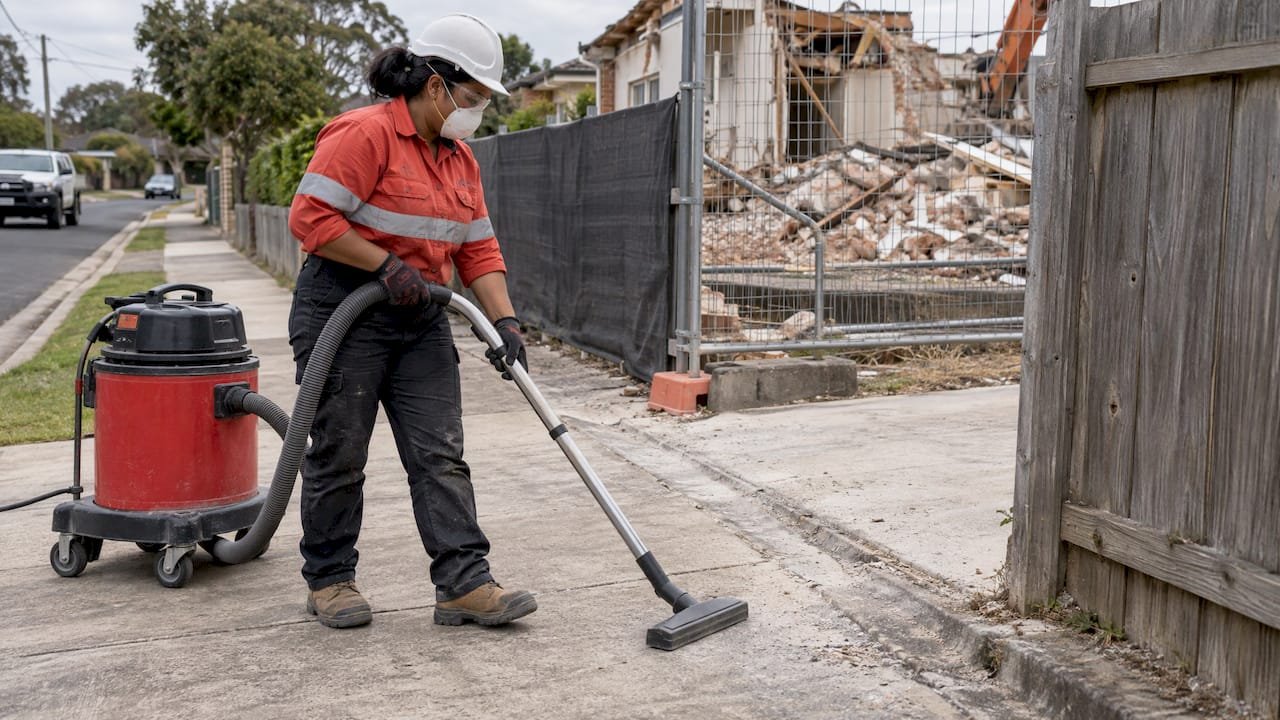
Dust is the part of the clean that owners see and neighbours complain about. Main Roads WA’s specification requires the contractor to clean up spillages and dust contamination to the site and adjacent properties, along with other environmental contamination, within one week of completing the demolition and disposal operations. That is a government road-project requirement, not a universal rule for private sites, but it is a useful benchmark for what a reasonable timeframe looks like.
On a residential block, adjacent properties mean the neighbour’s fence line, driveway and gutters. On a commercial or industrial site they may include shared access roads and stormwater drains. Sweeping, wet suppression and vacuuming with appropriate equipment belong in the scope, and the person responsible should be named in your contract.
4. Sort, transport and dispose of waste lawfully
Waste is where most compliance failures happen, because responsibility does not end when the truck leaves. The NSW EPA’s construction and demolition waste toolkit recommends that owners require contractors to provide evidence of lawful disposal, recycling or re-use before waste leaves the site. Examples include the facility’s licence or development consent and WasteLocate consignment numbers.
Here is how the main asbestos waste rules fit together in NSW:
| Step | What the official guidance says |
|---|---|
| Classify | Asbestos waste should be classified on-site using the EPA Waste Classification Guidelines (NSW EPA toolkit) |
| Package | Non-friable asbestos is securely packaged, friable asbestos is sealed in a container, and contaminated soils are wetted down (SafeWork NSW asbestos blueprint) |
| Transport | Carried in a covered, leak-proof part of the vehicle (SafeWork NSW asbestos blueprint) |
| Track | In NSW, more than 100 kg or 10 square metres of asbestos waste must be tracked with WasteLocate (NSW asbestos guidance on unlicensed removal) |
| Dispose | Taken to a licensed landfill that accepts asbestos waste (NSW asbestos guidance) |
Outside NSW the thresholds and tracking systems differ, and the Safe Work Australia code simply says asbestos waste must be transported and disposed of according to the relevant state or territory EPA requirements. Check your own state’s EPA for the local numbers.
There is also a consequence at the tip. Under the NSW EPA’s standards for managing construction waste, facility staff inspect the top of each load and reject the entire load if asbestos waste is identified or reasonably suspected. At a second inspection point, loads are spread for visual inspection, and rejected loads must leave the facility within one day. A contaminated skip of otherwise recyclable rubble can therefore cost you the whole load, a second trip and a delay to your program. Our guide on NSW’s hazardous by default rule explains how classification decisions affect disposal.
Asbestos: the clean is not finished until it is cleared
If asbestos was removed, “looks clean” is not a standard. In NSW, removal of more than 10 square metres of asbestos must be done by a licensed asbestos removalist. SafeWork NSW states that the removalist must notify SafeWork, display warning signs, follow the code of practice for safe asbestos removal, use the right PPE and decontaminate people, work areas and tools. Smaller jobs have their own rules, so confirm the position for your site before work begins.
After removal comes the clearance inspection. The SafeWork NSW asbestos blueprint says a competent person or licensed asbestos assessor must carry out the inspection and issue a clearance certificate before the removal area is re-occupied. The asbestos and demolition checklist goes further and asks for arrangements for the inspection by an independent licensed assessor or competent person, and for asbestos waste and contaminated PPE to be disposed of as soon as practicable at an authorised site.
The NSW EPA toolkit adds that a clearance certificate may be needed under work health and safety laws to verify the site is safe for normal use and re-occupation. For a homeowner this is the document your builder, certifier or lender may ask for before construction starts. For a business owner it is the evidence that staff and customers can return.
Three guides go deeper on this step: whether asbestos clearance is mandatory in Sydney, the asbestos clearance certificate process, and how a clearance inspection works in Sydney. If your site has contaminated soil rather than building material, read about asbestos in soil removal as well. Current NSW rules are summarised in our asbestos removal regulations guide.
What your final inspection and handover should confirm
A handover that is only a phone call saying “we’re done” leaves you holding the risk. Whoever signs off the site should be able to give you a short file. Based on the official material above, it should confirm:
- Hazardous materials: the pre-demolition hazardous materials findings and what was done about each item.
- Asbestos clearance: the clearance certificate from the competent person or licensed assessor, if asbestos was removed.
- Waste evidence: disposal or recycling records for each waste stream, including WasteLocate consignment numbers where tracking applied.
- Dust and spillage: confirmation that site and adjacent-property contamination has been cleaned up.
- Services: utility disconnections completed and recorded.
- Erosion and sediment controls: still in place where the site is not yet stabilised.
That last point matters for developers. The ACT’s Environment Protection Guidelines for Construction and Land Development say handover may occur before final stabilisation, but erosion and sediment controls must stay functional and managed until the site is fully stabilised. A bare, cleared block in heavy rain can send sediment into stormwater, so the file should say who looks after the controls after demolition crews leave.
For a longer list, our site clearance checklist runs through the checks that make clearance work in practice, and the house demolition preparation checklist covers the lead-up. If you are budgeting, the site clearance cost guide explains what drives the figure.
Differences by reader
Homeowners building a new home should focus on the clearance certificate, the waste records and the cleanup of neighbouring boundaries. These are the documents a builder or certifier will want.
Business owners with asbestos in a premises need the licensed removal, the clearance inspection and the certificate before staff or customers return.
Project managers and construction companies should write cleaning and disposal duties into the contract: who removes debris progressively, who holds the waste evidence, and when site clean-up is due.
Developers doing strip-outs should treat the clean as the last stage of the strip-out program. Our guides to the office strip out process and retail strip out process show where handover fits.
What we have learned about clean sites
The sites that finish smoothly are the ones where cleaning was planned on day one, not booked on the last day. Debris leaves as the job progresses, hazardous materials are identified before anyone swings a tool, and the paperwork is assembled as the work happens, not reconstructed afterwards.
That is why we run demolition, asbestos work and the final clean as one project. Approvals, utility disconnections, hazardous waste handling and final site cleaning sit under one project plan, so there is no gap between the demolition crew and a separate cleaner where responsibility can fall through. Our licensed asbestos removal is built around safety compliance and environmentally responsible waste disposal, because a clean site that was cleaned by dumping the problem somewhere else is not clean.
If you take one thing from this article, take this: ask for the handover file before you ask whether the floor is swept.
Tarek
Handing the whole job to one team
We provide residential, commercial and industrial demolition, licensed asbestos removal, asbestos inspection and testing, strip-outs, concrete cutting and site clearance across Sydney and Australia. Our full-service project management covers approvals, utility disconnections, hazardous waste handling and final site cleaning, so the standards in this article are part of the project plan from the start.
If you are planning a demolition or need a site brought to a clean, compliant finish, start at Mission Demolition or look at our residential demolition and industrial site clearance pages.
FAQ
Is post-demolition cleaning the same as a builders clean?
No. A builders clean removes construction dust, marks and debris from a finished build so it looks ready for occupants. Post-demolition cleaning is about safety and waste: progressive debris removal, hazardous material control, dust and spillage cleanup, lawful disposal and the paperwork that proves it. A builders clean may follow later, once those standards are met.
Do I need an asbestos clearance certificate after demolition?
If asbestos was removed, yes in practice. SafeWork NSW says a competent person or licensed asbestos assessor must inspect and issue a clearance certificate before the removal area is re-occupied. The NSW EPA also notes the certificate may be needed to verify the site is safe for normal use. Requirements vary by state, so confirm yours before work starts.
How long does the contractor have to clean up after demolition?
There is no single national deadline for private sites. Main Roads WA’s specification, which applies to its own projects, requires spillages and dust contamination to be cleaned up within one week of completing demolition and disposal. Set your own date in the contract, and tie final payment to the handover file.
What happens if asbestos is found in a skip load?
In NSW, a construction waste facility rejects the entire load if asbestos waste is identified or reasonably suspected, and rejected loads must leave within one day. That means a second trip and extra cost. Separating suspect material at the point of demolition prevents it.
Does asbestos waste need to be tracked?
In NSW, tracking with WasteLocate applies when asbestos waste is more than 100 kg or 10 square metres. Other states and territories have their own tracking rules, set by their EPAs, so check the one for your site.
Sources
- Model Code of Practice: Demolition work (Safe Work Australia, 2026)
- Model Code of Practice: Demolition work (Safe Work Australia, 2018)
- Demolition (SafeWork NSW)
- Asbestos and demolition checklist (SafeWork NSW)
- Specification 803 Dismantling and Demolition (Main Roads WA)
- Construction and demolition waste: A management toolkit (NSW EPA)
- Standards for managing construction waste in NSW (NSW EPA)
- Asbestos blueprint: roles and responsibilities of government agencies (SafeWork NSW)
- Unlicensed asbestos removal (NSW asbestos guidance)
- Environment Protection Guidelines for Construction and Land Development in the ACT