Your lease make-good clause determines what a shop defit will actually cost, not the size of your shop or the trade you hire first. Costs shift depending on whether the landlord wants a bare shell handed back or a full reinstatement to original condition. Before you ring around for quotes, pull your lease extract, photograph the current fit-out, and confirm the exact handover date and standard. That single step turns vague guesses into comparable, itemised numbers.
TL;DR:
- Most shop defit costs depend on the lease’s make-good clause, not shop size or trade type, and require precise documentation of current conditions for accurate quoting.
- A comprehensive quote should detail labour, specialist trades, asbestos removal, waste disposal, reinstatement, and include provisional sums and milestones to ensure transparency.
- Site access restrictions inside shopping centres, like limited working hours, loading dock scheduling, and noise limits, significantly increase costs compared to standalone buildings.
- Early asbestos testing, fixed scope agreements, and staged job planning help prevent costly overruns caused by hidden hazards or scope changes.
- Getting an itemised, site-specific quote before signing provides the most reliable budget and supports better financing and cost-control strategies.
Table of Contents
- Start with the lease and handover standard
- What actually makes up a shop defit quote
- How site access and building rules change the price
- What a reliable defit quote should include
- Timeline, approvals and handover planning
- Practical recommendations from a demolition specialist
- How retail, office and hospitality defits actually differ
- Average cost ranges by shop size and location
- How to budget and finance a shop defit
- Common cost-saving strategies during defit
- How design changes affect your final defit bill
- Typical cost overruns and how to avoid them
- Balancing cost control with landlord expectations
- Get an itemised defit quote from Mission Demolition
- Sources
- FAQ
Start with the lease and handover standard
The make-good clause in your lease is the document that decides your defit scope, not the contractor you eventually choose. Some leases require you to return the space to a bare shell (concrete floor, exposed services, stripped walls). Others only ask you to repair damage beyond fair wear and tear. A few demand a full reinstatement, matching the exact condition at the start of your tenancy, fixtures and all.
Read the clause alongside your original condition report if one was completed at handover. If no condition report exists, older photos from move-in day become your best evidence of what “original condition” actually looked like. This detail alone can turn into a significant dispute between landlord and tenant if the standard isn’t nailed down before demolition starts.
When you request quotes, give every contractor the same package so their numbers are genuinely comparable:
- The relevant lease extract covering make-good obligations
- Any existing condition report or move-in photos
- Current photos of the fit-out, including ceiling voids and services
- Your confirmed handover date and any centre management deadlines
If the clause is ambiguous, loop in your leasing lawyer or a property adviser before signing off on scope. It’s far cheaper than a landlord dispute after the work is done.
What actually makes up a shop defit quote
A defit quote is rarely one number. It’s a stack of separate cost components, and understanding each one lets you spot a lazy quote from a genuinely considered one.
Labour and plant cover the strip-out crew, demolition tools, and any machinery needed to remove fixtures, partitions, and shopfronts. Specialist trades often add more than people expect: electricians to make safe or remove wiring, fire services contractors to isolate sprinklers and alarms, plumbers for water and gas disconnections, and HVAC technicians if ductwork needs removal or capping.
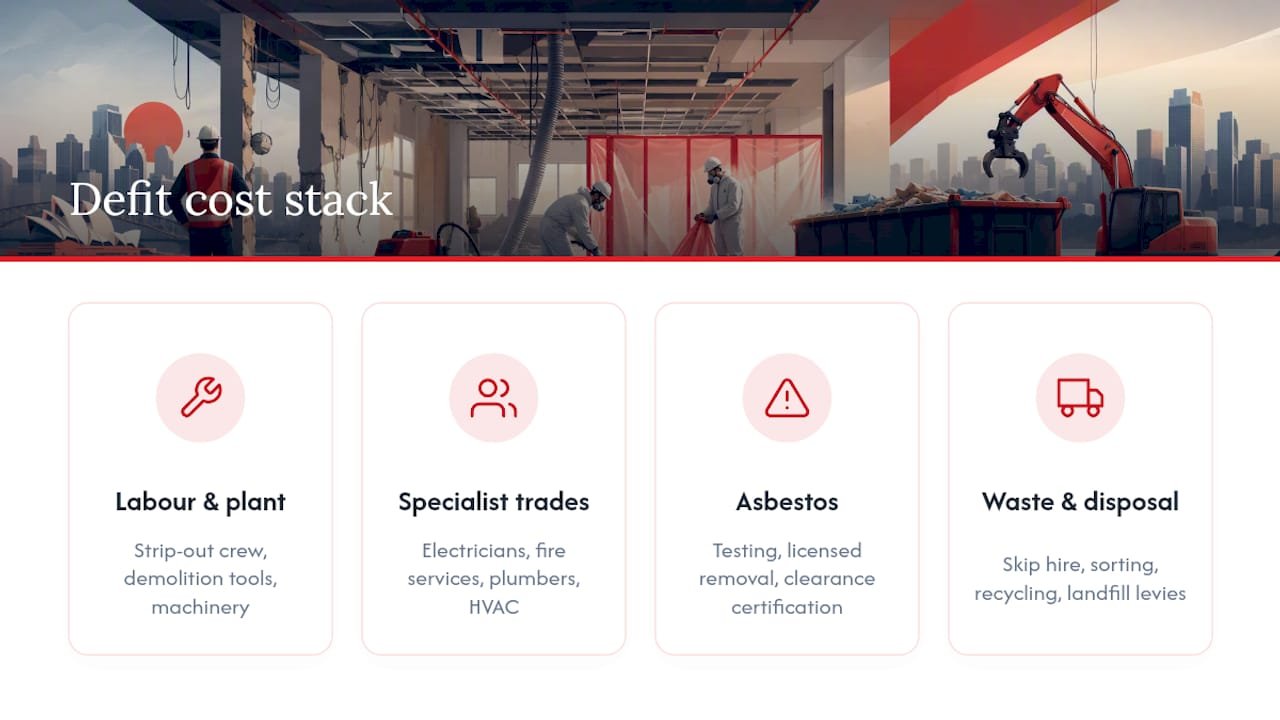
Asbestos is its own category, and it’s frequently the line item that blows out an otherwise tidy budget. Testing, licensed removal, and clearance certification are non-negotiable where asbestos-containing materials are found. SafeWork NSW guidance confirms demolition and strip-out work sits under construction safety rules, which means licensed controls apply the moment hazardous materials are suspected.
Pro Tip: Get asbestos testing done before you request full defit quotes. A confirmed result, positive or negative, lets contractors price with certainty instead of padding their number for the unknown.
Waste is another major driver. Skip hire, sorting, recycling, and landfill levies vary depending on volume and material type, and the EPA NSW construction and demolition waste toolkit shows how disposal choices swing both cost and compliance outcomes. Round out the quote with reinstatement work (patching, painting, flooring, doors) and project management or site supervision, particularly if the job needs traffic control or centre coordination.
How site access and building rules change the price
Where your shop sits changes what you pay just as much as what’s inside it. A standalone shopfront and a tenancy inside a busy shopping centre are two entirely different jobs, even with identical scope.
- Centre manager rules and curfews. Most shopping centres set strict working hours, noise limits, and permit processes for any works affecting common areas. Non-compliance can mean stop-work orders and rescheduling fees.
- Loading dock and lift access. Freight lifts, loading dock bookings, and permits for hoists or cranes all need advance coordination. Centres with limited dock windows often force contractors into slower, costlier removal methods.
- After-hours and staged work. Keeping neighbouring tenants trading usually means night or weekend shifts at overtime rates, or breaking the job into stages rather than one continuous strip-out.
- Noise, dust and trade restrictions. Live retail environments demand dust screens, quieter tools, and tighter scheduling around trading hours, all of which add time to the programme.
None of these costs show up if you’re quoting a vacant, standalone building. They show up fast in a live shopping centre.
What a reliable defit quote should include
A trustworthy quote reads like a breakdown, not a guess. Look for itemised line items covering labour, waste, specialist trades, and reinstatement separately, plus provisional sums for anything uncertain (like hidden services behind a wall) and an explicit list of exclusions.
A solid quote also sets out:
- A clear programme with milestone dates, not just a total duration
- Payment terms tied to those milestones, with defect rectification conditions spelt out
- Evidence of current insurance, trade licences, and (where relevant) asbestos clearance certificates
- How provisional sums get resolved if latent conditions turn up mid-job
Pro Tip: Before signing anything, run the contractor’s ABN through the Australian Business Register. It takes thirty seconds and confirms you’re dealing with a legitimate, active entity.
Treat a single lump-sum quote with no breakdown, no site inspection, and no mention of exclusions as a warning sign. It usually means either the contractor hasn’t looked closely enough to price accurately, or they’re planning to recover the gap through variations once work starts.
Timeline, approvals and handover planning
A small tenancy strip-out might run a short period, a medium retail space with reinstatement can take several weeks, and a large format store or hospitality fit-out with structural changes can extend over a longer duration once approvals are factored in.
- Check if council approval applies early. Structural changes, shopfront alterations, or plumbing work can trigger consent requirements under NSW exempt and complying development rules, and some categories move faster through complying pathways than others.
- Factor in asbestos lab turnaround. NATA-accredited testing typically takes several business days to return results, and that window sits on the critical path before removal work can start.
- Book centre access early. Loading dock slots and after-hours permits at busy centres fill up weeks ahead, especially around lease-end periods when multiple tenants defit at once.
- Schedule a pre-start inspection. Walk the site with the landlord or their representative before work begins, then lock in final sign-off criteria so the handover date doesn’t become a moving target.
Practical recommendations from a demolition specialist
Field experience across hundreds of tenancy defits points to a handful of habits that consistently save money. Screen for asbestos before you request full quotes, not after, so pricing reflects reality rather than risk padding. Split removal and reinstatement into separate quotes where possible. Different trades specialise in each, and bundling them under one head contractor often adds a margin you don’t need to pay.
Ask every contractor for itemised provisional sums and staged inspection points rather than a single lump figure. It keeps everyone honest as the job progresses. Where volume allows, push for lawful recycling and e-waste disposal streams instead of straight landfill. It’s often cheaper once you factor in current waste levies, and it keeps you on the right side of EPA obligations.
How retail, office and hospitality defits actually differ
Retail defits usually centre on shopfront removal, signage, flooring, and any built joinery like counters or display fixtures. Because most retail tenancies sit inside shopping centres, access rules and trading-hour restrictions dominate the programme far more than the physical demolition work itself.
Office defits lean heavier on services. Partition walls, data cabling, ceiling tiles, and HVAC ductwork make up the bulk of the strip-out, and older office towers frequently carry asbestos in ceiling tiles or vinyl flooring adhesive that needs testing before anything comes down. Structural work is rarer, but the sheer volume of cabling and partitioning can push labour hours higher than a comparably sized retail space.
Hospitality defits are usually the most involved of the three. Commercial kitchens bring grease trap removal, gas disconnections, extraction ductwork, and specialist plumbing that retail and office jobs simply don’t have. Health and food safety compliance can also extend the reinstatement scope, particularly around tiling, drainage, and ventilation. A hospitality fit-out with a full commercial kitchen will typically cost more per square metre to defit than an equivalent retail shell, purely because of the trade complexity involved.
Each category shares the same underlying cost logic though: the lease clause sets the standard, and everything else scales from there.
Average cost ranges by shop size and location
Pricing a shop defit without seeing the lease, the fit-out, and the site is guesswork, and any contractor who quotes a firm figure sight unseen is doing exactly that. What genuinely moves the number is scale and location rather than the trade itself.
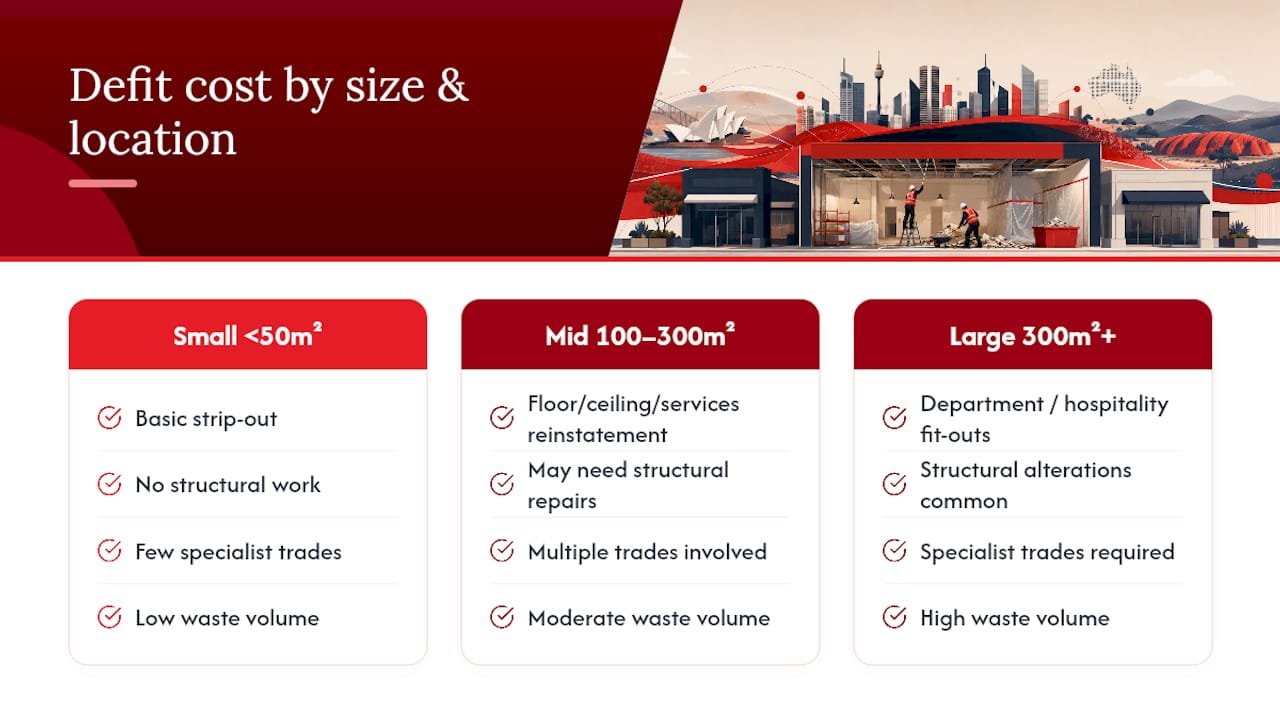
A small kiosk or compact retail tenancy under roughly 50 square metres, with a basic strip-out and no structural work, sits at the lower end of the market. A mid-sized store between 100 and 300 square metres, particularly one requiring reinstatement of flooring, ceilings, and services, lands in a noticeably higher bracket. Large format retail, department-style tenancies, or hospitality venues with commercial kitchens push costs higher again, largely because of specialist trade involvement and waste volume.
Location matters almost as much as size. A standalone strip shopfront in a regional area with easy street access and no centre management restrictions will generally cost less to defit than an identical tenancy inside a busy metropolitan shopping centre, where loading dock bookings, after-hours labour rates, and centre coordination fees all stack on top of the base scope. Sydney’s CBD and major regional shopping centres carry some of the tightest access windows in the country, and that access friction shows up directly in the final invoice.
Rather than chasing a benchmark figure that may not apply to your site, request site-specific itemised quotes once your lease standard and access conditions are confirmed. That’s the only number worth budgeting against.
How to budget and finance a shop defit
Start your budget from the lease clause outward, not from a rough industry estimate. Once you know whether you’re looking at a bare shell handover or a lighter repair standard, build a contingency of at least 10 to 15% on top of the itemised quote total to cover latent conditions like hidden asbestos or unexpected structural issues behind walls.
Separate your budget into three buckets: confirmed scope (what’s clearly required under the lease), provisional sums (what might be needed depending on what’s found once walls come down), and contingency (the buffer for genuine surprises). This structure makes it far easier to track spending against the original quote as work progresses.
On financing, most tenants either fund the defit from working capital, negotiate a make-good allowance with the incoming landlord if they’re also fitting out a new space, or use a business line of credit timed against the lease exit date. Some businesses time their defit to overlap with the final weeks of trade, spreading cash flow pressure across the last invoicing period rather than absorbing it as a single lump payment. Whichever approach you take, get the itemised quote locked in before committing to a financing structure. A vague number makes it impossible to size the funding correctly.
Common cost-saving strategies during defit
The biggest saving lever is timing, not haggling. Locking in your contractor and centre access dates early avoids the premium rates that come with rushed, last-minute bookings close to your lease expiry.
Splitting the job into separate scopes rather than one bundled head contract often reduces margin stacking, particularly on larger tenancies where demolition, asbestos removal, and reinstatement can genuinely run as three separate engagements. Recycling materials wherever the EPA’s construction and demolition waste guidance allows also trims landfill levies, sometimes substantially on higher-volume retail strip-outs.
Reusing existing fixtures or services where the incoming tenant or landlord agrees can cut both labour and disposal costs. If ceiling grids, some flooring, or shopfront glazing can stay in place rather than being fully stripped, that’s real money back in your budget. Finally, get your asbestos testing done early. A confirmed clean result removes a major pricing unknown, and contractors will typically quote tighter when they’re not pricing in risk for an unconfirmed hazard.
How design changes affect your final defit bill
Every variation request after a quote is signed adds cost, and design changes are the most common source of that creep. Deciding midway through the job that a wall should stay instead of come down, or that flooring needs to be a different finish than originally scoped, forces the contractor to reprice and often reschedule around the change.
The timing of the change matters enormously. A design decision made before the quote is finalised costs nothing extra. The same decision made once demolition has started can mean rework, wasted material, and lost labour hours on top of the new scope. Locking in your final layout, finishes, and any structural changes before signing the contract is the single most effective way to keep the number on the page matching the number on the invoice.
If you’re genuinely unsure about final design at quoting stage, ask your contractor to price the base scope with a separate, clearly flagged allowance for the variables still in play. That keeps the core number reliable while acknowledging what’s still undecided, rather than pretending certainty where none exists.
Typical cost overruns and how to avoid them
Overruns almost always trace back to one of three causes: undiscovered hazardous materials, scope creep from late design changes, or access delays that push work into overtime periods. Asbestos found after demolition has already begun is the costliest of the three, because it usually means stopping work entirely while licensed removal is arranged, then resuming on a compressed timeline.
Avoiding this starts with sequencing your due diligence correctly. Get asbestos testing done before the quote, not during the job. Confirm the make-good standard with the landlord in writing before any demolition starts, so there’s no dispute later about what “reinstated” actually means. Lock in centre access bookings well ahead of your handover date rather than assuming a slot will be available when you need it.
The other quiet overrun driver is provisional sums that were never properly scoped. If a contractor’s quote includes a vague allowance for “possible hidden services” with no methodology behind the number, ask them to explain how they arrived at it. A well-run defit treats provisional sums as a genuine risk allocation tool, not a placeholder for guesswork.
Balancing cost control with landlord expectations
The cheapest tender isn’t automatically the smart choice. When latent conditions like hidden asbestos are a real possibility, a low price often just means the risk hasn’t been priced in yet, and it surfaces later as a variation claim.
Some tenants deliberately choose a contractor who guarantees programme certainty and full compliance documentation over one offering the lowest number, because a landlord dispute at handover costs far more than the price gap ever would. Some contractors approach pricing with the same logic: price the known scope tightly, flag the unknowns honestly, and never cut corners on licensing or safety to win a job.
— Tarek
Get an itemised defit quote from Mission Demolition
Some companies offer a practical alternative to piecing a defit together across separate demolition, asbestos, and waste contractors by handling the whole job under one roof, with itemised strip-out and demolition pricing, asbestos testing and removal, compliant waste management, and site supervision, so clients can get one accountable quote instead of multiple separate invoices.
Send us your lease extract, condition report, and current photos of the fit-out, and we’ll return an itemised quote that reflects your actual handover standard rather than a generic estimate. Our asbestos inspection and testing service can screen the site before demolition starts, so pricing accounts for what’s actually there rather than padding for the unknown. For tenancies needing a full interior strip-out, our interior strip out services in Sydney cover everything from partition removal to reinstatement staging.
Call Mission Demolition today or request an online quote through our main services page to book a site visit and get your defit priced properly, before the surprises show up.
Sources
- Smallbusiness
- Demolition — SafeWork NSW
- Construction and demolition waste management toolkit — EPA NSW
- Exempt and complying development policy — NSW Planning
- Abr
FAQ
What is the average shop defit cost in Sydney?
There’s no single average figure that applies across the board. Cost depends on shop size, whether the lease requires a bare shell or partial repair, and site access conditions, so an accurate number only comes from an itemised quote based on your specific lease and fit-out.
Who pays for a shop defit, the tenant or the landlord?
The tenant is usually responsible for make-good costs under the lease, though this depends entirely on the specific make-good clause and should be confirmed with a property adviser or the lease document itself.
Does every shop defit require asbestos testing?
Not every defit will find asbestos, but testing is strongly advised for any building constructed or fitted out before the introduction of relevant asbestos regulations, and licensed removal is required by law wherever asbestos-containing materials are confirmed.
How long does a typical shop defit take?
A small tenancy strip-out can take one to two weeks, a mid-sized store with reinstatement often runs three to four weeks, and larger or hospitality fit-outs with structural work can extend to six weeks or more once approvals and asbestos testing are factored in.
How much does Mission Demolition charge for a shop defit?
Mission Demolition doesn’t publish flat defit pricing because costs depend on lease terms, site access, and scope. Current pricing is available by requesting an itemised quote through the Mission Demolition website.
