Start planning several months before site handover: secure permits, complete asbestos and structural testing, choose a demolition method, sort waste and salvage, and appoint licensed contractors. The documents to lock in early are the Construction and Demolition Management Plan, a Safe Work Method Statement, and an asbestos clearance certificate. Skip any one of these and the whole schedule stalls.
TL;DR:
- Securing all permits, approvals, and comprehensive surveys early can save weeks by avoiding delays in council review and structural inspections.
- Coordinating asbestos testing and structural surveys simultaneously reduces project timelines and integrates findings directly into the demolition plan.
- Salvage value depends heavily on early buyer engagement; lining up buyers for steel, racking, and plant before demolition begins maximizes recovery.
- Hazardous materials, especially asbestos, require licensed assessment and removal with independent clearance before structural work, to prevent costly delays.
- Effective contingency planning for unexpected asbestos discoveries, structural issues, or weather disruptions is essential to keep demolition projects on schedule.
Table of Contents
- Permits, approvals and the construction and demolition management plan
- What does a hazardous materials survey need to cover?
- Which demolition method suits your warehouse?
- Logistics, timelines and what really drives cost
- Waste, salvage and your environmental obligations
- What credentials should a demolition contractor have?
- What does handover actually require?
- How a specialist contractor runs this program end to end
- Planning for emergencies during demolition
- Why most demolition plans fail before the first excavator arrives
- Ready to plan your warehouse demolition properly?
- Where to check the official rules and templates
- Sources
Permits, approvals and the construction and demolition management plan
Councils rarely let a warehouse come down without paperwork proving you’ve thought the process through. Most jurisdictions require a demolition or construction permit, separate building approval where the site will be redeveloped, and formal utility disconnect sign offs from water, gas and electricity providers before anyone touches a wall.
The centrepiece is the Construction and Demolition Management Plan (CDMP). Many councils require a CDMP as part of any demolition or construction permit application, and it typically has to detail:
- Site access, traffic management and neighbouring property protection
- Waste segregation and disposal pathways
- Dust, noise and vibration controls
- Emergency contacts and incident response procedures
Approval timelines vary, but budget a few weeks for council review and longer if a certifier needs to inspect structural elements first. Engage a structural engineer and a licensed building certifier early. Waiting until after you’ve booked a contractor is the single most common reason projects slip their permit timeline in Sydney.
What does a hazardous materials survey need to cover?
A structural survey should map load paths, identify any compromised steel or concrete, and flag sections that need to come down in a specific order for safety. This report becomes the backbone of your demolition method statement.
Asbestos is the bigger variable. Warehouses built or fitted out before the early 2000s commonly contain asbestos in roof sheeting, insulation, gaskets and floor tiles. A licensed assessor needs to survey the site, and any material identified has to go through licensed removal followed by an independent clearance certificate before demolition proceeds. Contamination testing on soil and groundwater matters too, particularly on older industrial sites where fuel, chemicals or heavy metals may have leached into the ground.
Expect your consultants to hand over:
- A written asbestos survey with sample locations and lab results
- A structural condition report with recommended demolition sequencing
- A scope of works for licensed removal, including disposal tracking
- Soil or groundwater test results where contamination is suspected
Pro Tip: Order the asbestos survey and structural report in parallel, not sequentially. Running them together can save two to three weeks off your overall program, and both feed directly into your CDMP.
Which demolition method suits your warehouse?
Three approaches dominate warehouse teardown work, and the right one depends on salvage value, site access and how fast you need the block cleared.
Manual strip-out removes fixtures, racking, cladding and services by hand before structural work begins. It’s slower and more labour intensive, but it protects salvageable materials and lets you segregate waste cleanly as you go.
Mechanical demolition uses excavators fitted with shears, breakers or grapples to bring down the structure quickly. It suits sites with good access and few salvage ambitions, but it’s harder to control precisely near boundary lines or live neighbouring operations.
Staged deconstruction breaks the project into zones, allowing part of the site to keep operating while another section comes down. A staged approach lets business continue in unaffected zones, with demolition sequenced around active areas and scheduled for nights or weekends.
- Manual strip-out: best for high salvage value, tight timelines are the trade-off
- Mechanical demolition: best for speed on open sites with low salvage priority
- Staged deconstruction: best when part of the facility must stay operational
Logistics, timelines and what really drives cost
Site set-up needs to happen before a single hoarding panel goes up: define exclusion zones, plan plant staging areas, and map traffic movement so trucks aren’t fighting live loading docks. For a warehouse still trading in part, phasing decisions come next, deciding what shuts down first and what keeps running until the last week.
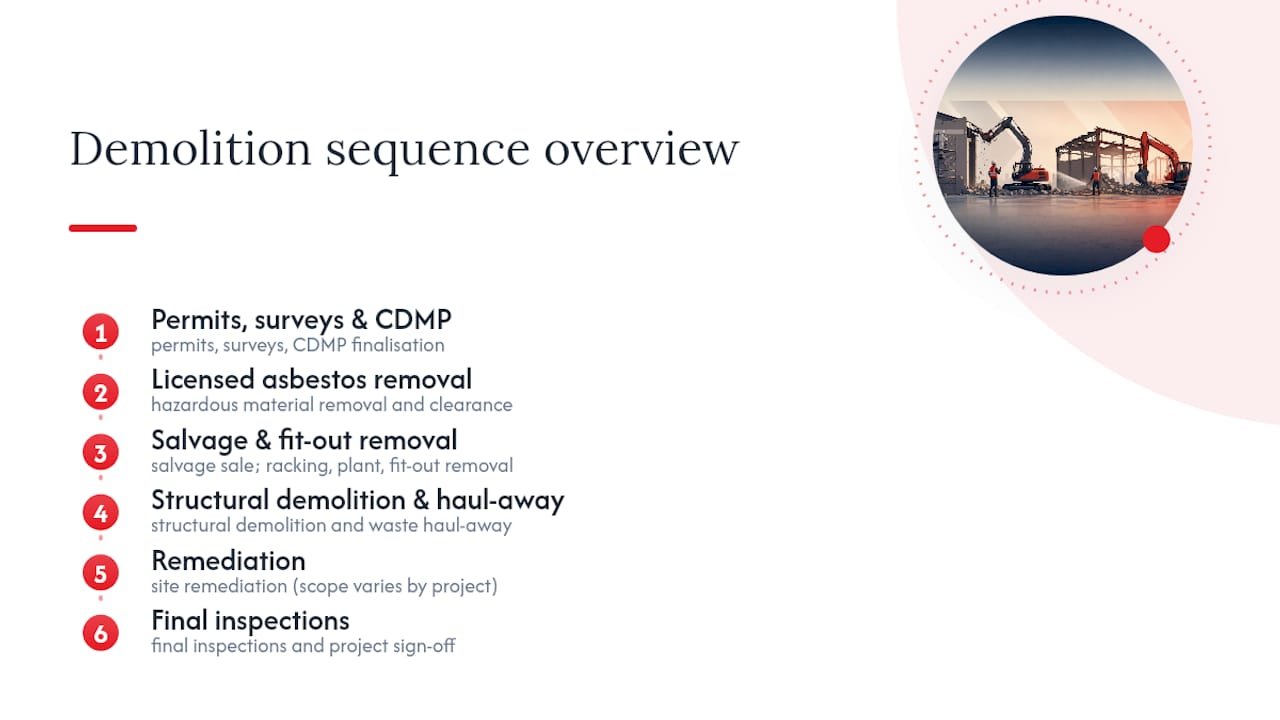
A realistic sequence for a mid-sized industrial site includes steps such as permits, surveys and CDMP finalisation, licensed asbestos removal and clearance, salvage sale and removal of racking, plant and fit-out, structural demolition and waste haul-away, and site remediation and final inspections, each requiring variable amounts of time depending on the project scope.
Large decommissioning jobs generate thousands of structural and racking components, and how well that salvage gets sold materially shifts both timing and the final invoice. Hazardous material removal, plant hire duration, remediation scope and salvage income are the four levers that move the budget most. Get the asbestos scope wrong and every other number in the plan moves with it.
Waste, salvage and your environmental obligations
Segregating waste on site, rather than mixing it into general skips, is what makes recycling and salvage economically viable. Set up separate streams for steel, timber, concrete, cabling and general waste from day one.
Pallet racking, structural steel and working plant equipment often have genuine resale value, and coordinating buyers before demolition starts means less gets crushed and landfilled for no reason. Legally, waste carriers need to be licensed, and disposal has to be tracked through docket records that councils or auditors can request later.
- Segregate steel, timber, concrete and general waste at the source
- Line up salvage buyers for racking and plant before teardown begins
- Use only licensed carriers and keep every disposal docket
- Control dust with water suppression and noise with staged working hours
Environmental controls matter beyond compliance. Warehouse demolition has to manage environmental impact and community disruption as a core part of the plan, not an afterthought bolted on once neighbours complain. Reviewing demolition waste removal options before work starts gives you a clearer read on what’s recoverable versus what’s genuinely rubbish.
What credentials should a demolition contractor have?
Before signing anything, ask to see a demolition licence appropriate to the project scale, a licensed asbestos removal certification if hazardous material is present, and current public liability insurance. None of these are negotiable extras.
A compliant Safe Work Method Statement (SWMS) should name the specific hazards on your site, not just generic industry risks, and it should tie directly into the CDMP you’ve already lodged with council. Practical safety measures worth asking about include PPE protocols, exclusion zones and daily briefings, which separate contractors who talk safety from those who practise it.
- Ask to see the actual SWMS for your site, not a template from another job
- Confirm asbestos licensing status directly with the regulator, not just the contractor’s word
- Request references from a similarly scaled warehouse project
- Check public liability cover extends to the specific work being quoted
Pro Tip: A contractor who can’t produce a project-specific SWMS within a day of inspecting your site is one you should walk away from. Generic paperwork on a warehouse job usually means generic attention to the hazards inside it.
Reviewing a checklist for choosing a licensed demolition company before you shortlist quotes weeds out the operators who look fine on price but thin on documentation. It’s also worth reading up on worksite safety regulations if you’re new to managing a demolition program directly.
What does handover actually require?
Closing out a warehouse demolition means more paperwork than most owners expect. You need a final asbestos clearance certificate confirming the site is free of residual fibres, plus structural sign-off if any adjoining walls or foundations were affected.
Where contamination was identified earlier, soil testing needs to confirm remediation worked before the site is handed back or sold. Final cleaning and dated photo documentation protect you if a dispute arises later about site condition at handover.
- Collect the final asbestos clearance certificate and file it permanently
- Obtain structural engineer sign-off on any retained elements
- Complete soil retesting if contamination remediation occurred
- Photograph the cleared site and archive all permit and disposal paperwork
The most common handover pitfall is treating verbal confirmation from a contractor as good enough. Insist on the physical certificate before releasing final payment.
How a specialist contractor runs this program end to end
A documented workflow, coordinating assessment, salvage, removal and handover under one program, is what keeps a warehouse demolition on schedule. Licensed asbestos removal gets folded into the same sequence as structural works rather than treated as a separate job with its own delays.
For owners working against a lease deadline, the practical move is to prioritise salvage buyer coordination and contractor scheduling earlier than seems necessary, sometimes accepting a lower salvage price to guarantee removal happens on time. Missiondemolition applies this same logic across residential, commercial and industrial jobs: line up the compliance documents first, then let the physical works follow a sequence that’s already been cleared with council and certifiers, rather than improvised on site.
Planning for emergencies during demolition
Every warehouse demolition plan needs a contingency section, not as a formality but because industrial sites throw up surprises even after a thorough survey. Unexpected asbestos discovered mid-demolition, a structural collapse risk that wasn’t visible in the original survey, or a fire from cutting works near stored materials are the scenarios worth planning for specifically, not generically.
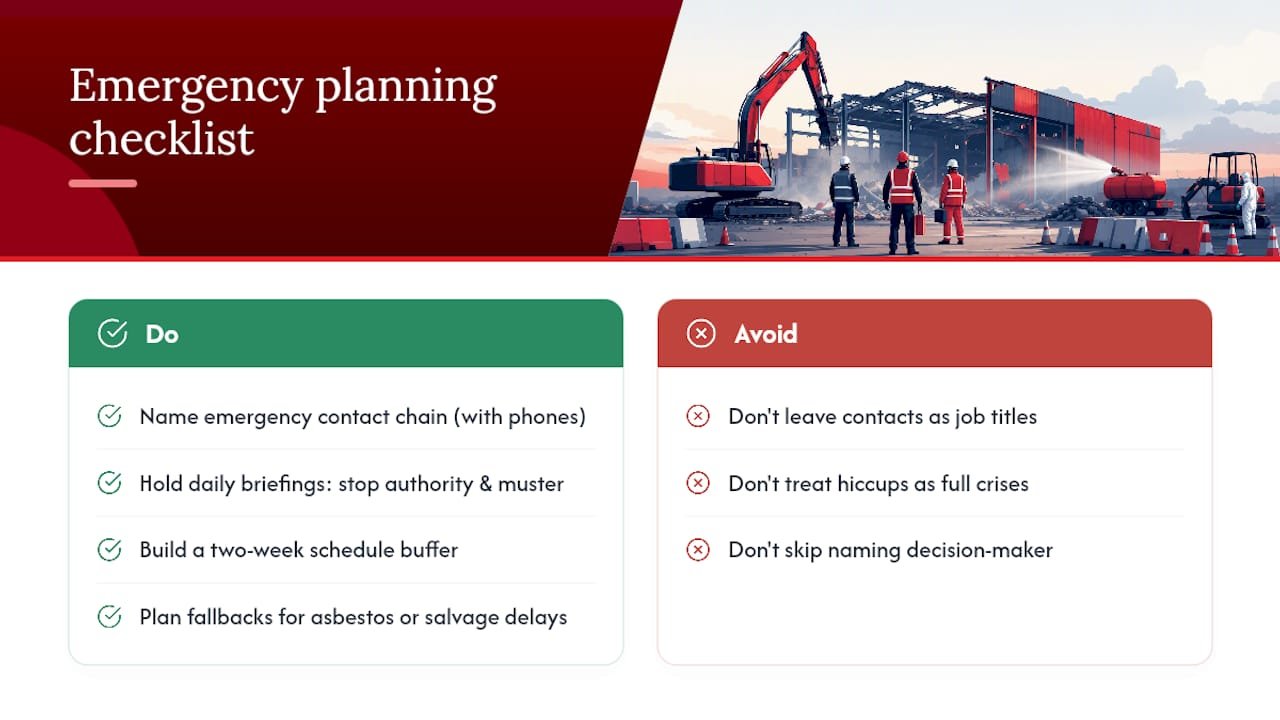
Your CDMP and SWMS should name an emergency contact chain: site supervisor, structural engineer, and the licensed asbestos assessor, with phone numbers listed, not just job titles. Daily briefings should cover what to do if work needs to stop immediately, who has authority to call it, and where the nearest muster point sits.
Contingency planning also covers the practical disruptions. What happens if a scheduled asbestos removal takes longer than quoted because more material turns up than the survey identified? What’s the fallback if a salvage buyer pulls out a week before pickup, leaving racking sitting on site past the agreed clearance date? Building a two-week buffer into your overall timeline absorbs most of these without blowing the whole schedule.
Weather delays, utility disconnection hiccups and access disputes with neighbouring properties round out the list of things that derail otherwise well-planned jobs. None of these are exotic risks. They’re the ordinary friction of industrial sites, and a plan that names them upfront, with a clear decision-maker and a defined response, recovers faster than one that treats every hiccup as a crisis requiring a fresh meeting.
Why most demolition plans fail before the first excavator arrives
The conventional advice on warehouse demolition treats permits, testing and contractor selection as sequential boxes to tick. That’s backwards. The projects that run smoothly are the ones where asbestos testing, structural survey and CDMP drafting happen in parallel, because each one informs the others and running them one after another burns weeks for no good reason.
What’s genuinely overrated is chasing the cheapest demolition quote before the hazard assessment is complete. A quote without a confirmed asbestos scope is a guess, and guesses on hazardous material removal are where budgets blow out hardest. What’s underrated is salvage coordination timing. Owners who line up buyers for racking and steel before, not after, teardown starts consistently recover more value and keep contractors moving instead of waiting on a stalled sale.
If there’s one priority to fix first, it’s this: treat the CDMP, SWMS and asbestos clearance as the actual project, not the paperwork around it. The demolition itself is often the easy part once those three documents are locked in and everyone holding them has signed off.
— Tarek
Ready to plan your warehouse demolition properly?
A specialist contractor can handle the whole sequence under one program: project management, licensed asbestos removal, structural demolition and waste handling, so you’re not chasing separate contractors for each stage of a warehouse teardown.
That matters most on industrial sites where a missed clearance certificate or an unlicensed waste carrier can hold up handover by weeks. Coordinating the permit documentation, hazard testing and demolition works as one managed process, with licensed asbestos removal built into the schedule rather than bolted on as an afterthought, reduces delays. If you’re weighing up a warehouse teardown against a lease deadline or redevelopment date, request an on-site assessment and quote and get a realistic timeline before you commit to a date with council or a buyer.
Where to check the official rules and templates
- City of Perth’s CDMP guidance for what councils expect in a management plan.
- Warehouse decommissioning process guide for asset inventory and timeline planning.
- Demolition safety protocols overview for practical SWMS content.
Sources
- Construction and Demolition Management Plans – City of Perth
- Comprehensive guide to warehouse decommissioning process – Conesco
- Large warehouse decommissioning: what to expect – Conesco
- What happens during a warehouse teardown and reconfiguration – ECSECO
