
Class A permits removal of any amount of friable asbestos and non-friable material, while Class B is restricted to non-friable, bonded asbestos. Small bonded jobs under 10 square metres can often be done without a licence, though SafeWork NSW and Safe Work Australia both flag exceptions by state. If you are at all unsure what you are looking at, stop work and call a licensed removalist such as our team at Mission Demolition before you touch anything.
TL;DR:
- Class A operators need two removal courses and a certified safety system; Class B holders need three recent jobs documented and an available supervisor.
- The exemption varies by jurisdiction: the ACT requires a licence for any asbestos removal, while insurers and councils may require licensed contractors and independent clearance.
- Class A clearance must come from an independent licensed assessor; for Class B work, a competent person or assessor may qualify, depending on the job and jurisdiction.
- Before work starts, check the licence and class on the state register, confirm the named supervisor, and request the removal plan, insurance, and required notification.
Table of Contents
- Friable versus non-friable: what the terms mean and common on-site examples
- Licence scope: exactly what Class A and Class B licences allow
- The unlicensed threshold and jurisdictional exceptions
- On-site controls, air monitoring and the clearance process
- Verifying licences, the documents to request and notification duties
- Environmental disposal protocols specific to Class A and Class B asbestos removal
- Health and safety risks associated with improper handling of Class A and Class B asbestos
- Overview of the asbestos removal process stages distinctive to each licence class
- Differences in PPE requirements for Class A vs Class B tasks
- Typical scenarios or examples when Class A or Class B licence is required
- Practitioner perspective: why conservative decisions protect property and people
- How Mission Demolition helps with licensed removal and clearance coordination
- FAQ
- Sources
Friable versus non-friable: what the terms mean and common on-site examples
Friable asbestos is material that can be crumbled, pulverised or reduced to powder by hand pressure when dry. That matters because crumbly material sheds fibres into the air far more readily than material that holds its shape, and airborne fibres are what cause harm when inhaled.
On older Australian properties, friable material commonly turns up as pipe lagging, sprayed-on fire protection or loose insulation packed into ceiling cavities. Non-friable, or bonded, asbestos is mixed into a solid matrix such as cement sheeting, vinyl floor tiles or corrugated roofing, and it generally stays stable unless it is disturbed. We explain the practical differences between these bonded materials in our guide to bonded asbestos.
The trouble starts when bonded material gets cut, drilled, sanded or broken. Those actions can convert a stable cement sheet into airborne dust that behaves like friable asbestos, which is exactly why so many home renovation jobs turn into contamination incidents.
- Friable examples: pipe lagging, sprayed insulation, loose-fill ceiling insulation.
- Non-friable examples: asbestos cement sheeting, vinyl floor tiles, corrugated roofing.
- Conversion risk: cutting, grinding or demolition work can turn bonded material into airborne dust.
Pro Tip: Treat any suspected bonded material as if it could become friable the moment you disturb it, and plan containment before you start, not after dust appears.
Licence scope: exactly what Class A and Class B licences allow
The two licence classes are not interchangeable, and the gap between them is wider than most property owners expect.
A Class A licence covers any amount of friable asbestos, any quantity of asbestos-contaminated dust, and non-friable asbestos-containing material as well. Holding this licence means meeting a much higher regulatory bar: SafeWork NSW requires Class A operators to complete both the two-day non-friable and two-day friable removal courses, plus hold a certified safety management system compliant with ISO 45001:2018, certified by a JAS-ANZ accredited body.
A Class B licence is limited to non-friable, bonded asbestos and its associated dust. SafeWork NSW requires Class B holders to complete the non-friable removal course, show evidence of at least three Class B jobs over the previous 12 months, and name a supervisor who is readily available on request.
- Class A: any amount of friable asbestos, any contaminated dust, plus non-friable material.
- Class B: non-friable asbestos and related dust only, with no authority to touch friable material.
- Class A holders may legally perform Class B work; Class B holders cannot step up into Class A jobs.
One licence class carries noticeably heavier compliance requirements than the other: Class A operators must maintain a certified safety management system under ISO 45001:2018, a standard Class B licensing does not demand.
The unlicensed threshold and jurisdictional exceptions
Across much of Australia, removing up to 10 square metres of non-friable asbestos is treated as unlicensed work, something a competent property owner or trades contractor can carry out without holding a removal licence, provided they follow safe handling practice. In practical terms, 10 square metres is roughly the size of a small bathroom’s wall sheeting or a single garage wall panel, not an entire roof.
That threshold is not universal. The ACT requires a licence for any amount of asbestos removal, with no unlicensed exemption at all, and other jurisdictions carry their own variations on notification and permit requirements. SafeWork NSW confirms the ≤10 m² unlicensed allowance applies in NSW, excluding the ACT’s stricter rule, so checking your own state regulator before assuming the exemption applies is worth the five minutes it takes.
Even where the law technically allows unlicensed removal, insurers, local councils and head contractors frequently insist on a licensed removalist and an independent clearance inspection regardless of job size. A small bonded job that goes wrong, through poor bagging, uncontained dust or improper disposal, can void insurance cover or trigger a council enforcement notice.
- Unlicensed threshold: up to 10 square metres of non-friable material in most states and territories.
- ACT exception: any quantity of asbestos removal requires a licence, with no unlicensed allowance.
- Practical reality: insurers and councils often require licensed removal even under the threshold.
For state-specific detail, our NSW asbestos removal regulations guide covers the current notification and licensing rules in more depth.
On-site controls, air monitoring and the clearance process
Class A and Class B jobs look very different once work actually starts, because the controls scale with how easily the material releases fibres.
- Class A sites require rigorous controls, including air (control) monitoring, and may involve enclosure, negative pressure units and decontamination facilities.
- Class B sites use containment and decontamination practices too. Air monitoring may be used as needed.
- Both classes end with a clearance step before the area can be reoccupied, though who issues that clearance differs by job type and jurisdiction.
The Model Code of Practice: How to safely remove asbestos sets out duties under the WHS Regulations and describes the more rigorous controls required for Class A work.
An independent clearance certificate is the document confirming air or visual inspection results show it is safe to reoccupy a space. For Class A work this must come from a licensed assessor independent of the removal contractor. For Class B work, a competent person or assessor can issue it depending on the job and state, though many property managers still engage an independent assessor for objectivity. We explain clearance certificates in our asbestos clearance certificate guide.
Pro Tip: Never accept a clearance certificate from the same crew that did the removal work when the job is Class A; it has to come from an independent assessor to count.
Verifying licences, the documents to request and notification duties
Before any asbestos work starts on your property, a short checklist protects you from both health risk and legal exposure.
- Check the removalist’s licence number and class against the relevant state SafeWork register before work begins.
- Confirm the nominated supervisor named on the licence is the person actually attending site, and that they are readily available as required.
- Request the asbestos removal control plan (ARCP) for the specific job and copies of current insurance.
- Ask who will issue the clearance certificate, and insist on an independent assessor for anything beyond a small bonded job.
- Confirm the removalist has lodged the required notification with the state regulator before work starts.
SafeWork NSW maintains a public register so you can verify a Class A or Class B licence before signing anything. Notification requirements vary by state; check the applicable rules with your regulator and see our notification guide. Skipping notification or using an unlicensed operator for work that needed a licence can lead to enforcement action, stop-work orders and, in the worst cases, contamination that costs far more to fix than the original job.
Environmental disposal protocols specific to Class A and Class B asbestos removal
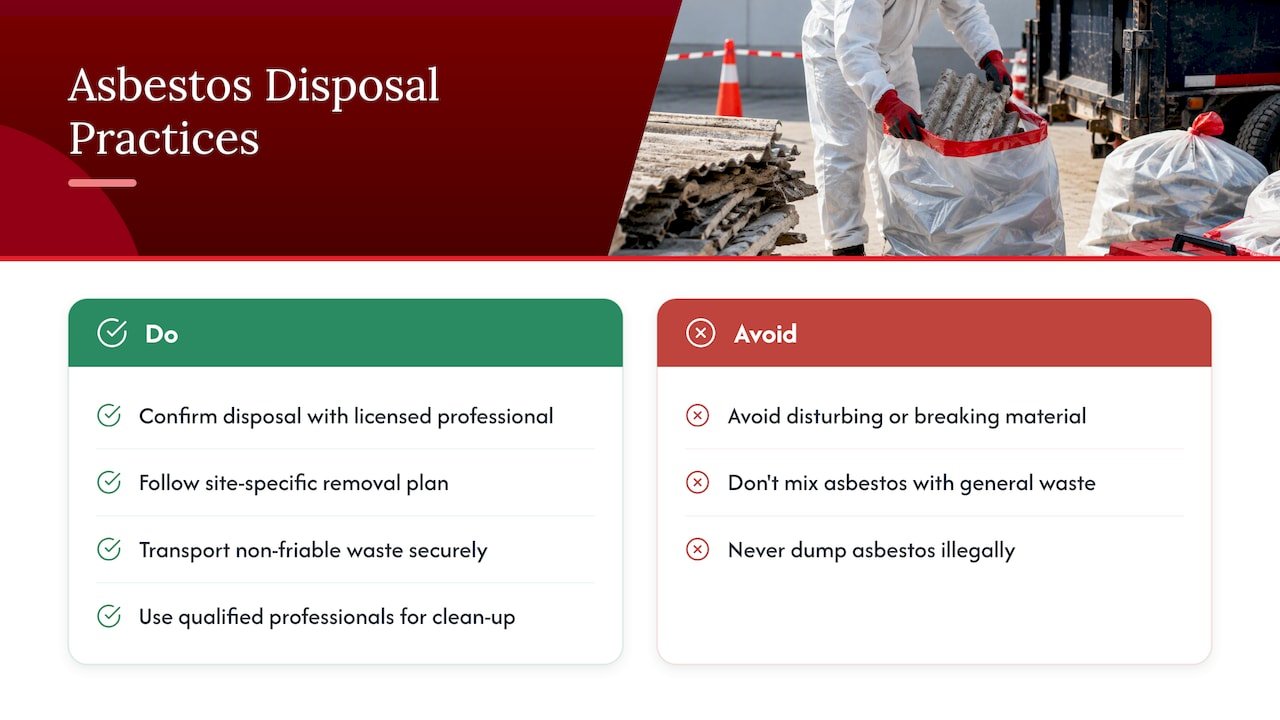
Disposal rules apply regardless of licence class, but the handling steps differ with how friable the material is. Asbestos waste must be handled and disposed of in accordance with the applicable state or territory requirements. Use a licensed professional to confirm the proper disposal process.
Friable waste from Class A jobs demands careful control at every stage. Follow the site-specific removal plan and applicable requirements to prevent dust and exposure. Non-friable waste from Class B jobs also requires careful handling and secure transport. Avoid disturbing or breaking the material.
Site clean-up after asbestos work should be carried out by qualified professionals using methods that avoid spreading dust. Services like the compliant site cleaning covered by Sweep & Scrub’s construction site requirements are a useful complement to a removal job, particularly on larger commercial sites where dust control after demolition matters as much as during it. Getting rid of the resulting waste streams, from wrapped asbestos through to general demolition debris, often involves coordinating multiple collections; firms such as Onyx Removals’ large rubbish removal service handle the non-hazardous waste side so the asbestos stream stays properly segregated from general site rubbish.
Getting disposal wrong, through illegal dumping or mixing asbestos waste with general skip loads, carries heavy penalties under state environmental protection law and leaves property owners exposed if the waste is later traced back to the job.
Health and safety risks associated with improper handling of Class A and Class B asbestos
Asbestos exposure is a serious health concern, particularly when material is disturbed and fibres may become airborne. Avoid disturbing suspected asbestos and seek professional advice. Breathing in asbestos fibres is linked to serious long-term lung conditions. Avoid exposure and have suspected asbestos handled by qualified professionals.
Improper handling of friable material can create a serious exposure risk. Use qualified professionals and appropriate controls to prevent contamination. Improper handling of bonded material during a Class B or unlicensed job also carries risk. Cutting cement sheeting can release fibres, so do not disturb suspected asbestos.
Beyond the health risk, improper handling creates secondary risks that catch property owners out: cross-contamination of air conditioning systems, carpets and furnishings that then require their own separate decontamination, and the legal exposure that comes from unknowingly exposing tenants, workers or visitors to asbestos dust. This is why stopping work the moment you suspect asbestos, rather than finishing the job and testing later, is the only sensible approach.
Overview of the asbestos removal process stages distinctive to each licence class
A Class A job generally runs through more stages than a Class B job, reflecting the higher risk profile of friable material.
Planning starts the same way for both: an asbestos assessor identifies and samples suspect material, with testing done at a NATA-accredited laboratory, as outlined in guidance on planning asbestos removal work. From there, a licensed removalist prepares a site-specific asbestos removal control plan before any physical work begins.
Class A work may involve enclosure, air monitoring, controlled handling of friable material and decontamination. A licensed asbestos assessor performs clearance inspections for Class A work. For Class B work, the process includes controls for the work area, careful removal and disposal, and a clearance inspection by a competent person or assessor depending on the job and jurisdiction.
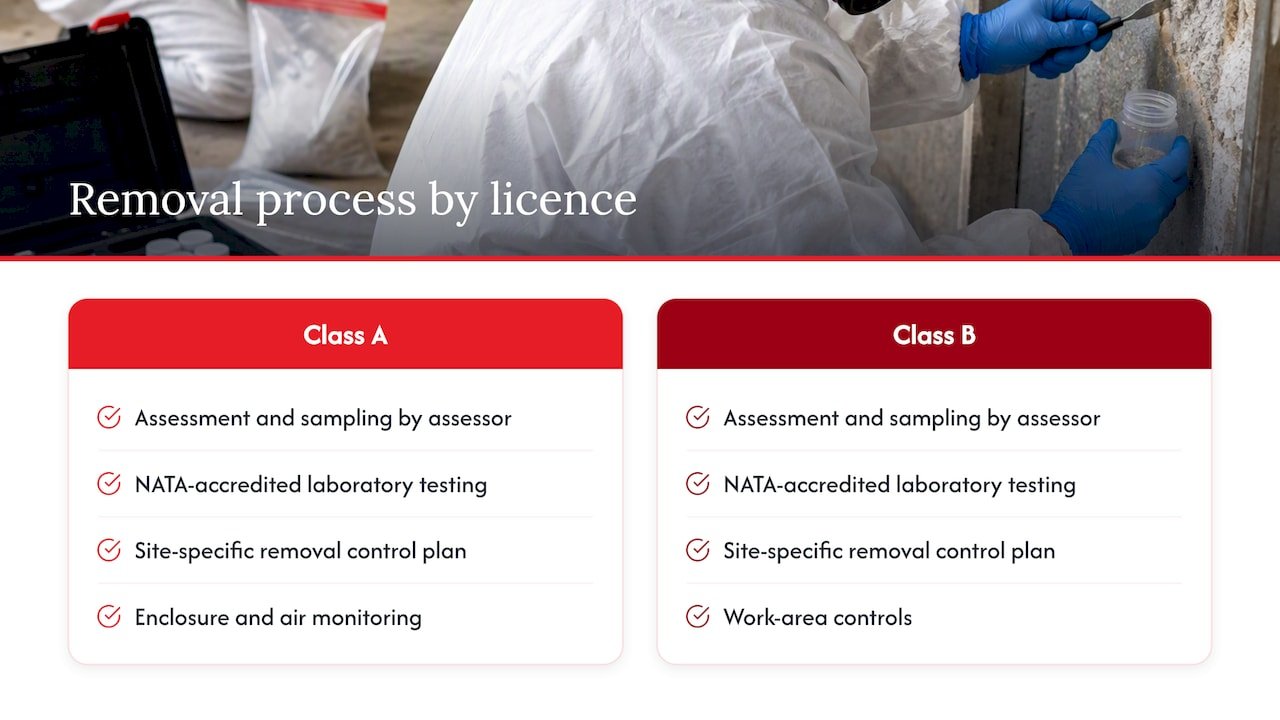
Licensed removalists must prepare a site-specific asbestos removal control plan. Whether clearance is required depends on the job and applicable requirements.
Differences in PPE requirements for Class A vs Class B tasks
Personal protective equipment scales with how readily the material releases fibres, so Class A and Class B crews are not equipped the same way.
Class A removal workers need appropriate PPE and decontamination procedures, as set out in the site-specific plan and applicable requirements. Because friable material sheds fibres so easily, respiratory protection on Class A jobs is non-negotiable for the entire duration of the task, not just during active cutting or breaking.
Class B workers handling bonded material need appropriate respiratory protection and protective clothing. Follow the applicable requirements and site-specific plan. Gloves and eye protection apply across both classes as standard practice.
A job falling under the unlicensed threshold does not remove the need for safe handling and appropriate protective measures. The material does not know it is a small job, and a power tool cutting bonded cement sheet without a respirator produces the same fibre release whether the licence threshold applies or not.
Typical scenarios or examples when Class A or Class B licence is required
Matching a real-world scenario to the right licence class is often the part property owners get wrong.
A full ceiling removal involving friable material requires a Class A licence. Removing a small amount of non-friable asbestos may fall into the unlicensed category where local rules allow it, but requirements vary by jurisdiction.
Stripping an asbestos cement roof that exceeds the applicable unlicensed threshold requires a Class B licence. If renovation work uncovers suspected pipe lagging, stop work and contact a qualified professional. Friable asbestos requires a Class A removal licence.
A job involving both friable and non-friable asbestos requires a Class A licensed removalist, who is authorised to handle both material types.
Practitioner perspective: why conservative decisions protect property and people
Disturbing bonded material with tools can release asbestos fibres, so avoid cutting or breaking suspected asbestos. We know that disturbing bonded material with tools can release asbestos fibres.
DIY attempts on a small bonded job can create added risks and costs, including possible insurance disputes and further assessment. Our standing advice is simple: stop work the moment you are unsure what you are looking at, get it tested, and bring in a licensed removalist and an independent assessor rather than guessing.
— Tarek
How Mission Demolition helps with licensed removal and clearance coordination
We provide licensed asbestos removal, inspection and testing. We work with site-specific removal control plans and coordinate with independent assessors.
If you have found suspect material or need a job scoped properly before work starts, request an inspection through our asbestos inspection and testing page or get a quote via our asbestos removal services.
This article is general information, not a substitute for advice from a qualified doctor. Consult a qualified healthcare professional about your own circumstances before acting on anything here.
FAQ
What are the rules on asbestos in Australia?
Asbestos removal work is regulated under state WHS laws and the Model Code of Practice, which set licensing, training and control requirements for Class A and Class B removal. The rules cover who can remove which materials, what controls apply on site, and when an independent clearance certificate is required before reoccupation.
Is asbestos still used in Australia?
Asbestos found in buildings may be legacy material. Check official Australian guidance for information about the ban and its scope. It may be present in older homes and commercial buildings.
Will 30 minutes of asbestos exposure hurt you?
Any suspected asbestos exposure should be taken seriously. Leave the area, avoid disturbing the material and seek professional advice about what to do next. If you suspect exposure, leave the area, avoid further disturbance and seek professional advice promptly.
What is brown asbestos?
Brown asbestos, known as amosite, is one of the asbestos fibre types found in building products such as insulation and cement sheeting in older Australian buildings. Like other asbestos types, it requires the matching licence class (Class A if friable, Class B if non-friable and over the unlicensed threshold) for legal removal.
Sources
- Working as a licensed asbestos removalist | SafeWork NSW
- Model Code of Practice: How to safely remove asbestos
- Find a licensed asbestos removalist | Asbestos
