Most asbestos roofs in Australia are one of four things: corrugated asbestos cement sheeting (usually Super Six), asbestos cement slates or shingles, flat or profiled cement sheets used on carports and sheds, or bituminous membrane under or on the roof. Any of them can sit on a building from before 1990, and you cannot confirm which you have by eye. Only a NATA-accredited laboratory can confirm it. This guide shows what each type looks like, where the hidden parts are, and when the work needs a licensed removalist.
TL;DR
- Asbestos was banned nationally on 31 December 2003, but products installed before then can legally stay in place. Treat any roof on a building from before 1990 as suspect.
- The main roof types are corrugated cement sheeting (Super Six), cement slates and shingles, bituminous membrane, and the less obvious ridge capping, flashing, gutters and eaves.
- Intact, sealed or painted bonded asbestos is a low risk. Breaking, drilling, sawing, sweeping or pressure washing it is what releases fibres.
- You cannot identify asbestos by looking. A sample tested by a NATA-accredited lab is the only confirmation.
- Removing more than 10 square metres of non-friable asbestos needs a licensed Class B removalist.
Table of Contents
- Why the type of roof matters
- The main asbestos roof types in Australia
- The three fibre types inside
- How to tell if your roof might contain asbestos
- Condition, not just presence
- Who is allowed to remove an asbestos roof
- What we see on site
- Getting the roof assessed and removed
- Before you hire anyone
- FAQ
- Sources
Why the type of roof matters
Asbestos roofing is not one product. Different manufacturers made different profiles over several decades, and each behaves differently as it ages. A sound 1960s sheet roof that has been painted is a different job from a brittle shingle roof with moss and cracked corners, or a hail-damaged carport.
Knowing the type helps you do three things: judge how urgent the situation is, brief a tester or removalist accurately, and avoid the common mistakes, such as cleaning gutters full of debris that is itself contaminated.
The asbestos in these roofs is mostly bonded, also called non-friable. The Asbestos Product Guide classes common roofing products this way: fibres are locked into a cement matrix, so the material is far less hazardous when left alone than when it is broken or abraded.
The main asbestos roof types in Australia
Corrugated asbestos cement sheeting (Super Six)
This is the roof most people picture. Moulded cement sheets with parallel ridges, used on houses, units, factories, garages and farm buildings. The national product guide notes the sheets may be painted, and some were factory-coloured red or brown.
Super Six is the best-known profile. It is distinguished by deep 50 mm corrugations, and the same organisation notes it was also made in a shallower “Standard” profile. Look-alikes exist: modern fibre cement and metal sheets can resemble old ones from the street, which is another reason to test rather than guess.
Things to look for:
- A matte, slightly chalky surface, often with lichen or moss in the troughs
- Sheets that feel rigid and heavy compared with metal
- Cracked corners, lifted edges or broken sheets around fixings
- Fixing points where sheets overlap and rub
Asbestos cement slates and shingles
These are moulded cement tiles used as roofing, on gable ends and as exterior cladding. The product guide describes them as around 4 mm thick. Later shingles were often made as larger sheets patterned to look like several tiles, so a roof that looks like individual slates may be panels.
Because they are thin and cover a lot of small fixings, they crack easily when walked on. Cracked and weathered shingles are where problems tend to start, and they are the type most often found when a homeowner is asked to deal with them for a re-roof. Our guide on asbestos roof tiles and the paperwork Australian homeowners need covers the steps in detail.
Flat and profiled cement sheets on outbuildings
Garages, carports, sheds and lean-tos from the same era often use flat or lightly profiled cement sheets for roofs and walls. They are easy to overlook because they are not the main house. They are also the sheets most likely to be broken during a casual clean-up or a demolition, so check them before any work. See also our note on asbestos in garages and why not to disturb it before NATA testing.
Bituminous membrane
Bituminous membrane is a thin, flexible black sheeting used for waterproofing or dampening sound. NSW Government guidance says it contains bitumen with added asbestos and lists commercial and industrial buildings as common locations. It can sit under other roof coverings, on flat roofs or in parapets, so it is easily missed. Felt-like black layers beneath old tiles or sheets deserve a test.
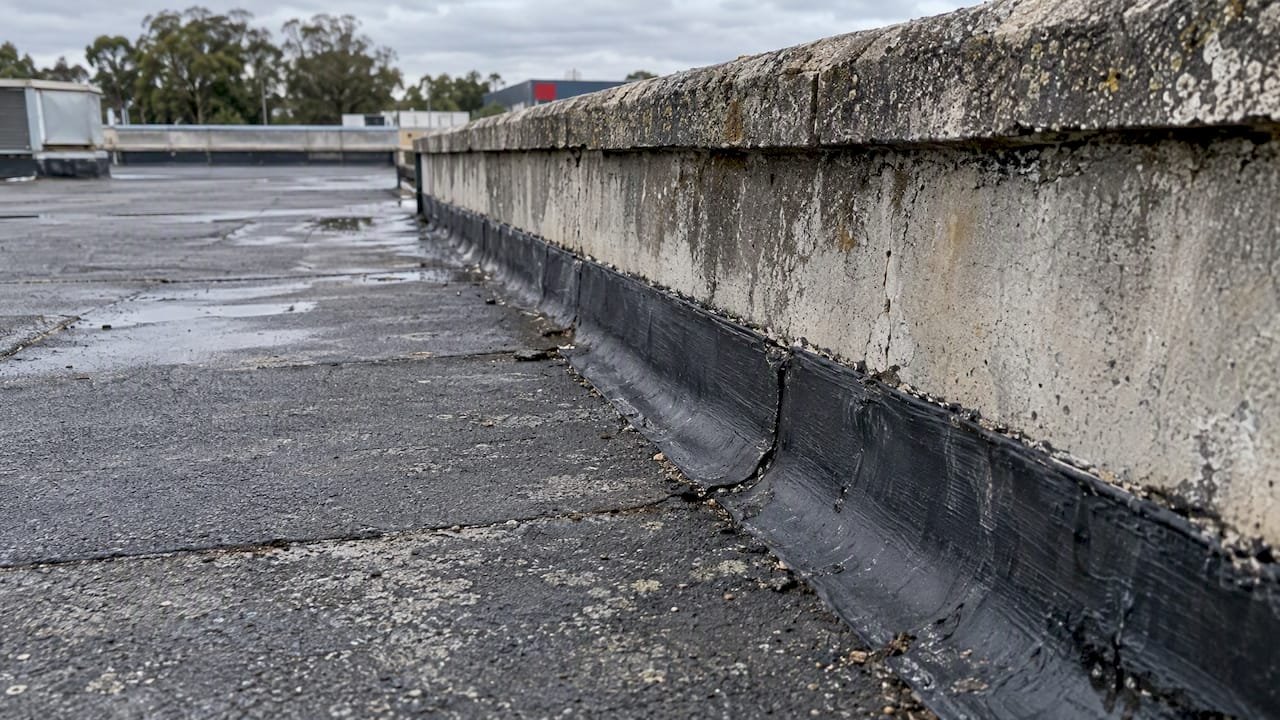
The hidden parts of a roof
The visible sheets are not the whole roof. Asbestos cement was also used for:
- Ridge capping and flashings
- Gutters and downpipes
- Eaves and soffit lining
- Bituminous waterproofing layers
In the ceiling space, the NSW Government notes loose-fill insulation is usually white to grey, is loose and friable, and can be found over roofing beams and in wall cavities. That is a different category of risk from bonded sheeting, and it needs specialist handling.
The three fibre types inside
Most roofing was made with chrysotile (white asbestos). The Asbestos Product Guide notes that some products, especially older or high-strength materials, may contain amosite (brown) or crocidolite (blue). Colour of the sheet tells you nothing about the fibre. A lab report identifies the fibre type, and all types are hazardous when released.
| Roof element | Typical look | Usual risk if intact | Main trigger for fibre release |
|---|---|---|---|
| Corrugated sheeting (Super Six) | Matte, deep ridges, often painted | Low | Cracking, drilling, pressure washing |
| Slates and shingles | Thin tiles or tile-pattern panels | Low | Walking on them, breakage, weathering |
| Flat cement sheets (outbuildings) | Flat or shallow profile | Low | Smashing, cutting, demolition |
| Bituminous membrane | Black, felt-like layer | Low to moderate, depends on condition | Tearing, lifting, heat work |
| Loose-fill insulation | White to grey, fluffy | High (friable) | Any disturbance |
How to tell if your roof might contain asbestos
Start with age. Safe Work Australia says buildings built or renovated before 1990 should be suspected of containing asbestos. The Queensland Government states that since 31 December 2003 it is illegal to import, supply, install or re-use asbestos products, but the ban does not apply to material previously installed.
Then look at the roof from the ground, without climbing on it:
- Note the material and profile. Corrugated cement, tile-pattern panels, or sheets on outbuildings are all flags.
- Check the age of the house, and of any additions. A 1970s house with a 1995 extension may have two different roofs.
- Look at the eaves, gutters and ridge. They often match the main sheeting.
- Check the condition: cracks, broken edges, heavy weathering, moss.
- Find paperwork: building approvals, previous inspection reports, a hazardous materials survey if the property was bought for development.
The NSW Government is clear that you cannot confirm asbestos by looking. A sample tested by a NATA-accredited laboratory is the only confirmation. Do not break off a piece yourself. A licensed assessor or testing service takes the sample safely. Our asbestos inspection and testing service does this, and our explainer on asbestos testing methods shows what the lab report will tell you.
Condition, not just presence
The Queensland Government’s guidance makes a point that gets lost: undamaged bonded asbestos that is sealed or painted does not pose a significant health risk, because fibres stay trapped. The hazard rises when material is damaged, weathered or worked on with tools.
That means an asbestos roof in good condition can often be managed in place: documented, labelled, inspected regularly and left alone. A roof that is cracked, crumbling or about to be re-roofed is a different matter.
The gutter problem
Corrugated sheets expand and contract with temperature. Over decades the sheets rub, and the Asbestos Product Guide notes this can grind fine asbestos-containing dust that collects in gutters and downpipes. If you live under an older cement roof, treat gutter debris as potentially contaminated. Do not scoop it out with your hands or blast it with a hose.
After storms and hail
High winds, heavy rain, fire and flooding can damage and displace asbestos material and can make it friable or carry it to unexpected places. After a hailstorm on an older roof, keep people away from broken pieces, do not sweep or vacuum them, and call a licensed removalist or assessor. If you are also dealing with an insurance claim, a guide on how hail affects different roof surfaces helps you understand what damage to document before work begins. Take photos from a distance, and do not handle the debris.
Who is allowed to remove an asbestos roof
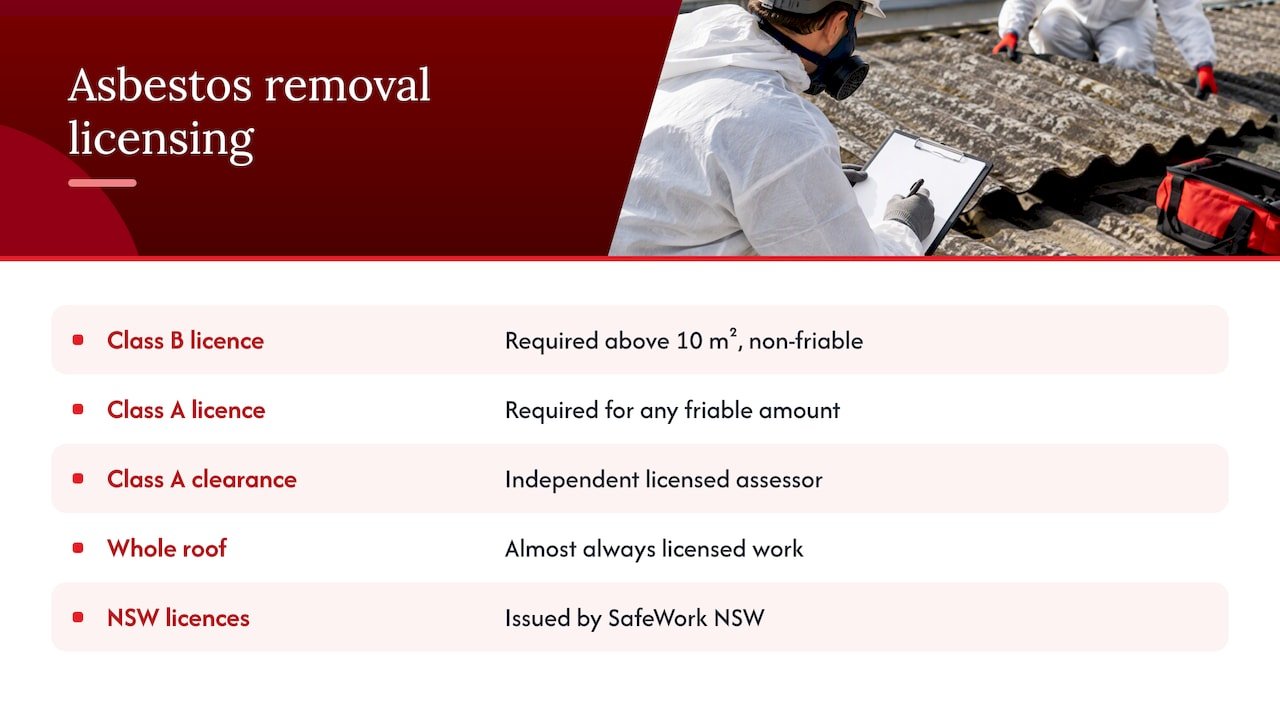
Licensing is set under state and territory work health and safety laws, so check the rules for your state. The model code of practice published by Safe Work Australia sets the national pattern: removal of more than 10 square metres of non-friable asbestos needs a licensed Class B removalist, and Class A is required for any amount of friable asbestos. Independent licensed assessors handle air monitoring and clearance for Class A work. In NSW, SafeWork NSW issues the licences. Our explainer on Class A and Class B asbestos, ARCP and clearance goes through the difference.
Most house roofs are well over 10 square metres, so a whole-roof job is almost always licensed work. Even where a homeowner may legally remove a small amount, the NSW Government notes that power tools and sweeping can make bonded material friable. Brittle, aged sheets break easily.
What we see on site
We handle demolition and asbestos removal for homeowners, builders and developers, and the roof is where many jobs start. This is our view, in our own words.
The type of roof is rarely the surprise. The surprise is what sits around it: ridge capping on a roof that was replaced years ago, a black membrane under a tin overlay, a fibro carport at the back that nobody counted, or eaves that were never tested. A quote based only on the main roof tends to grow once the rest is found.
Our advice is to test everything before pricing anything. Get samples of each material taken by a competent person and sent to a NATA-accredited lab. Then plan the removal, the waste disposal and the demolition or re-roof together, so that the licensed work happens once and the site is cleaned and cleared before the next trade arrives. If the building is coming down anyway, asbestos removal comes first, and demolition follows.
We would also say that leaving a sound, painted roof alone for now is a legitimate choice. We would rather you make a documented decision than rush into removal or, worse, a DIY job that spreads fibres through your yard.
— Tarek
Getting the roof assessed and removed
If you have a cement roof from before 1990 that is cracked, or you plan to re-roof, extend, or demolish, we can arrange asbestos inspection and testing, licensed removal, disposal, and demolition under one project. See our asbestos roof removal and disposal services, or read how roof asbestos removal works in Sydney. To discuss your property, start from our main page and send the roof details and photos taken from a safe distance.
Before you hire anyone
Whoever you choose, ask for:
- The removal licence class and number, and confirmation it is current
- Proof of insurance
- A written scope covering ridge, gutters, flashing and any membrane, not only the main sheets
- How waste will be wrapped, transported and disposed of at a facility that accepts it
- Whether an independent assessor will provide a clearance certificate where one is required
FAQ
What does an asbestos roof look like?
Often a corrugated, matte grey cement roof with deep ridges, or a roof of thin tile-pattern panels. It may be painted, and some sheets were coloured red or brown. Looks alone cannot confirm it, so have a sample tested by a NATA-accredited laboratory.
Which three types of asbestos were used in Australian roofs?
Chrysotile (white), amosite (brown) and crocidolite (blue). Most roofing used chrysotile, but some older or high-strength products contained the others. A lab report names the fibre, and all types are hazardous when released.
Is an asbestos roof dangerous if I leave it alone?
Sealed or painted bonded asbestos in good condition is a low risk because the fibres are trapped. Risk rises when it is cracked, weathered, drilled, cut or cleaned with high pressure. Keep an eye on its condition and ask a licensed assessor if you are unsure.
Can I remove an asbestos roof myself?
Some jurisdictions allow homeowners to remove up to 10 square metres of non-friable asbestos, but most roofs are larger and the work is risky. Above 10 square metres you need a licensed Class B removalist. Check your state regulator’s rules before touching anything.
Sources
- Safe Work Australia: Asbestos
- Safe Work Australia: Model code of practice, how to safely remove asbestos
- Asbestos Product Guide: Corrugated asbestos cement sheeting roofs
- Asbestos Product Guide: Asbestos cement slate and shingles
- Bernie Banton Foundation: Asbestos cement corrugated roof, wall and fence sheeting
- NSW Government: Bituminous membrane and asbestos
- NSW Government: Loose fill asbestos insulation
- NSW Government: Planning checklist for DIYers
- NSW Government: Managing asbestos in emergencies and disasters
- Queensland Government: What is asbestos
- Queensland Government: FAQ for homeowners
- Sydney Safety Training: Asbestos removal licences in NSW

One Response