
In Australia there is no single “asbestos roof removal permit” that a homeowner applies for. Compliance runs through a chain instead: a licensed removalist, a notification to the state work health and safety regulator, council or certifier paperwork where demolition or building work is involved, and proof the waste reached a facility licensed to take it. This guide explains who handles each link, what you should ask to see, and where homeowners get caught out. The detail leans on NSW, and rules differ by state, so check yours.
TL;DR
- No standalone permit exists for removing an asbestos roof. The safeguards are a licence held by the contractor, a notification to the regulator and lawful disposal.
- In NSW, a Class B licence is needed to remove more than 10 m² of bonded (non-friable) asbestos, and a roof is almost always well over that.
- The notification to the regulator is the contractor’s job. You cannot lodge it yourself as a private individual.
- If the roof comes off as part of a demolition or complying development, your certifier will want a signed contract with a licensed removalist and a landfill receipt.
- You stay responsible for the waste after you pay. Keep the receipt from the licensed landfill.
Table of Contents
- Why people search for a permit and what they actually need
- Which licence the work needs
- Notification: the closest thing to a permit
- When council or a certifier gets involved
- Waste: where most of the legal risk sits
- The paperwork to ask for, in order
- Perspective: what we see on site
- Common mistakes that cost homeowners money
- How we can help
- How to plan the job, step by step
- FAQ
- Sources
Why people search for a permit and what they actually need
Most homeowners expect a form, a fee and an approval stamp. That is how a lot of building work feels. Asbestos works differently. The regulatory emphasis in NSW falls on using a licensed contractor, because that contractor carries the legal duty to manage the work safely, notify the regulator and get the waste to a licensed landfill.
That is why a Google search for a permit tends to return a mix of licence pages, notification forms and planning documents. They are all pieces of the same answer. Here is how they fit together for a typical roof.
| Requirement | Who is responsible | What you should see |
|---|---|---|
| Asbestos removal licence (Class A or B) | Contractor | Licence number and class, which you can check with the regulator |
| Notification to the regulator | Contractor | A copy or confirmation of the notification |
| Council or certifier approval, where relevant | Owner, with contractor input | Approval or consent, plus the waste documents the certifier asks for |
| Safe removal and site controls | Contractor | A written work plan and control measures |
| Lawful disposal | Contractor delivers, owner remains liable | Receipt from a licensed landfill |
| Clearance inspection, where required | Independent assessor | Clearance certificate |
Which licence the work needs
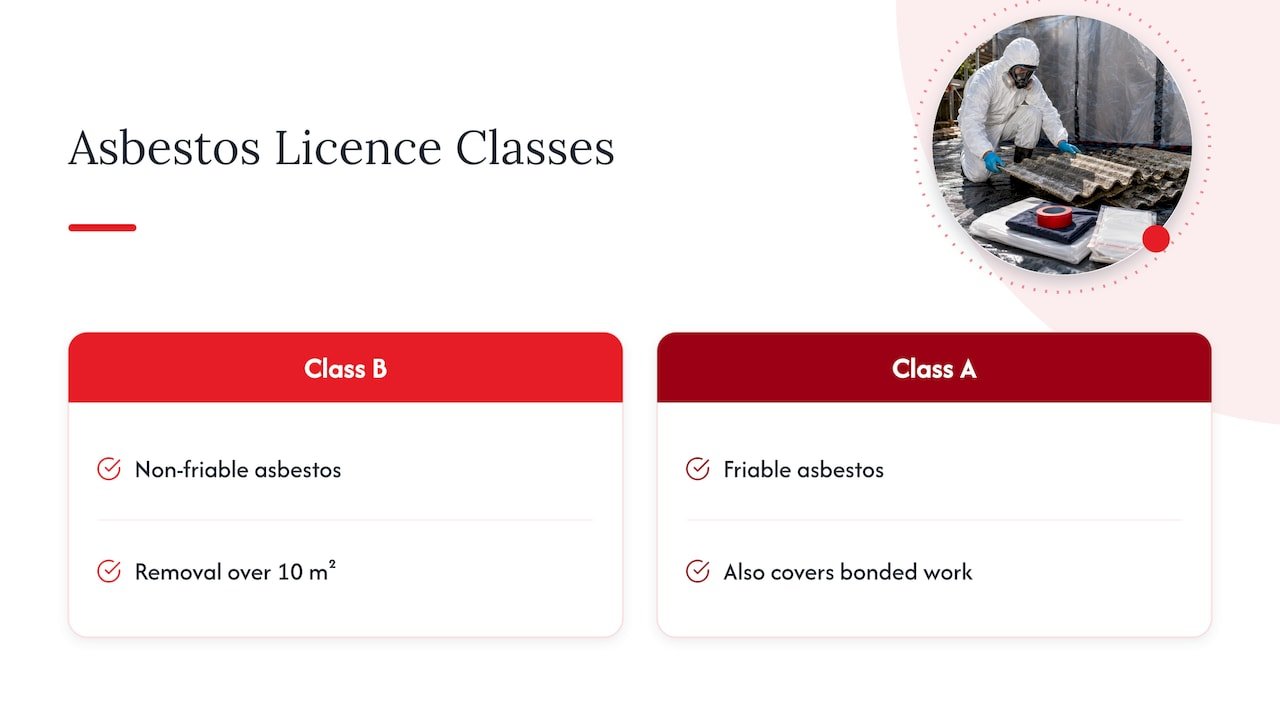
Asbestos cement roofing, the corrugated sheeting common on houses, garages and sheds, is generally bonded (non-friable). In NSW, SafeWork says you need a Class B licence to remove more than 10 m² of non-friable asbestos. A Class A licence covers friable asbestos, such as sprayed insulation or crumbling lagging, and a Class A licence also covers bonded work.
A standard house roof runs well beyond 10 m², so in practice the job goes to a licensed removalist. Even where a small area falls under the threshold, SafeWork NSW recommends only licensed people do asbestos work. Weathered roof sheets can be brittle. Walking on them, drilling them or pressure washing them is what releases fibres. The Asbestos Safety and Eradication Agency explains that the aim is to identify asbestos so it is not disturbed until a licensed professional can remove it safely.
If you are not sure what your roof is made of, our guide to asbestos roof types in Australia shows how the common profiles differ. A visual guess is not a test, though. Sampling by an accredited laboratory is the only way to confirm. Our asbestos inspection and testing service covers that first step.
Notification: the closest thing to a permit
What homeowners think of as a permit is usually the regulator notification. A licensed removalist must tell the state regulator before most asbestos removal begins. The national Model Code of Practice on safely removing asbestos sets out the framework that states adopt. In NSW the standard lead time for most work is five business days, which we cover in our page on SafeWork asbestos notification and the five days’ notice.
Two points matter for you:
- It is the contractor’s filing. The licence is the condition of lodging it. A private individual cannot file it on their own behalf.
- Timeframes vary by state and by type of work. WorkSafe Victoria runs its own online asbestos removal notification and requires a licence to use it. Its form sets different timeframes depending on the type of work, so a Victorian job should not assume the NSW lead time.
Practical effect: book early. A roof job cannot start the day you sign, because the notice period has to run first. Ask your contractor for the planned start date and the notification confirmation.
When council or a certifier gets involved
A roof replacement on its own is mainly a work health and safety matter. It becomes a planning matter when the roof comes off as part of a demolition, an alteration or an addition. In NSW, the planning rules for exempt and complying development contain specific asbestos requirements. The Department of Planning circular on asbestos material says that for complying development involving asbestos, the certifier needs a signed contract with a licensed asbestos removalist and a receipt from a landfill operator showing the material was lawfully accepted.
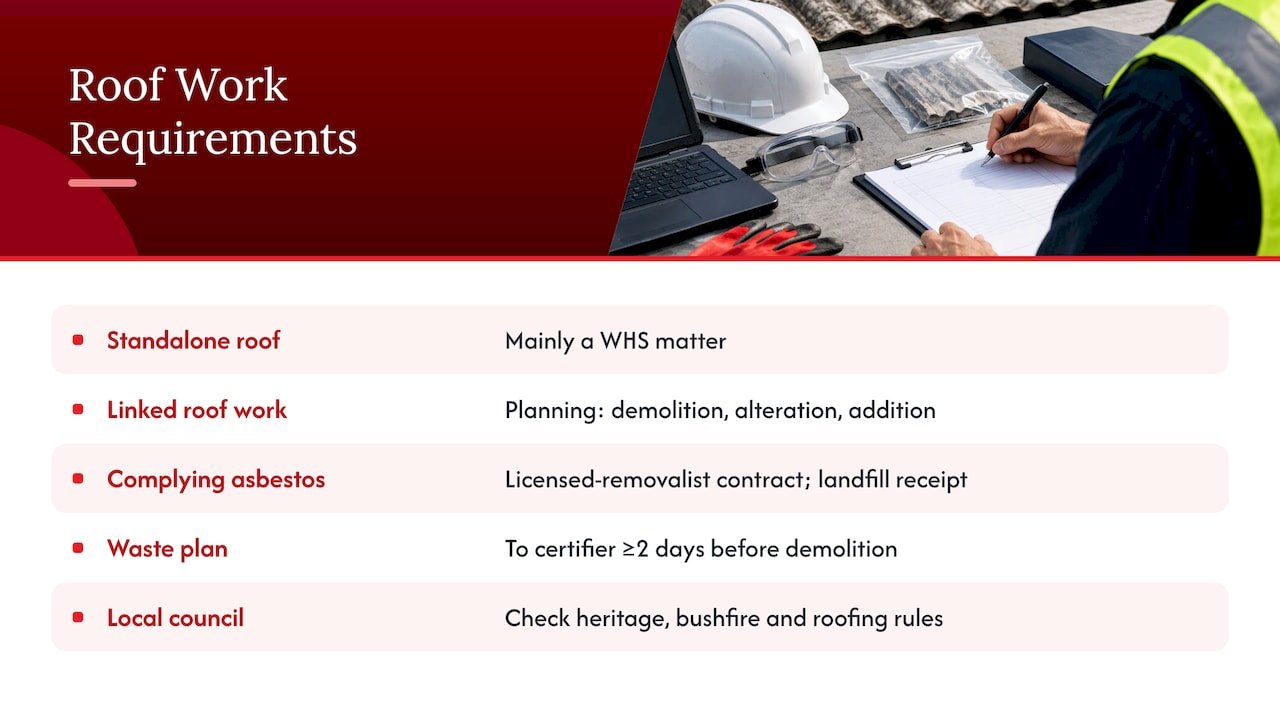
The demolition rules add another timing trap. The NSW guide to demolition of buildings under exempt and complying development requires a waste management plan to reach the principal certifier at least two days before demolition starts. Missing that is a common reason a site gets stopped. If your roof sits on a house you are knocking down, our demolition permits guide for Sydney walks through the approvals side.
Councils also differ on what they require for heritage areas, bushfire zones and replacement roofing. Call your local council before you fix a start date.
Waste: where most of the legal risk sits
Asbestos cement sheets must not go into a skip, a kerbside bin or general demolition waste. The NSW EPA states that dumping asbestos in general waste is illegal, with fines for individuals of up to $7,500 and court penalties up to $1,000,000. The same page announces a two-year trial of free household collection and disposal, supported by $9 million, starting next year. It is a trial for householders, so ask whether a given job would qualify before you assume it does. Outside it, disposal costs fall to the owner.
The EPA also makes the liability point plainly in its household asbestos guidance: you remain responsible for asbestos waste you generate, even if you pay someone else to take it away. That is why the final document matters.
What good disposal looks like:
- Wrapped and labelled on site. Sheets are wetted, kept intact where possible and sealed in heavy-duty plastic, then labelled as asbestos waste.
- A pre-booked licensed facility. Landfills are tightly regulated and many want advance notice, so turning up unannounced can mean being turned away.
- A receipt in your name or the job’s name. In NSW landfills must generally cover asbestos waste with virgin excavated natural material, unless the EPA has approved an alternative. This is why the facility is specific about packaging.
NSW also treats waste as hazardous by default in some situations. We explain how that plays out in our page on hazardous waste disposal rules in NSW.
The paperwork to ask for, in order
The documents are your protection if a neighbour complains, a buyer’s solicitor asks questions or a regulator checks. Ask for them as a matter of course:
- The contractor’s licence class and number, checked against the regulator’s records.
- Evidence of insurance.
- The written scope: what area is being removed, how the site is isolated, what happens to nearby surfaces and gutters.
- Confirmation the regulator has been notified, and the date work may begin.
- Any certifier or council correspondence if the roof is part of a larger project.
- A landfill receipt showing the weight and the date of acceptance.
- A clearance certificate from an independent assessor if one is required for your job type.
Keep these in the same folder as your building records. A conveyancer can tell you which records buyers will expect, and checking property documents with a conveyancer is especially worthwhile in a strata or townhouse setting where the roof may be common property and approvals involve the owners corporation.
Perspective: what we see on site
The single most common misunderstanding we meet is the belief that someone else holds the permit. Homeowners assume the council has it, the roofer assumes the homeowner has it, and nobody has lodged the notification or booked the landfill. Then the start date slips, the quote changes and the household is stuck with a damaged roof and a hole in the schedule.
We treat it as a project with a critical path. The sequence is confirm the material, plan the work, notify, remove, dispose, document. Approvals, utility disconnections, hazardous waste handling and the final clean all sit on that path, and any of them can hold up the others. Our view is that you should never be left to chase the paperwork yourself, and that the landfill receipt is the document that closes the job.
We also advise against owner-builder removal on a full roof. The area is large, the sheets can be fragile and the real risks, such as a hidden section of friable material in the roof space, are the ones an untrained person is least likely to recognise.
— Tarek
Common mistakes that cost homeowners money
Treating a cheap quote as a sign of savings. If a quote makes no mention of notification, disposal or clearance, ask why. Unlicensed work can leave you with the liability.
Cleaning or repairing first. Pressure washing a cement roof, or screwing new fixings into old sheets, damages the surface and spreads debris. Leave it alone until it is tested or removed.
Skipping the test before a renovation. If solar panels, a new deck or an extension is planned, the roof may need testing before anyone starts. Our overview of asbestos in roof tiles and homeowner paperwork covers triage.
Ignoring fines. Penalties for improper handling are real. We summarise the NSW position in our asbestos fines checklist, and our full NSW asbestos removal regulations guide covers the rest.
Forgetting the sale. Federal rules do not require every vendor to declare asbestos, but NSW has specific disclosure rules for loose-fill asbestos insulation. Roof sheeting is a different material, though a buyer’s inspection will often flag it. Records of lawful removal make that conversation easier.
How we can help
Mission Demolition handles licensed asbestos roof removal, disposal and the surrounding project management, including approvals, utility disconnections, hazardous waste handling and final site cleaning. If your roof is part of a larger demolition, we can coordinate both. See our asbestos roof removal and disposal services or our guide to roof asbestos removal in Sydney, or contact us through our website to discuss the job. If the roof is on a garage, see asbestos garage removal.
How to plan the job, step by step
- Confirm the material. Have a sample tested by an accredited laboratory. Do not break or drill the roof to take it.
- Check your approvals. Ask your council or certifier if the roof is part of a demolition, addition or complying development.
- Get written quotes from licensed removalists. Compare scope and inclusions, not only the number.
- Allow for notification time. Your contractor files, then the notice period runs.
- Prepare the site. Keep pets, children and neighbours’ washing away. Close windows and vents near the work.
- Remove and dispose. Your contractor wraps, labels and delivers to a licensed facility.
- Collect the paperwork. Landfill receipt, clearance certificate where relevant and any certifier sign-off.
- Replace the roof. Book the new roofing only after the area is cleared.
FAQ
Do I need a permit to remove an asbestos roof in Australia?
There is no single permit. A licensed removalist must hold the right licence and notify the state regulator, and a council or certifier may need documents if the roof is part of a demolition or build. Check with your council and your state regulator.
Can I remove my own asbestos roof?
Some states allow homeowners to remove a small area of bonded asbestos without a licence. In NSW that limit is 10 m², and a whole roof almost always exceeds it. We recommend using a licensed removalist for any roof.
How much does it cost to dispose of asbestos?
Cost depends on the facility, the weight and how the waste is packaged. In NSW, a two-year household collection trial is planned, but outside it disposal costs are the owner’s. Ask your removalist to list disposal as a separate line in the quote.
What happens if I find asbestos?
Leave it alone if it is in good condition and not being disturbed. Do not drill, sand or wash it. Arrange testing and ask a licensed removalist for advice before any renovation.
Sources
- SafeWork NSW: asbestos
- SafeWork NSW: working as a licensed asbestos removalist
- Asbestos Safety and Eradication Agency: what is asbestos and why is it dangerous
- Safe Work Australia: Model Code of Practice, how to safely remove asbestos
- WorkSafe Victoria: asbestos removal notification
- NSW Planning circular PS 21-036: asbestos material
- NSW Planning: demolition of buildings, exempt and complying development
- NSW EPA: making it free to dispose of household asbestos waste
- NSW EPA: dealing with household asbestos
- NSW EPA: asbestos waste
- NSW Government: loose-fill asbestos insulation laws
