Last Updated: November 1, 2026
Quick Summary
Demolition project management is the coordination of scope, approvals, safety, sequencing and documentation from first site assessment to final handover. Demolition project management services in Sydney aim to keep a job compliant and on schedule, with the planning phase usually deciding whether a project runs smoothly or stalls.
- A commercial demolition timeline runs in five stages, with each milestone signed off before the next begins.
- Service disconnection and approvals typically take 2 to 6 weeks and often sit on the critical path.
- A commercial demolition quote should itemise scope, exclusions, waste disposal, approvals support and provisional sums.
- Payment should follow signed-off milestones rather than calendar dates, with retention released on a stated date.
- Book a scope review before finalising the scope, as it usually finds disconnection, asbestos or access issues early.
Table of Contents
- What Demolition Project Management Services in Sydney Actually Cover
- The Commercial Demolition Project Timeline From Award to Handover
- Stage 1: Contract award and documentation (typically 1-2 weeks)
- Stage 2: Service disconnection and approvals (typically 2-6 weeks, the critical path)
- Stage 3: Soft strip-out (typically 1-3 weeks depending on floor area)
- Stage 4: Structural demolition (typically 1-4 weeks)
- Stage 5: Site clearance and handover (typically 1-2 weeks)
- How a project manager protects the programme
- What Drives Commercial Strip-Out Cost and How Budgets Stay Under Control
- What a Commercial Demolition Quote Should Itemise
- An Office Strip-Out Checklist for Property Managers
- Residential, Commercial and Industrial Demolition: How the Management Differs
- Safety Management, Risk Registers and Stakeholder Communication
- Booking a Demolition Scope Review With Mission Demolition
- Frequently Asked Questions
What Demolition Project Management Services in Sydney Actually Cover
Demolition project management is the coordination of scope, approvals, safety, sequencing and documentation from first site assessment to final handover. Demolition project management services in Sydney aim to keep a job compliant and on schedule. The planning phase usually decides whether a project runs smoothly or stalls.
Demolition scope, site assessment and work sequencing
Every job begins with a scope document stating exactly what comes down, what stays, and how the structure will be brought down safely. A site assessment then checks access, neighbouring structures, services and ground conditions. Work sequencing follows: which elements are removed first, where waste is stockpiled, and how the site is kept secure overnight.
Permits, approvals and utility disconnection
Approvals are where inexperienced owners lose weeks. Before demolition can proceed, services must be formally disconnected and documented, and the relevant consents obtained. NSW owners’ checklist of exact documents to secure before demolition covers the BYDA referral, ASP job sheet, DNSP lodgement reference and CCEW.
The Commercial Demolition Project Timeline From Award to Handover
A commercial demolition project timeline runs in five stages: contract award and documentation, service disconnection and approvals, soft strip-out, structural demolition, and site clearance with handover. Each stage has a milestone signed off before the next begins. What separates a managed programme from a hopeful one is the dependency map between stages, because most elapsed time sits in the handoffs rather than the demolition itself.
Stage 1: Contract award and documentation (typically 1-2 weeks)
The milestone here is a signed contract with an agreed scope, programme, variation process and payment schedule. A document register is typically assembled at award, covering scope drawings, hazardous material assessment, service search plans, site access plan and safety management plan.
Stage 2: Service disconnection and approvals (typically 2-6 weeks, the critical path)
This stage often decides the programme, because utility disconnection and approvals usually run in sequence and can take weeks to complete before demolition can start.
Stage 3: Soft strip-out (typically 1-3 weeks depending on floor area)
The milestone is a stripped shell with hazardous material removed and documented. Soft strip-out typically involves removing ceilings and services and dealing with any hazardous material found on site.
Stage 4: Structural demolition (typically 1-4 weeks)
The milestone is the structure brought down to slab or ground level with the method statement signed off. Sequencing follows the engineer’s or competent person’s method: which elements are removed first, how the structure is propped or progressively demolished, and where plant can safely stand. Access constraints, adjoining structures and heritage facades shape the sequence and therefore the duration.
Stage 5: Site clearance and handover (typically 1-2 weeks)
The milestone is a cleared, swept site with a documentation pack: waste disposal records, hazardous material clearance, disconnection certificates, and photographic evidence of condition. Handover is a document event as much as a physical one.
How a project manager protects the programme
Delay usually comes from two places: late service disconnection and undiscovered hazardous material. Build both into the programme as held time rather than assuming a clean run. Projects often hold contingency time against the disconnection stage and a provisional sum against hazardous material.
On many commercial jobs the critical path runs through the service disconnection stage. Where a programme is at risk, common levers include bringing the hazardous material assessment forward, splitting strip-out into zones, and agreeing after-hours or weekend access with building management. SafeWork NSW guidance on construction and demolition work sets the safety expectations that shape how each stage is sequenced, and any compression of the programme has to stay inside those controls.
A demolition programme is a chain of signed-off milestones, and the longest link is almost always service disconnection. Manage that link first and the rest of the timeline behaves.
What Drives Commercial Strip-Out Cost and How Budgets Stay Under Control
Commercial strip-out cost is driven by five things: floor area, how much can be salvaged, ceiling and services complexity, access constraints, and waste volume. A tight CBD loading dock or a heritage facade adds labour hours a suburban warehouse never sees.
Budget control comes from a detailed scope and a clear variation process. Our commercial internal strip out pricing guide breaks down what drives each cost line, which is the fastest way to sanity-check a quote before you sign.
Hazardous materials, asbestos removal and environmental controls
Asbestos is a cost line that can significantly affect a budget. Buildings constructed or renovated before the national ban may require assessment before strip-out begins, and removal must be carried out under the appropriate licence. Asbestos removal cost factors and project estimates explains the pricing factors to budget for this cost line.
What a Commercial Demolition Quote Should Itemise
A commercial demolition quote should itemise scope, exclusions, waste disposal, approvals support, provisional sums for hazardous material, and the variation process. If a quote is one line and a total, ask for the breakdown before comparing it to anything. The breakdown lets you see which cost lines are fixed, which are estimates, and which are yours to control.
The cost lines that should appear separately
A quote that can be compared line by line will usually separate:
Get a Free Demolition And Asbestos Removal Quote →
- Preliminaries, site establishment, fencing, signage, supervision, amenities, insurance and the project management fee itself.
- Approvals and documentation support, who prepares and lodges what, and whether the fee covers council correspondence, utility liaison and the documentation pack.
- Hazardous material, a provisional sum for asbestos and other hazardous material, with the assessment basis stated (for example, priced on the known register versus an allowance pending assessment).
- Soft strip-out, labour and plant by floor area, with salvage handling and separation stated.
- Structural demolition, method, plant and duration, with any propping or temporary works called out.
- Waste and disposal, volume estimated, destination named, and whether recycling credits or disposal levies are passed through at cost.
- Site clearance and handover, sweeping, make-good of access routes, and the documentation pack.
Provisional sums, contingencies and who carries the risk
Provisional sums for asbestos and unexpected services are normal; a quote with none usually means the risk has been moved to you. The question is not whether a provisional sum exists but how it is measured and who signs off the spend.
The cheapest quote is often the one with the longest exclusions list. Compare exclusions before you compare totals, because an excluded item is a cost you will meet later, usually at a worse time.
Payment stages and retention
Payment should follow milestones, not calendar dates. A typical structure ties payments to the signed-off stages in the programme: award and mobilisation, completion of strip-out, completion of structural demolition, and handover of the documentation pack. Retention, if any, is held against defects or incomplete documentation and released on a stated date.
The variation process
A variation process should state who can instruct a change, how it is priced (agreed rates, day rates, or a quoted sum), how long the contractor has to price it, and how it affects the programme.
| Quote line | What to check | Why it matters |
|---|---|---|
| Scope and exclusions | Written, specific, itemised | Prevents mid-job disputes |
| Hazardous material | Provisional sum stated with basis and approval step | Covers asbestos found on site without an open-ended bill |
| Waste and disposal | Volume estimated and destination named | Confirms lawful disposal and lets you check recycling claims |
| Approvals support | Who lodges what, and what the fee covers | Avoids programme delays and double-charging |
| Payment stages | Tied to signed-off milestones | Keeps cash aligned with progress |
| Variations | Rate, process and programme effect agreed | Controls budget creep |
Our commercial internal strip out pricing guide breaks down what drives each cost line, which is the fastest way to sanity-check a quote before you sign.
A comparable quote is one where every cost line is either fixed, a named provisional sum with an approval step, or an exclusion you have chosen to accept. If you cannot tell which is which, the quote is not ready to sign.
An Office Strip-Out Checklist for Property Managers
An office strip-out checklist keeps a tenancy handover predictable. The office strip-out process from planning to handover walks through each step so you can plan the job properly. Work through it in order, and each step confirms the one before.
- Confirm lease exit date and make-good obligations in writing
- Book hazardous material assessment before any strip-out
- Arrange service disconnection and obtain documentation
- Agree lift, loading dock and after-hours access with building management
- Set waste segregation and recycling targets
- Walk the site with the contractor and sign off the scope
- Photograph existing conditions before work starts
- Confirm handover inspection and documentation pack
Residential, Commercial and Industrial Demolition: How the Management Differs
Residential demolition is fast and neighbour-sensitive, commercial demolition is programme-driven and access-constrained, and industrial demolition is dominated by services, contamination and heavy structural sequencing. The management approach changes with each.
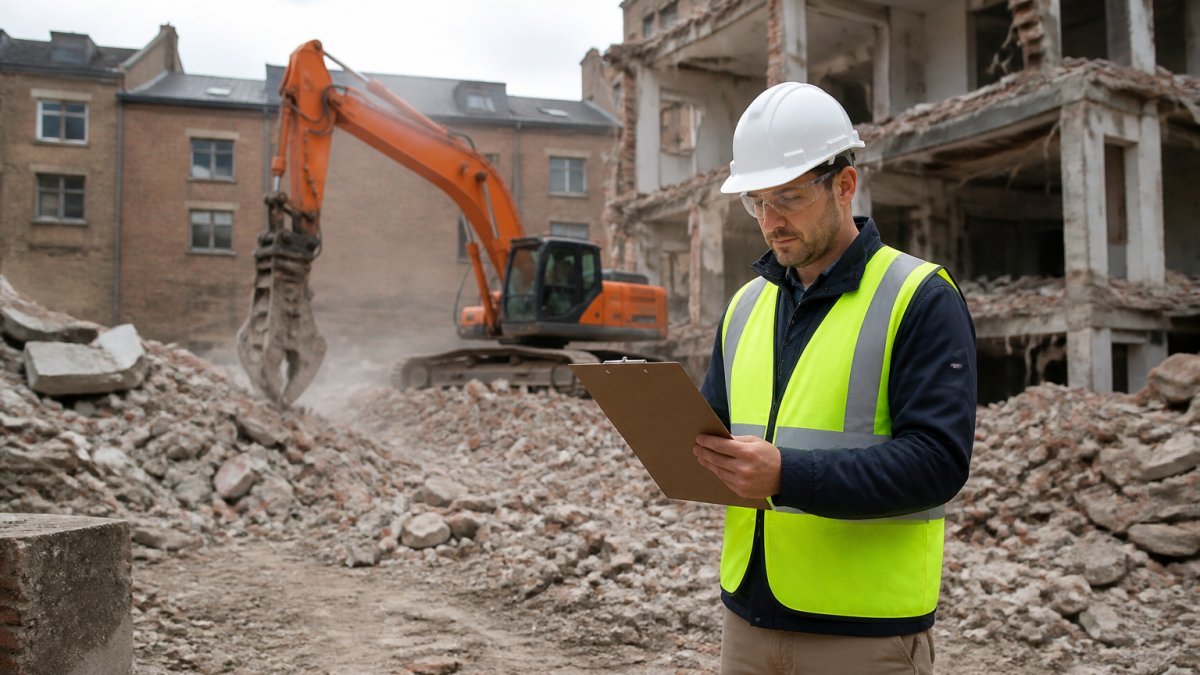
Industrial work can involve longer lead times because service isolation, environmental controls and structural sequencing often need sign-off. How industrial site demolition is managed in Sydney shows how this differs from other project types.
Site access, traffic management, dust and noise controls
Site access and traffic management plans are commonly required on urban jobs, with dust and noise controls alongside.
Safety Management, Risk Registers and Stakeholder Communication
Safety management on a demolition site rests on a written risk register, daily pre-starts, and a clear incident response path. The register should name each hazard, its control, and who owns it.
Stakeholder communication is the underrated half. Neighbours, building managers and adjoining tenants need notice before work starts and a contact during it.
Booking a Demolition Scope Review With Mission Demolition
The best time to bring in a demolition contractor is before you finalise the scope, not after.
Mission Demolition is fully licensed and insured, with asbestos licence AD213684 and demolition licence AD213693.
Get started with Mission Demolition and book a scope review before your next project locks in a date.
Frequently Asked Questions
What does demolition project management include?
It covers the full sequence: site assessment and scope definition, permits and utility disconnection, asbestos and hazardous materials handling, work sequencing, safety and environmental controls, waste tracking and recycling, and final site clearance. A demolition contractor in Sydney coordinates these stages so the build can start on schedule. Mission Demolition runs this process across residential, commercial and industrial projects, with licensing and insurance in place.
How long does a commercial strip-out take?
Duration depends on floor area, how much asbestos is present, whether the building stays occupied and how approvals are handled. A single-level office strip-out can run to a couple of weeks, while multi-storey fit-outs with hazardous materials take longer. The commercial demolition project timeline should be set as milestones in the quote, so delays are visible early rather than discovered at handover.
What affects the cost of a commercial demolition project?
Key factors include the building’s size and construction, asbestos and hazardous materials, access and traffic management, waste volumes and disposal fees, and whether works happen after hours. Commercial strip-out cost is also shaped by recycling requirements and any heritage or approval conditions. Because these vary so much, ask for a detailed quote built on a site assessment rather than a per-square-metre estimate.
What should a demolition project management quote include?
A commercial demolition quote should itemise scope, asbestos removal and clearance certification, permits and approvals, utility disconnection, waste disposal and recycling, plant and labour, site access and traffic management, and provisional sums for unexpected finds. Ask how variations are priced and who holds responsibility for hazardous materials discovered mid-job.