Hazardous waste handling in a demolition comes down to four steps in a fixed order: identify the hazardous material before work starts, remove it before the structure comes down, contain and label it, then move it to a facility that can lawfully accept it with the paperwork to prove it. The owner or developer who commissions the job carries duties at every step. Our demolition and licensed asbestos removal teams run all four steps as one project, so the approvals, utility disconnections, hazardous waste handling and final site clean sit under one contract rather than being split between trades.
TL;DR
- Hazardous materials (asbestos above all, but also lead, PCBs, fuels and contaminated dust) must be identified before demolition, using the asbestos register and a competent person’s inspection where no register exists.
- Asbestos must be removed before demolition starts, so far as reasonably practicable. In NSW, more than 10 m² of non-friable asbestos, or any friable asbestos, needs a licensed removalist.
- Waste must be contained, labelled, covered in transit and taken only to a facility licensed to accept it. In NSW, asbestos loads over 100 kg or 10 m² are tracked in WasteLocate.
- Keep the register, clearance certificate, waste dockets and landfill receipts. Certifiers, regulators and later buyers ask for them.
Table of Contents
- What hazardous material turns up in a demolition
- Step 1: identify before you touch anything
- Step 2: remove asbestos before demolition
- Step 3: contain, label and store on site
- Step 4: transport, track and dispose lawfully
- The paperwork that protects you
- Where owners and developers go wrong
- Our view: one contractor, one paper trail
- Getting a compliant job from one contractor
- FAQ
- Sources
What hazardous material turns up in a demolition
Most owners think of asbestos, and it is the most common problem in older Australian buildings. But the Safe Work Australia Model Code of Practice for demolition work lists a wider set of hazards you must plan for. These include:
- asbestos in sheeting, roofing, lagging and flooring
- hazardous chemicals in demolished material or contaminated ground, such as lead, PCBs (polychlorinated biphenyls, industrial chemicals once used in electrical equipment and sealants), contaminated dust and combustible materials
- live or buried essential services: gas, water, sewerage, telecommunications, electricity, fuel and refrigerant
The same code asks that basements, cellars, vaults and waste dumps be examined for fire and explosion risks, for decomposition from previous use, and for toxic or other hazardous chemicals. Workers must be told what is present and how it is controlled.
A house built before the mid-1980s, a former workshop, a service station site or an old factory all deserve extra attention. Commercial and industrial sites often carry chemical residues that a residential block never will.
Step 1: identify before you touch anything
Identification is where the legal duties start, and where most expensive surprises are avoided.
Start with the asbestos register. Under the model WHS Regulations (regulations 449 to 453, as published on the Federal Register of Legislation), the person managing or controlling a workplace must give the asbestos register to the demolition contractor, and the contractor must obtain it. If no register exists, a competent person must inspect the structure before work proceeds. SafeWork NSW’s demolition guidance says the same.
A competent person here means someone with the training and experience to identify asbestos and assess its condition, not a builder’s best guess. Our asbestos inspection and testing covers this step, and our explainer on why asbestos inspection before demolition matters shows what the report should contain.
Use history, labels and records. The Model Code points to safety data sheets, container labels, any former hazardous chemicals register or manifest, and government records such as the location of underground fuel tanks.
Judge the material. When planning, the code asks you to weigh:
- the age of the building
- where the asbestos sits relative to the demolition
- whether it is friable (crumbles easily and releases fibres) or non-friable (bonded in cement or similar)
- its condition and quantity
- inaccessible areas likely to hold more
- the demolition method
The earlier edition of the code notes that part of a structure may be demolished to reach asbestos in place so it can be removed safely before further work.
If you manage property, our asbestos register requirements audit is a quick way to check yours is complete.
Step 2: remove asbestos before demolition
The rule is consistent across jurisdictions: asbestos likely to be disturbed is removed before demolition begins, so far as reasonably practicable. WorkSafe Queensland cites sections 452 and 453 of the WHS Regulation and adds that a duty holder who does not remove it first must have evidence of why removal was not reasonably practicable. The ACT Demolition Work Code of Practice sets out the same sequence under its regulations 450 and 451. In Victoria, WorkSafe’s demolition compliance code treats asbestos under Part 4.4 of the OHS Regulations, separate from the general hazardous substance duties in Part 4.1, so a Victorian plan must address both.
When you need a licensed removalist
The NSW asbestos regulator sets the line this way:
| Material | Quantity | Who can remove it in NSW |
|---|---|---|
| Non-friable asbestos | Under 10 m² | Homeowner or tradesperson |
| Non-friable asbestos | Over 10 m² | Licensed Class A or Class B removalist |
| Friable asbestos | Any amount | Licensed Class A removalist |
Class A removalists can handle friable and non-friable asbestos. Class B can handle non-friable only. Queensland uses the same A and B structure, per WorkSafe Queensland. The Model Code also requires that a business commissioning asbestos removal ensure the work is done by an appropriately licensed removalist, unless the regulations say a licence is not needed.
For friable work, the removalist must seal off the work area, carry out air monitoring and issue a clearance certificate on completion. That certificate is the document you will want in your file when the site is handed to a builder or buyer.
We hold the licensing and insurance for asbestos removal, and our asbestos removal in Sydney service and our guide to the Australian process for removing asbestos before demolition show how it fits ahead of the demolition itself.
Step 3: contain, label and store on site
Once material is out, the aim is to keep it from spreading and to make it identifiable at every later stage.
- Asbestos waste is contained and labelled before it leaves the removal area. WorkSafe Queensland states this, and adds that asbestos-contaminated surface soil scraped 30 to 50 mm deep in the demolition zone must be wetted and contained in two layers of 200 micrometre polythene.
- Wrapped, sealed and wet. In Western Australia, the Controlled Waste Regulations require asbestos waste to be separated, wrapped in plastic, clearly labelled and sent only to a licensed facility, with the facility told the load contains asbestos.
- Never mix it into general rubble. The same WA guideline says a load at a recycling facility with suspect asbestos that cannot be easily removed by hand must be rejected, isolated and kept wet. Mixed skip bins are how a clean demolition load becomes a rejected, costly one.
Where other hazardous waste is involved, such as fuel, chemicals or lead-contaminated material, the same logic applies: separate it, contain it, label it, and keep it away from general waste streams. Waste is also classified under the state’s rules before it leaves, which determines where it can go. Our overview of environmentally responsible demolition waste disposal covers the wider waste picture.
Step 4: transport, track and dispose lawfully
This is where the owner’s liability often outlasts the demolition crew’s time on site. Using NSW as the example, because most of our work is in Sydney:
- Vehicle rules. Under clause 78 of the Waste Regulation 2014, as explained by the NSW EPA, any part of a vehicle carrying asbestos must be covered and leak-proof. Bonded asbestos must be securely packaged, friable asbestos kept in a sealed container and contaminated soil wetted down.
- Penalties. The same page lists a $750 fine for an individual or $1,500 for a corporation for breaching those requirements. Under section 143 of the POEO Act 1997, transporting waste to a place that cannot lawfully accept it carries penalties up to $1,000,000 for a corporation or $250,000 for an individual.
- Tracking. NSW’s asbestos waste page states that loads over 100 kilograms or 10 square metres must be tracked using WasteLocate, the EPA’s online tracking system. The C&D waste toolkit adds that on-road details are recorded via a connected device.
- Records. Transporters must keep written records of waste details and copies of waste dockets or receipts.
Rules differ by state. In the ACT, for example, City Services landfill fees from 1 July 2026 apply to asbestos packages, which must be fully wrapped and sealed, and larger loads are accepted by appointment only. Victoria applies a landfill levy to asbestos, and its 2023-24 levy was $32.75 per tonne according to the national waste reporting summary. Levies are reset by each state, so check the current schedule for your site.
The paperwork that protects you
The documents below are what regulators, certifiers and future buyers actually ask for.
| Document | Why it matters |
|---|---|
| Asbestos register or competent person’s inspection report | Shows what was known before work began |
| Licensed removalist’s licence details | Proves the work was lawful |
| Clearance certificate | Shows the area was safe after friable removal |
| Waste classification and sampling results | Determine where the waste may go |
| Waste dockets and landfill receipts | Prove it reached a lawful facility |
The NSW EPA toolkit lists sampling results, asbestos audits, SafeWork NSW notification copies, the removalist’s licence and clearance certificates as the evidence to retain. For complying development in NSW, Planning Circular PS 21-036 goes further. Where the work involves more than 10 m² of bonded asbestos or any friable asbestos, the certifier must see a signed contract with a licensed removalist that names the lawful landfill, then a landfill receipt after the work. The work must follow AS 2601-2001, the Australian Standard for the demolition of structures, which in turn requires asbestos removal to follow the Safe Work Australia code.
For demolition notification duties in NSW, see who lodges the SafeWork demolition notification and when. For the disposal paper trail, our guide on how to document asbestos disposal in Sydney walks through it.
Where owners and developers go wrong
Treating the demolition quote as the whole job. A quote that says nothing about the register, inspection, removal, waste classification and disposal evidence leaves those duties with you.
Leaving asbestos in the building to save time. The duty is to remove it first, so far as reasonably practicable. Skipping it means you need evidence of why that was not practicable, and the cost of contaminated rubble is far higher than a planned removal.
Splitting the job across several trades. When one contractor demolishes, another removes asbestos and a third carts waste, the handovers are where labelling, tracking and receipts are lost. Our guide to preparing for house demolition and stopping illegal dumping is a checklist for exactly this.
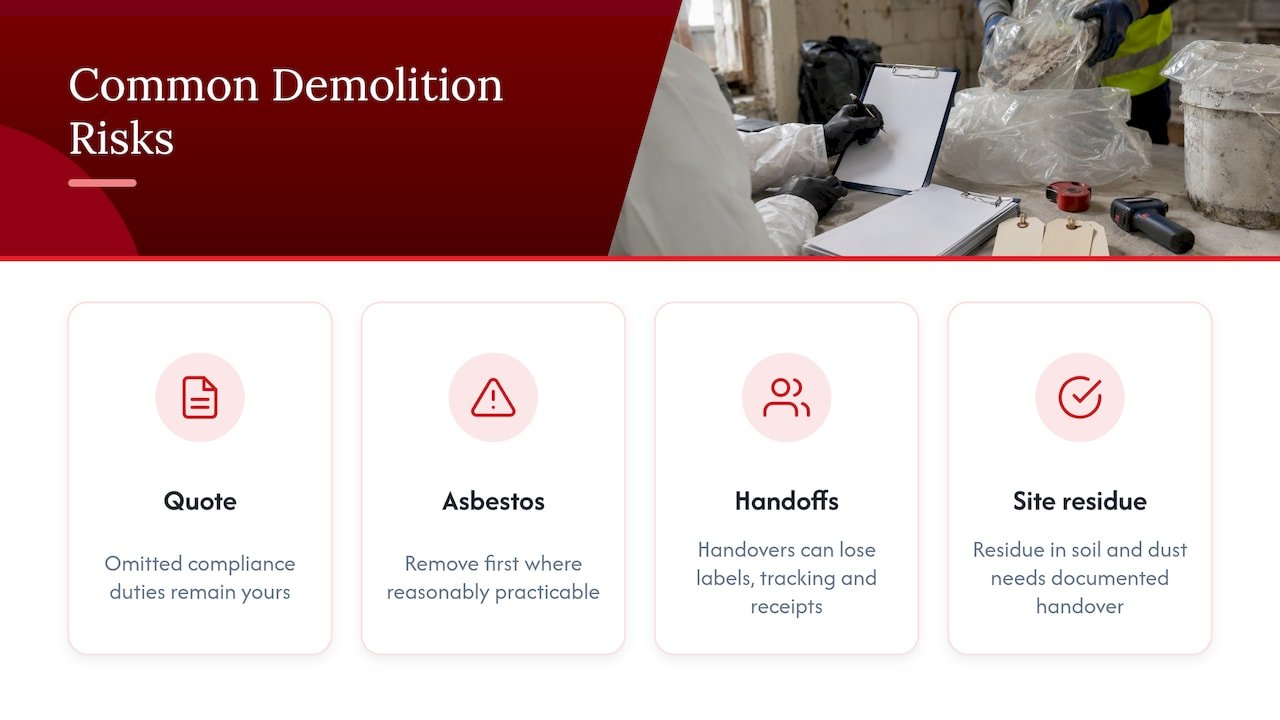
Forgetting the final site. Hazardous waste includes residue in soil and dust. A final clean and a documented handover are what a builder or certifier will look for. See final site cleaning for handover.
Our view: one contractor, one paper trail
We handle the whole sequence on one contract. That includes the approvals, utility disconnections, hazardous waste handling and the final site clean, for residential, commercial and industrial properties.
The reason is simple. Every rule above is about continuity: the register leads to the inspection, the inspection to the removal, the removal to the packaging, the packaging to the tracked load and the load to the receipt. When one team owns that chain, nothing falls into a gap between trades.
Asbestos is where we put the most care. Our asbestos removal is fully licensed and insured, and we pair it with demolition so the building is made safe before it is taken down, not after.
Safe handling and responsible waste disposal are part of how we plan every project, not an add-on at the end.
Tarek
Getting a compliant job from one contractor
If you are planning a demolition, strip-out or site clearance and want the hazardous material dealt with properly, we can scope the whole job: inspection, licensed asbestos removal, demolition and disposal. Start with our demolition and asbestos removal services or, for industrial and larger sites, our industrial demolition and site clearance service.
For homeowners, residential demolition covers house and structure removal. For fit-outs and refurbishments, interior strip-out removes old fixtures before the new build, and our asbestos removal compliance checklist helps you prepare.
FAQ
Who is responsible for hazardous waste on a demolition site?
Responsibility is shared. The person managing the workplace must provide the asbestos register, and the demolition contractor must obtain it and plan for the hazards. The business commissioning asbestos removal must use a suitably licensed removalist. Hiring one contractor who covers the whole chain keeps these duties clear.
Can I remove asbestos myself before demolition?
In NSW, a homeowner may remove less than 10 m² of non-friable asbestos, but anything larger, or any friable asbestos, needs a licensed removalist. Because the risks and the disposal rules are strict, most owners with a demolition planned have the whole job handled by a licensed team.
What is C&D waste?
C&D waste is construction and demolition waste: rubble, timber, metal and other material from building work. It becomes hazardous when it contains asbestos, lead, PCBs or chemical contamination, and then it is classified, contained and sent only to a facility that can lawfully accept it.
What is the Australian standard for demolition?
AS 2601-2001, The demolition of structures. NSW planning rules point to it for complying development and require asbestos removal to follow the Safe Work Australia model code. Safe Work Australia also publishes the Model Code of Practice for demolition work.
What records should I keep after demolition?
Keep the asbestos register or inspection report, the removalist’s licence details, any clearance certificate, waste classification results, waste dockets and landfill receipts. These show the material was identified, removed and disposed of lawfully.
Sources
- Model Code of Practice: Demolition work, Safe Work Australia (2018)
- Model Code of Practice Demolition Work, Safe Work Australia (2016)
- Work Health and Safety Regulations 2011, Federal Register of Legislation
- Demolition, SafeWork NSW
- Asbestos and demolition, WorkSafe Queensland
- Demolition Work Code of Practice, ACT
- Demolition compliance code, WorkSafe Victoria
- Unlicensed asbestos removal, NSW asbestos regulator
- Managing asbestos at construction and demolition waste recycling facilities, WA
- Transporting waste, NSW EPA
- Asbestos waste, NSW EPA
- Construction and demolition waste: A management toolkit, NSW EPA
- Planning circular PS 21-036, NSW Planning
- Waste management, ACT City Services
- States, territories and local government, DCCEEW