Most concrete from a demolished building can be recycled, but only if it leaves the site clean, sorted and free of asbestos and other contaminants. Clean concrete is crushed into aggregate for road base, pavements and, within limits, new concrete. Mixed or contaminated concrete costs far more to handle, and it is the main reason recycling fails. The best result is decided before the first wall comes down, in the demolition plan, the hazardous materials check and the way the site is cleared.
This guide is for homeowners clearing a lot for a new build, developers, builders and project managers who want to know what happens to the concrete, what it affects on cost and compliance, and what to organise up front.
TL;DR
- Clean, sorted demolition concrete is crushed into recycled concrete aggregate (RCA) and reused as road base, pavement and subbase, and in some structural concrete with approval.
- Contamination is the biggest barrier: contaminated concrete can cost more than five times as much to manage as clean waste.
- Asbestos must be identified and removed by licensed people before demolition, so the concrete and the rest of the debris stay recyclable.
- Rules differ by state. In NSW the plan for concrete waste goes into your development or building application.
- Decide early between crushing on site, recycling off site or disposal, because each depends on space, quality and distance.
Table of Contents
- What happens to concrete after a building is demolished
- Is concrete 100% recyclable?
- The steps from demolition to recycled aggregate
- What recycled concrete can be used for
- Rules that affect your concrete, by state
- Safety points that sit alongside recycling
- Planning the concrete on your project
- Why use one contractor for demolition, asbestos and clean-up
- Perspective
- Plan your demolition with the waste in mind
- FAQ
- Sources
What happens to concrete after a building is demolished
Concrete is the heaviest part of most demolition jobs: slabs, footings, driveways, retaining walls and structural elements. After it is broken out, it follows one of three paths.
- Recycled into aggregate. The concrete goes to a recycling facility, or a mobile crusher on the site, and is crushed and screened into graded material.
- Reused directly on site. Crushed material goes back into the new project as fill, base or drainage rock, where it meets the specification.
- Disposed of. Concrete that is contaminated, mixed with other waste or too far from a facility ends up in landfill, with the disposal costs that come with it.
Australia already recycles a great deal of it. The Australian Government’s YourHome guide, citing 2018-19 national data, says construction and demolition produces about 44% of the country’s waste, roughly 27 million tonnes a year, with about 77% recovered. A South Australian industry report puts concrete at around 60% of all masonry material recycled in Australia. The infrastructure exists. What decides whether your concrete uses it is how it arrives.
Is concrete 100% recyclable?
Physically, almost all of it can be crushed and reused. In practice the recovery rate depends on quality, and there are two separate questions.
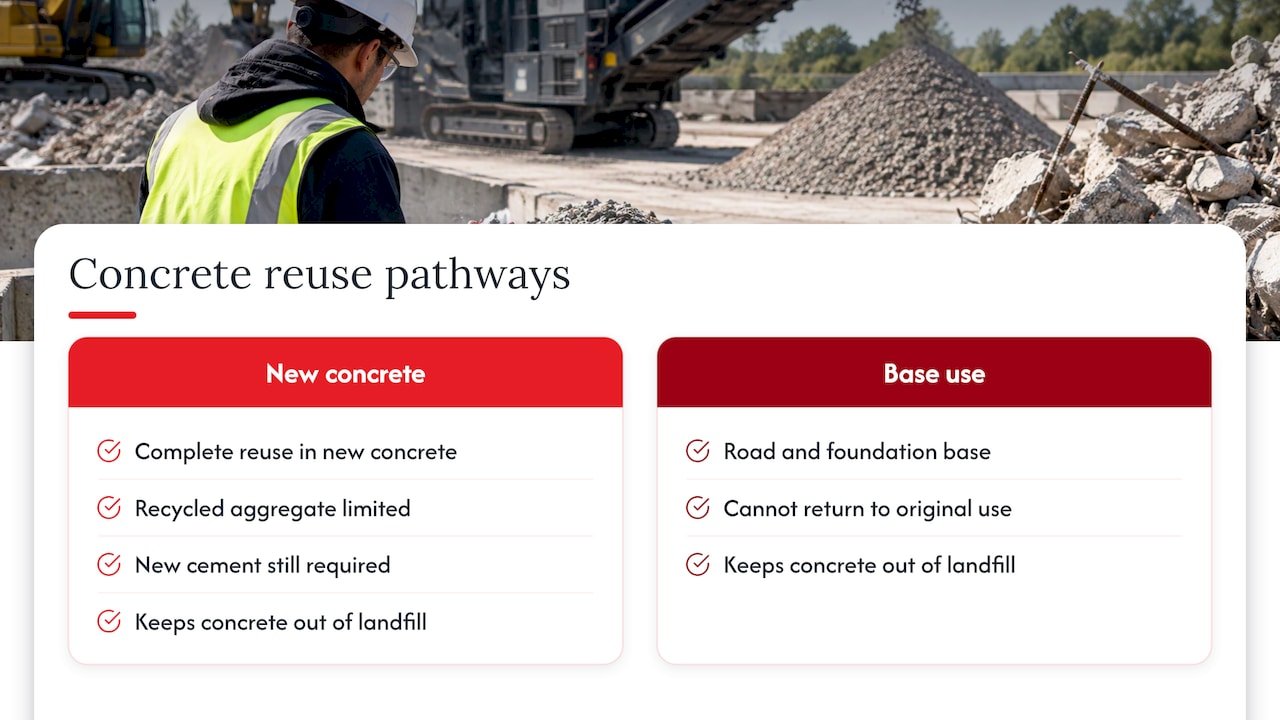
Can it be reused at all? Sika’s technical explanation separates two outcomes. Concrete can be completely reused in new concrete production, or down-cycled into road and foundation base, where it cannot return to its original use. Both keep it out of landfill.
Can it go back into new concrete? Only partly. The Cement Sustainability Initiative notes that new cement is always needed, and regulations and physical properties limit how much recycled aggregate goes into structural concrete. So expect most crushed concrete from your site to become base, subbase, drainage rock and non-structural fill, with structural reuse the exception.
What stops concrete being recycled
The South Australian research identifies three barriers to wider use of recycled concrete aggregate:
- Separation. Concrete mixed with timber, plasterboard, soil or hazardous material is hard to process. The same report says contaminated concrete costs more than five times as much to manage as clean waste.
- Standards. Specifications differ between states, which limits a national market for the product.
- Distance. Long distances between sites and recycling facilities can make hauling uneconomic.
You control the first completely and influence the third through your choice of recycler or on-site crushing. The second is a reason to check your own state’s rules before you commit to a reuse plan.
The steps from demolition to recycled aggregate
The sequence is similar across Australia, though the details vary by state.
1. Survey for hazardous materials before anything is touched
Older buildings can contain asbestos in sheeting, eaves, roofing, flooring and fittings. Safe Work Australia’s demolition code of practice says to obtain the asbestos register or arrange a competent inspection if none exists, and to remove all asbestos likely to be disturbed before demolition so far as reasonably practicable.
This step protects people first. It also protects your recycling result, because one asbestos-contaminated load can turn clean concrete into restricted waste. We cover the process in our guide to removing asbestos before demolition. Where a building has not been tested, asbestos inspection and testing comes before the demolition programme, not during it.
2. Strip the building and separate the waste streams
Timber, metal, glass, plasterboard, insulation and fittings come out first. A strip-out before the structure comes down gives you clean concrete and masonry at the end, rather than a mixed pile. For commercial fit-outs, an interior strip-out is usually the stage that decides how clean the later concrete is.
3. Demolish and break out the concrete
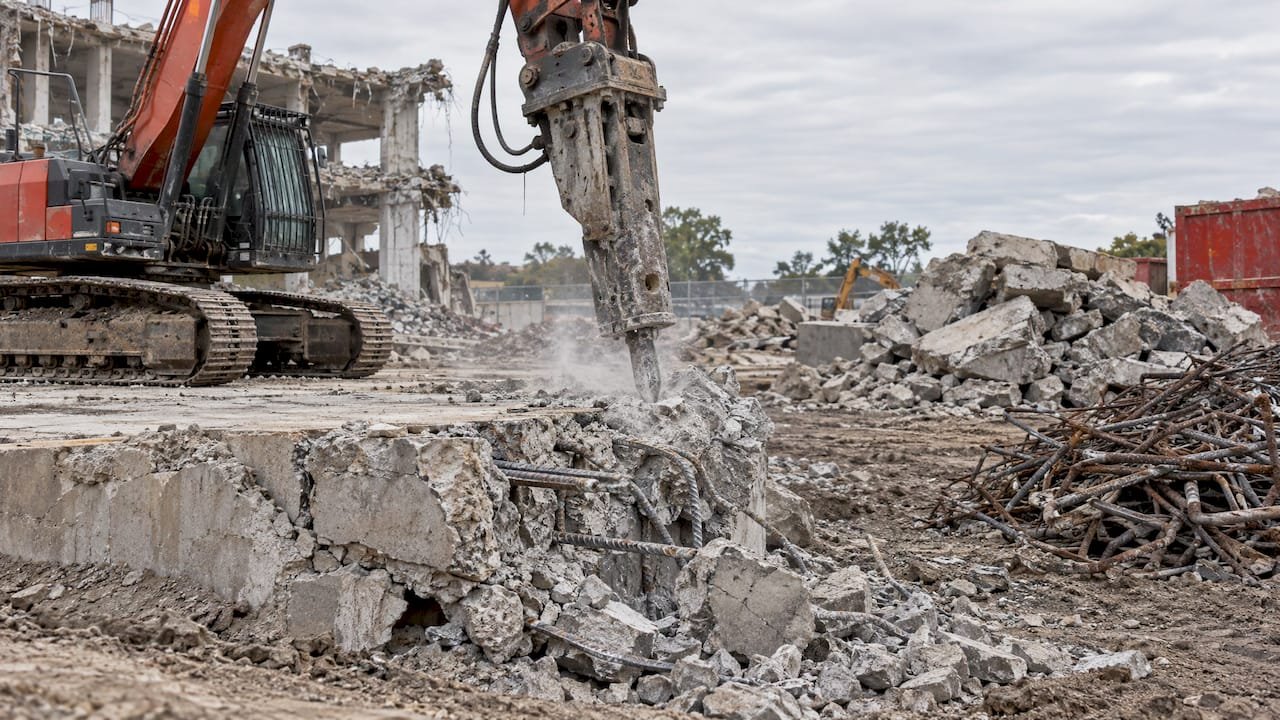
Slabs, footings and walls are broken down to a manageable size. Reinforcing steel is cut out and recovered separately, as it is a recyclable material in its own right. Where concrete has to be cut rather than smashed, for a partial demolition or a boundary, controlled concrete cutting keeps the retained structure intact and the removed pieces clean.
4. Keep hazardous debris out of the concrete pile
The ACT code of practice is a clear model of site rules: debris containing asbestos or other hazardous substances is kept separate from other debris, contained, labelled and removed from site as soon as possible, with dust controlled by watering down or vacuuming. Other states have their own codes, but the principle is the same everywhere: never let it mix.
5. Transport to a recycler, or crush on site
An Australian research review notes that on-site mobile crushers are an excellent option where space permits, but mobile plant is limited to one-stage crushing, magnetic separation and screening. Tight suburban blocks often have no room, so the concrete goes to a recycling centre. There it is sorted, processed and used in products. One national materials supplier describes demolition and excavation waste going to a local recycling centre, being sorted and separated, then processed for reuse.
6. Final clean and handover
The site needs a final clean, with the slab, footings and any remaining debris removed to the level your next stage requires. Disposal records for each waste stream are worth keeping, since they show where the material went.
What recycled concrete can be used for
NSW’s Department of Climate Change, Energy, the Environment and Water (DCCEEW) published a 2025 factsheet on recycled concrete aggregate. It defines RCA as coarse aggregate made by crushing sound, clean demolition waste. The same factsheet lists these uses:
| Use | What the factsheet says |
|---|---|
| Structural concrete | Up to 50 MPa, with approval from the Superintendent, Principal or Project Delivery Authority |
| Non-structural concrete | Suitable |
| Concrete pavement | Suitable |
| Pavement base and subbase | Suitable |
For structural uses the mix needs a performance review covering workability, strength, shrinkage, creep, chloride diffusion and alkali aggregate reaction. For a homeowner this is a conversation for your engineer and builder, not something to settle on site.
The NSW rules also limit where hardened returned concrete can go. The research review notes it cannot be used in NSW for dam, mine, quarry or sand dredge rehabilitation, void backfill, or reshaping land for agriculture. “Reuse” still has to match a permitted use.
A large-scale example
A South Australian CBD demolition shows the scale this can reach. Waste Management Review reported in May 2024 that ResourceCo recycled 12,500 tonnes of concrete from the project into new products for civil construction. That was done by crushing and screening to a specification the civil market could accept.
Rules that affect your concrete, by state
There is no single national rulebook. These examples show what to expect and why you should check your own state’s rules.
New South Wales
NSW EPA guidance says developers, whatever the project size, must show in the Building or Development Application how concrete wastes will be stored on or off site and collected. It also sets general requirements for treated concrete effluent that is irrigated: a pH between 6.5 and 8.5 and non-filterable residue of no more than 50 mg/L, and facilities that collect, treat or dispose of it need approval and a licence. Planning how concrete waste is stored and collected is the same exercise whether you are in Sydney or anywhere else, and construction waste collection services show what a collection arrangement for site waste typically covers.
Queensland
Queensland’s Environmental Legislation Amendment Regulation 2025 added construction and demolition waste to the prescribed recycling activities from 1 July 2025. Businesses that achieve a recycling rate above 80% can apply for a waste levy discount on residual waste. The state’s end-of-waste code for recycled aggregates also covers hardened concrete. It requires producers to register, meet the relevant Australian Standard or technical specification, segregate the product and keep dispatch records for loads over 5 tonnes. It excludes aggregate reused at the same site it came from.
Western Australia
The Waste Authority’s Roads to Reuse specification requires loads of construction and demolition waste to be inspected for discolouration, hydrocarbon staining, asbestos-containing materials, acid sulfate soil odours and non-permitted waste before they are used to make recycled road base or drainage rock. Contaminated material is isolated and tested before it can be included.
The common thread: recyclers want clean, documented loads, and regulators want evidence of what went where.
Safety points that sit alongside recycling
Two safety issues matter more than the recycling itself.
Asbestos. Disturbing asbestos is high risk construction work. The ACT’s Work Health and Safety Regulation 2011 defines high risk construction work to include demolition of a load-bearing element, work likely to disturb asbestos, and processing crystalline silica material with a power tool or other mechanical method. Licensed removal comes first, whatever the recycling plan.
Silica dust. Concrete contains crystalline silica. Cutting, crushing and breaking it creates dust that is a health risk to workers and neighbours, so dust suppression and the right controls belong in the site’s safety plan. Your demolition contractor should be able to explain how the job controls them.
Planning the concrete on your project
Work through these questions with your demolition contractor before the contract is signed.
- What is in the building? Is there an asbestos register? If not, arrange an inspection first.
- How much concrete is there? Slabs, footings, driveways and walls add up quickly by weight. An estimate shapes the choice of crush on site or haul away.
- Is there room for a crusher? Mobile crushing needs space, noise tolerance and approvals.
- Where will it go? Ask which facility or reuse destination each stream is going to, and how far away it is. Distance affects both cost and emissions.
- Can you reuse it yourself? Crushed material may suit your own driveway base, fill or drainage layer, subject to your engineer and your state’s rules.
- What does your approval require? In NSW, concrete waste handling is part of the application.
A worked example: a homeowner demolishes a 1960s house with a concrete driveway and a garage slab. If the eaves and garage roof contain asbestos and are removed first by a licensed removalist, the slabs, footings and driveway come out as clean concrete. That load can go to a recycler as one stream. If the asbestos sheeting is smashed with the rest, the whole pile is suspect, and it becomes costlier, slower and harder to place.
Why use one contractor for demolition, asbestos and clean-up
Concrete recycling depends on the work that comes before it: the survey, the asbestos removal, the strip-out and the careful sequence of demolition. When those are handled by different parties, the handovers are where contamination and delays happen.
Mission Demolition covers residential, commercial and industrial demolition, licensed asbestos removal, strip-outs, concrete cutting and site clearance across Sydney and Australia. Our project management includes approvals, utility disconnections, hazardous waste handling and final site cleaning, so a single team is accountable from the first inspection to the cleared site. We prioritise environmentally responsible waste disposal on every project.
Perspective
Concrete recycling is rarely lost at the crusher. It is lost earlier: an asbestos sheet nobody found, a skip filled with timber and slab together, a site cleared in the wrong order.
That is why we treat demolition and asbestos work as one job. Testing and licensed removal come before the machines. Waste streams are kept apart as the building comes down. Approvals, disconnections, hazardous waste and the final clean are managed together, so the person who knows what is in the building is also the person deciding how it leaves.
If you are planning a demolition for a new build or a commercial project, ask early how the concrete will be handled. A clean, sorted site gives you the most options and the fewest surprises.
Tarek
Plan your demolition with the waste in mind
If you are clearing a site for a new build or a commercial project, our team can handle the demolition, the asbestos and the clean-up as one project. Start with our house and commercial demolition services, or go straight to residential demolition for a home or industrial demolition and site clearance for larger sites.
Contact us with your address, the type of building and what you plan to build, and we will walk you through the approvals, hazardous materials and waste handling that apply.
FAQ
Is concrete 100% recyclable?
It can be crushed and reused almost entirely, but quality decides the outcome. Clean concrete becomes road base, subbase, drainage rock or non-structural fill, and some goes into structural concrete with approval. Contaminated or mixed concrete is much harder and costlier to place.
Can I reuse crushed concrete on my own block?
Often yes, for base, fill and drainage, as long as it meets your state’s rules and your engineer’s specification. In Queensland, for example, the end-of-waste code for recycled aggregates excludes aggregate reused at the site it came from. Confirm the rules for your state before you plan around it.
Does asbestos affect whether concrete can be recycled?
Yes. Asbestos must be identified and removed by licensed people before demolition so far as reasonably practicable, and asbestos debris must be kept separate and labelled. Recyclers inspect loads for asbestos-containing materials, and a contaminated load can be rejected.
Do I need to tell the council what happens to my concrete?
In NSW, the EPA says developers must show in the Building or Development Application how concrete wastes will be stored and collected, whatever the project size. Other states have their own approval and waste rules, so ask your certifier or council.
Sources
- Waste minimisation, YourHome (Australian Government)
- Concrete, SBE NRC
- Can Concrete Be Recycled?, Sika
- The Cement Sustainability Initiative, Recycling Concrete
- Demolition Work Code of Practice, Safe Work Australia
- ACT demolition code of practice
- Circular Materials Solution, Boral
- Recycled Concrete Aggregates factsheet, NSW DCCEEW
- South Australia project raises circularity outcomes, Waste Management Review
- Concrete wastes, NSW EPA
- Waste policy and legislation changes, Queensland Government
- End-of-waste code for recycled aggregates, Queensland Government
- Roads to Reuse product specification, Waste Authority WA
- Work Health and Safety Regulation 2011, reg 291 (ACT)