Most standalone house demolitions in NSW go through a complying development certificate (CDC), which carries a benchmark of around 20 days for a compliant site. Sites with heritage overlays, bushfire risk, flooding, or other constraints usually need a full development application (DA), which commonly runs 40 to 90 or more days. Asbestos assessments and an incomplete waste management plan are the two things most likely to blow out either timeline, so sort them before you lodge anything.
TL;DR:
- Applying for a CDC can take roughly 20 days, with most approvals issued in three to four weeks when notifications are involved.
- Full development applications may require 40 to over 90 days, especially if heritage, environmental, or community objections are present.
- Missing asbestos assessments or incomplete waste management plans are the most common causes of delays during the approval process.
- Confirming site eligibility and preparing all documents beforehand, including asbestos and hazardous materials reports, can save several weeks.
- Engaging certifiers and asbestos assessors early and in parallel prevents delays caused by rework and incompleteness.
Table of Contents
- Which approval pathway applies: exempt, CDC or DA?
- How long does demolition approval actually take?
- What documents and standards do you need to lodge?
- What causes demolition approval delays in NSW?
- Your demolition approval timeline: a step-by-step checklist
- How Mission Demolition compresses the approval-to-start gap
- Speed versus certainty: which pathway should you choose?
- Get a pre-approval review before you lodge anything
- Where to check the official NSW rules yourself
- Sources
- FAQ
Which approval pathway applies: exempt, CDC or DA?
Every demolition in NSW falls into one of three baskets, and picking the wrong one is the single most common reason projects stall.
Exempt development covers a narrow set of minor structures that don’t need council or certifier sign-off at all. It’s rare for a full residential demolition to qualify, and Shoalhaven City Council’s own guidance advises property owners to assume approval is required until they’ve confirmed otherwise.
Complying development certificates (CDCs) are the fast track for straightforward jobs, assessed by a registered certifier against a fixed set of standards rather than by council planners.
Development applications (DAs) go through full council assessment and apply whenever a site doesn’t meet CDC standards.
A handful of things routinely knock a project out of CDC eligibility:
- Heritage listings or conservation area overlays
- Bushfire prone land or flood-prone land classifications
- Sites likely to attract significant neighbour or community objection
- Structures with unusual size, location, or proximity to boundaries
Before you commit to a pathway, run your address through the NSW Planning Portal’s eligibility tools and get a registered certifier to sanity check it. A five minute search here can save you weeks later, because switching from a CDC application to a DA midway means starting the clock again.
How long does demolition approval actually take?
The two pathways operate on genuinely different clocks, and the gap between them is the biggest variable in any demolition schedule.
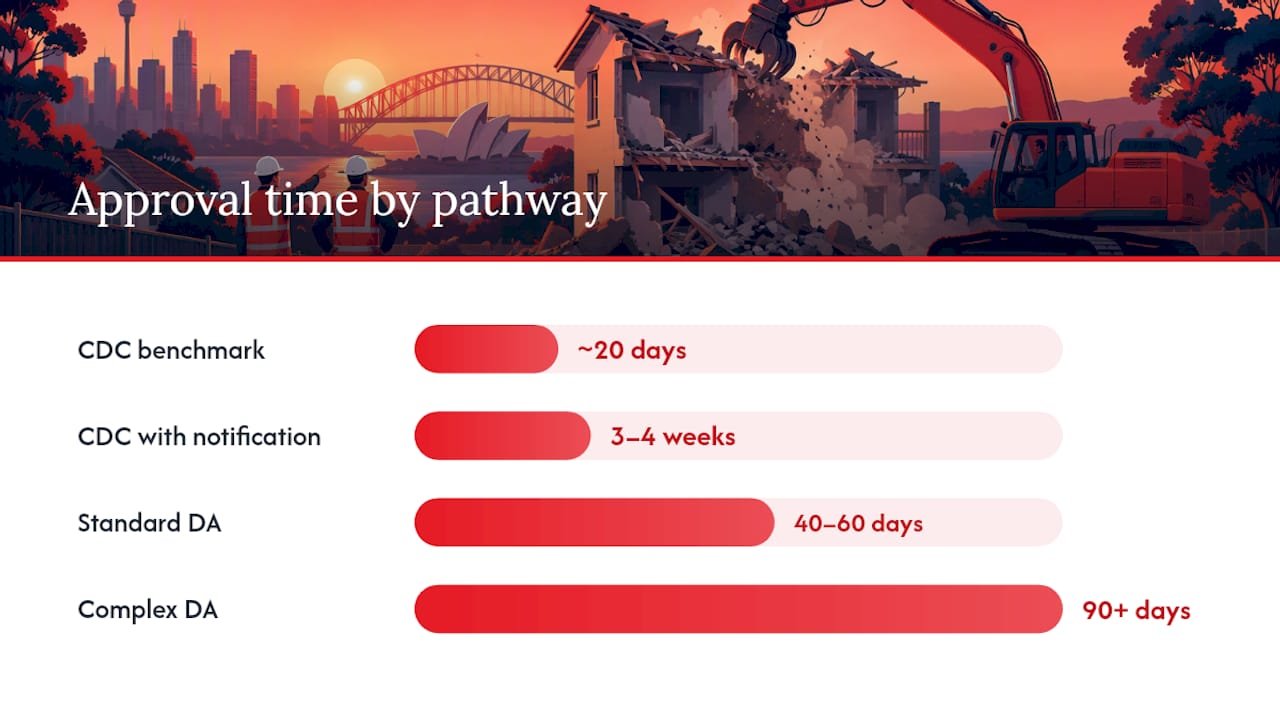
A CDC for an eligible, compliant site can be issued in as little as 20 days. That figure is the processing benchmark, not the total elapsed time. Some CDCs carry a mandatory neighbour notification period, and that window runs alongside or before the certifier’s assessment, so the realistic wait from submission to certificate is often closer to three to four weeks once notification and document checks are folded in.
A DA is a different proposition entirely. Statutory assessment windows commonly sit between 40 and 60 days, but that’s before you factor in exhibition periods, council information requests, or deferred commencement conditions attached to approval. Complex sites, especially those with heritage or environmental sensitivities, frequently push out beyond 90 days.
Quick reference:
- CDC (eligible sites): ~20 day benchmark, often 3 to 4 weeks elapsed with notification
- Standard DA: 40 to 60 days statutory window
- Complex DA (heritage, environmental, contested): 90+ days
A smaller subset of projects, including some under the Housing Pattern Book complying development pathway, can move even faster than the standard CDC benchmark where the design meets pre-approved criteria. It’s worth asking your certifier whether your project fits.
What documents and standards do you need to lodge?
Certifiers and councils will not process an incomplete application, and missing paperwork is the fastest way to add weeks to your timeline. Prepare these before you lodge, not after a request for more information lands in your inbox.
- Waste management plan. This must set out how demolition waste will be separated, stored, and disposed of, and it must include an asbestos declaration for any building constructed before 1987.
- Hazardous materials assessment. Pre-1987 buildings almost always require a licensed asbestos inspection under NSW WHS rules, and the Planning Portal is explicit that hazardous materials should be removed before you apply for consent in many cases.
- Dilapidation reports for adjoining walls or structures, particularly on tight urban lots.
- Engineering plans and service disconnection evidence, confirming power, water, and gas have been safely isolated.
- Council-specific application forms, which vary by local government area.
All demolition work, regardless of pathway, must comply with Australian Standard AS 2601 and NSW WHS regulations governing hazardous materials handling.
What causes demolition approval delays in NSW?
Almost every delayed application traces back to one of a handful of avoidable problems.
Incomplete waste management plans or missing asbestos assessments are the most frequent culprits. Commissioning your hazardous materials assessment early, rather than scrambling for one after a certifier flags the gap, routinely shaves weeks off the process.
Choosing the wrong pathway wastes time too. Attempting a CDC application on a site that actually needs a DA means the certifier bounces it back, and you’ve lost however many days it spent in their queue.
Neighbour notification and objections can also slow things down, particularly on DAs where exhibition periods invite formal submissions. Council information requests and deferred commencement conditions add further rounds of back and forth if your initial pack is thin.
A short pre-lodgement action list goes a long way:
- Engage a registered certifier before you finalise your approach
- Use standard council templates for the waste management plan rather than drafting from scratch
- Pre-book your hazardous materials assessor so the report is ready when you lodge
- Ask your certifier to review the full pack before submission, not after
Pro Tip: Book your asbestos assessor and your certifier in the same week. Running them in parallel rather than sequentially is often the single biggest time saving available to you.
Your demolition approval timeline: a step-by-step checklist
Here’s how the process typically sequences from first enquiry to first day on site.
- Days 0 to 7: Check CDC eligibility on the NSW Planning Portal and book your asbestos assessor.
- Days 7 to 21: Prepare your waste management plan, asbestos report, dilapidation report, and engineering plans, timing depends on assessor and engineer availability.
- Lodgement: Submit your CDC or DA. Expect roughly 20 days for an eligible CDC, or 40 to 90+ days for a DA, including any exhibition or notification period.
- Post-approval: Issue neighbour notices, appoint your principal certifying authority, and arrange utility disconnections and site setup before the first demolition day.
Recent ABS data on knock-down rebuilds shows the gap between demolition approval and subsequent building approval has been narrowing, a sign that councils and certifiers are getting better at coordinating the two processes for rebuild projects.
How Mission Demolition compresses the approval-to-start gap
Coordinating your asbestos assessment, waste management plan, and certifier review before you tender the job avoids the rework that comes from doing them one at a time. When a contractor handles both the licensed asbestos removal and the demolition itself, there are fewer handoffs between separate trades and fewer gaps where paperwork sits waiting on someone else’s desk.
Mission Demolition uses standard pre-lodgement checklists and waste management plan templates built specifically to head off the council information requests that stall most applications. Pairing that with a documented safety and site setup process keeps the job compliant without adding extra review cycles.
- Asbestos assessment and waste planning run in parallel, not sequentially
- Certifier liaison happens before tendering, not after
- Standard templates reduce the odds of a council request for more information
Pro Tip: Ask any contractor quoting your job whether they coordinate the certifier review themselves or leave that entirely to you. That one question tells you a lot about how many weeks you’ll spend chasing paperwork.
Speed versus certainty: which pathway should you choose?
A CDC is the right call whenever your site genuinely qualifies. Faster processing, fewer unknowns, and a clear benchmark to plan around. But forcing a CDC application onto a site with heritage or environmental constraints just delays the inevitable DA you’ll end up needing anyway.
Starting demolition without the right approval risks stop-work orders and fines that dwarf whatever time you thought you saved. Getting a certifier or asbestos assessor involved early almost always costs less than the delay it prevents.
— Tarek
Get a pre-approval review before you lodge anything
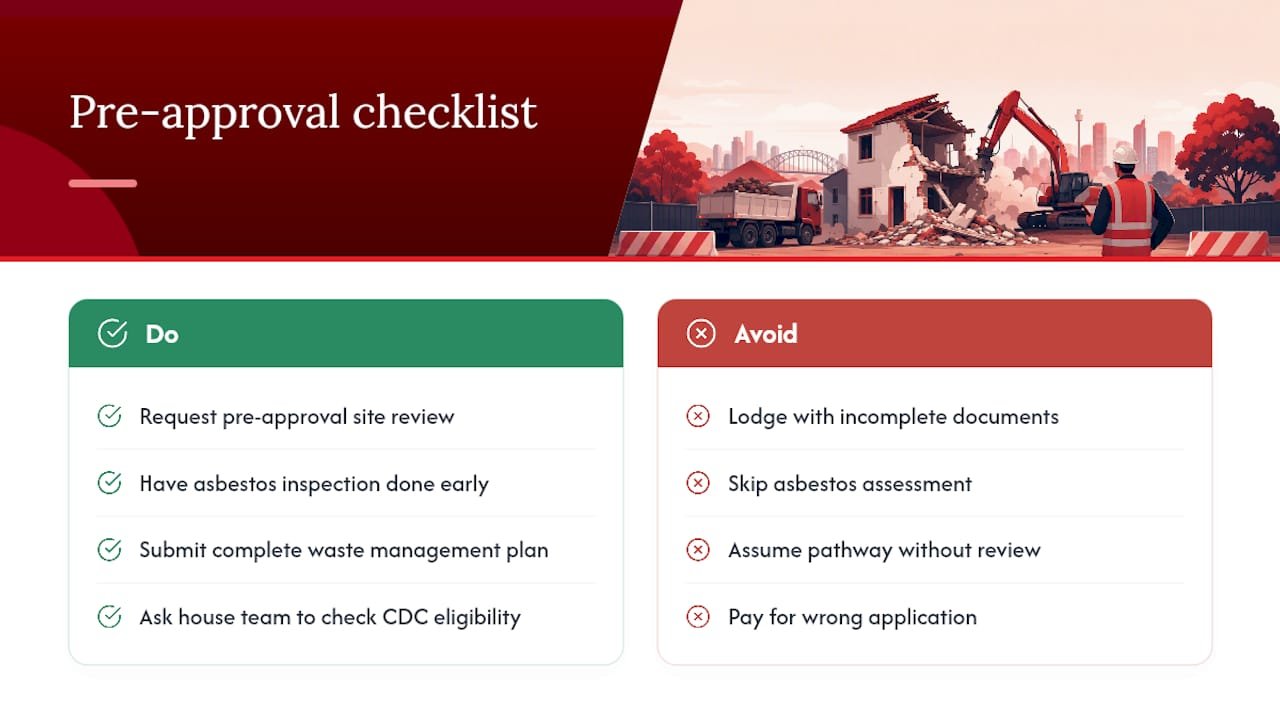
Getting your approval pathway wrong, or lodging with an incomplete waste management plan, costs weeks you don’t get back. Some demolition contractors work through the exact prerequisites councils and certifiers ask for, including asbestos assessment, waste planning, and certifier coordination, before your application goes anywhere near a council desk.
That means fewer information requests bouncing back, fewer surprises on lodgement, and a realistic schedule you can actually build a project around. If your site has pre-1987 construction, Missiondemolition’s asbestos inspection and testing service gets that report sorted before it becomes a bottleneck. For residential jobs specifically, the house demolition team can walk your site and flag CDC eligibility issues before you spend money on the wrong application.
Request a pre-approval site review through Missiondemolition and find out which pathway actually applies to your property before you lodge a thing.
Where to check the official NSW rules yourself
Verify your own project against the Planning Portal’s CDC guidance and MyHome Planner demolition pages, plus your local council’s demolition page for area-specific exemption rules and DA requirements.
Sources
- Complying development | Planning Portal – Department of Planning and Environment
- Demolish – MyHome Planner | Planning Portal – Department of Planning and Environment
- Waste management plan appendix (Planning Portal)
- Demolition | Shoalhaven City Council
FAQ
What are the demolition regulations in NSW?
NSW demolition is governed by the NSW Planning Portal’s CDC and DA frameworks, Australian Standard AS 2601 for demolition practice, and WHS regulations covering asbestos and hazardous materials. Every project also needs a waste management plan, and most councils advise assuming you need formal approval unless you’ve confirmed an exemption.
How long does DA approval take in NSW?
Standard development applications for demolition typically take 40 to 60 days under statutory assessment windows, but complex sites with heritage, environmental, or community objection issues often extend beyond 90 days. Deferred commencement conditions or council information requests can add further time on top of that.
Do you need approval before demolishing a building?
Yes, in almost all cases. Councils including Shoalhaven advise property owners to assume approval is required until they’ve confirmed an exemption applies, since only a narrow category of minor structures qualifies as exempt development.
What is the Australian Standard for demolition works?
Demolition work in NSW must comply with AS 2601, the standard governing safe demolition practice, alongside NSW WHS rules for asbestos and hazardous materials handling.
How much does Mission Demolition charge for a pre-approval review?
Current pricing isn’t published online. You can request a quote and site review directly through Missiondemolition.
