
Demolition traffic management is the planned control of trucks, machinery, workers, pedestrians and passing vehicles around a demolition site. In Australia it usually means a written traffic management plan (TMP), and when work touches a public road or footpath, a traffic control plan or traffic guidance scheme prepared by an accredited person and approved by the road authority or council. The rules differ by state and by council, so the plan has to be built for your site and your street.
This guide explains what the plan contains, when councils ask for it, who may control traffic, and how to avoid the delays that catch owners and builders out.
TL;DR
- A demolition traffic plan documents how vehicles and people move at, into and out of the site, and how the risks are controlled. Safe Work Australia treats it as part of keeping the workplace safe.
- If work affects a road, footpath or cycleway, expect your council or road authority to require an approved traffic control plan, accredited traffic personnel and public liability insurance.
- The Australian Guide to Temporary Traffic Management (AGTTM) is the national reference most state authorities build on.
- Site-specific details decide the plan: truck routes, entry and exit points, hours, pedestrian paths and restricted streets.
- Sort out the traffic plan early. It is one of the approvals that can hold up a demolition start date.
Table of Contents
- Why demolition needs its own traffic plan
- What a demolition traffic management plan needs to cover
- When you need a plan, and who approves it
- The AGTTM: the national reference
- Who can control traffic at a demolition site
- How traffic flow works day to day
- What traffic management costs
- Our perspective
- Planning your demolition job with us
- A short checklist before you apply
- FAQ
- Sources
Why demolition needs its own traffic plan
Demolition generates more heavy vehicle movements per day than almost any other early-stage site job. Excavators arrive on floats, skip bins and tipper trucks come and go, and spoil, concrete and metal leave in a steady stream. Every one of those movements crosses a footpath and enters a live road.
Safe Work Australia’s traffic management guide for construction says managing traffic is part of providing a workplace without risks to health and safety. It names reversing, loading and unloading, and vehicles and powered mobile plant moving in and around the workplace as common risk points. All three are daily realities on a demolition site.
The plan is also how you show a council or road authority that you have thought it through. In many local government areas it is a condition of the permit that lets you occupy a footpath, place a hoarding or put a truck on the kerb.
What a demolition traffic management plan needs to cover
A plan is a short document backed by drawings. Safe Work Australia says it explains how risks will be managed at the workplace and suggests starting with a map or sketch of the site and the surrounding traffic area to help spot hazards. Its examples of content include:
- designated travel paths and entry and exit points
- pedestrian and vehicle routes
- delivery, loading and unloading areas
- temporary works drawings showing barriers, walkways, signs and general arrangements
- for work on a public road, signs and devices, temporary speed zones and pedestrian and cyclist routes
Councils add their own layer. The City of Sydney’s standard requirements for construction traffic management plans apply during demolition, excavation and construction. They call for site-specific truck routes and entry and exit points, a list of roads that construction traffic must avoid (for example roads with load limits, quiet residential streets or turn-restricted streets), and a truck route plan handed to drivers.
Entry, exit and queuing
The same City of Sydney document sets a clear baseline. Vehicles must enter and exit the site in a forward direction unless the City’s Construction Regulation Team approves a one-off exception. Trucks must not queue on public roads. Controllers should wait for a suitable gap in traffic before stopping it, and pedestrians may be held only briefly when trucks enter or leave, not in anticipation of truck movements.
In practice, that shapes how a site is laid out. On a tight residential block, forward entry and exit can mean a temporary turning area inside the boundary, a staged demolition sequence that keeps space clear, or a truck scheduled so only one vehicle is ever waiting. Our guide to demolition in tight Sydney urban spaces covers how access constraints shape the job.
Waste trucks and bins
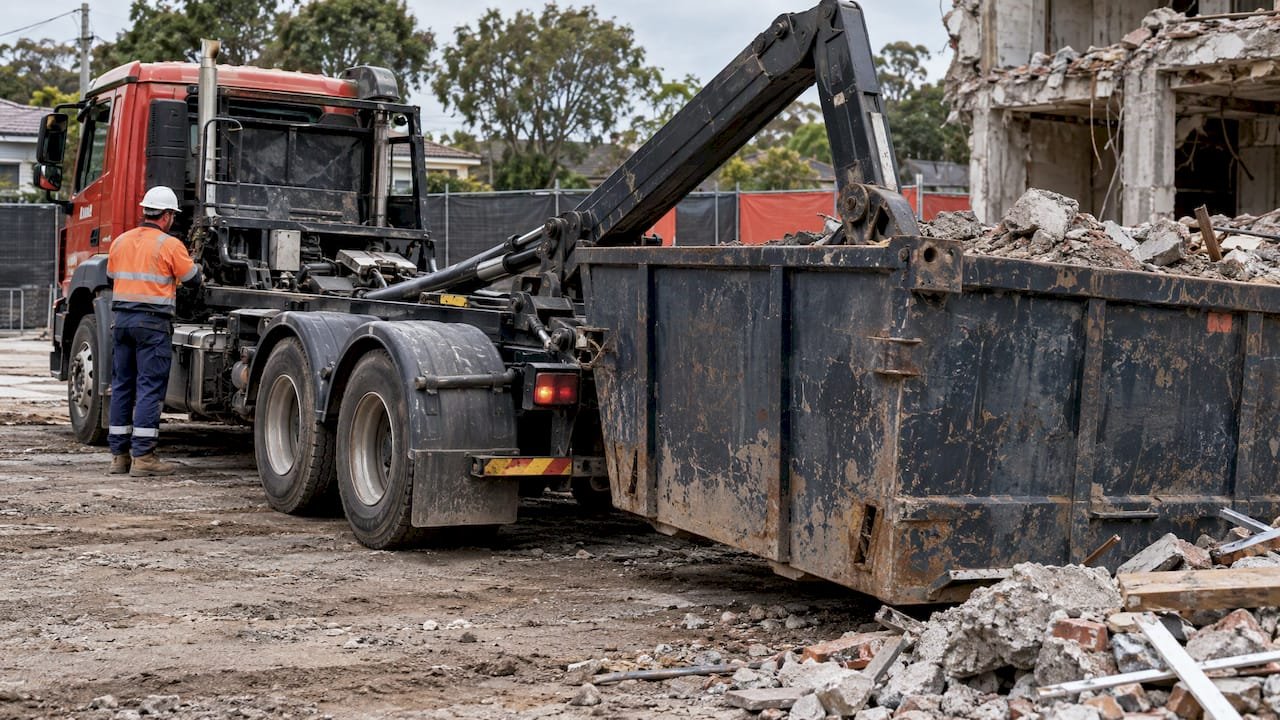
The plan should also account for where bins sit and how waste leaves. Debris routes affect truck numbers, loading areas and the time vehicles spend at the kerb. If you are weighing how material leaves the site, this overview of construction debris disposal options is a helpful way to think about volumes before you fix the truck schedule.
Risk first, then controls
WorkSafe ACT says risk management should happen before work starts, with control measures built into the design of the temporary traffic management plan. That order matters. A plan written after the site is set up usually ends up describing problems rather than preventing them.
Staging counts too. The ACT directorate expects a traffic guidance scheme for every stage of work, and a separate one for day, night, weekend and out-of-hours work. Demolition typically moves through strip-out, structure removal, slab removal and site clean, each with a different truck profile, so a single generic plan rarely fits.
When you need a plan, and who approves it
There are two layers, and owners often confuse them.
- The workplace traffic management plan. This is about safety inside and at the edge of the site. It follows work health and safety duties and is the responsibility of the people running the work.
- The traffic control plan or guidance scheme for the road. This applies when work affects a public road, footpath or cycleway, and it is what a council or road authority wants to see.
Main Roads Western Australia states that any party working on a road must prepare a traffic management plan providing for worker and road user safety while keeping an adequate level of service, with planning following AGTTM Part 2. In the ACT, approval from an appropriate authority is needed to install traffic control devices, and Roads ACT must approve an application for activities on or within a set distance of a public roadway, footpath or bicycle path.
What NSW councils ask for
Because most of our work is in Sydney, here is how a few councils phrase it. Check your own council’s current page, since requirements are updated.
- Inner West Council’s hoarding and temporary fencing permit requires a traffic control plan prepared by an RMS accredited person, in line with AS1742.3 and the relevant work health and safety regulations. The council says it does not approve the plan. It treats it as information about traffic flow impacts, not as a safety risk assessment, so the safety responsibility stays with you and your contractor.
- Its road, footpath and carpark occupancy permit is issued under section 138 of the Roads Act 1993 and section 68 of the Local Government Act 1993, with the traffic control plan as a mandatory supporting document.
- Wollondilly Shire Council’s road occupancy application form asks for an approved traffic guidance scheme or traffic management plan where applicable, traffic management accreditation tickets, and contractor public liability insurance of $20,000,000.
The traffic plan sits alongside other approvals. Our demolition permits guide for Sydney explains how the pieces fit, and the demolition site signage briefs help you get the signs right the first time.
The AGTTM: the national reference
Austroads describes the Australian Guide to Temporary Traffic Management as based on best temporary traffic management practice. It helps road authorities meet workplace and public safety responsibilities and covers planning, design and implementation. It applies to works on or near roads, and to off-road activities that interact with or affect the road environment, which is exactly the case for a demolition site with trucks crossing a footpath.
States adapt it. Queensland, Western Australia, the ACT and NSW each publish their own procedures, accreditation arrangements and forms, which is why a plan that passes in one council area may need rework in another.
Who can control traffic at a demolition site
Traffic control is a regulated task. It is not a job for a labourer with a stop-slow bat.
In Queensland, a person authorised to control traffic must be accredited under the Traffic Controller Accreditation Scheme. Controllers must hold valid accreditation to carry out on-site traffic control tasks, keep the accreditation document on their person, and renew it after completing an approved training course. In NSW, councils ask for traffic control plans prepared by an accredited person and for traffic management tickets, as the Wollondilly and Inner West forms above show.
A development approval for a Sydney demolition, remediation and early works project at 821 Pacific Highway sets out the same principle in practice: truck movements at the construction driveway are managed by appropriately qualified traffic controllers, and exiting trucks give way to traffic on adjacent roads. The same plan commits to signage, fencing, barriers and line marking that follow Australian Standards and the Manual for Traffic Control at Work Sites.
How traffic flow works day to day
A good plan translates into a handful of routines on site:
- A truck route briefing. Every driver gets the approved route and the excluded streets before the first load.
- Scheduled arrivals. Float, bin and tipper movements are timed so no truck waits on the road.
- Forward entry and exit. Space inside the boundary is kept clear for turning, unless an exception is approved.
- Controlled gaps. Controllers stop traffic only when a safe gap exists, and release pedestrians promptly.
- Separated pedestrian paths. Hoardings, barriers and covered walkways keep the public away from the work zone and the truck crossing.
- Working hours respected. Truck activity follows approved hours. Our NSW demolition working hours checklist and demolition noise rules overview show where hours and noise limits come in.
If the job involves asbestos, the traffic plan has to accommodate licensed removal and sealed waste transport as well. We explain the sequence in how asbestos is removed before demolition.
What traffic management costs
There is no single price. The cost of a traffic plan depends on how complex the site is, the class of road in front of it, how long the work runs, and whether the plan needs swept-path analysis showing that trucks can physically turn in and out. A simple residential job is a small item compared with a commercial site on an arterial road that needs staged plans and on-road controllers for weeks.
Council fees, permit charges and the cost of traffic controllers are separate again and are published by each council. Ask your council for its current fee schedule, and ask your contractor to show traffic management as its own line in the quote so you can see it.
Our perspective
We see the same pattern on Sydney jobs. The demolition itself is rarely the thing that delays a start. A missing road occupancy permit or a traffic plan that doesn’t match the site is.
Our view is that traffic management belongs in the first planning conversation, not the last. The truck route decides where the bins go, which in turn decides the sequence of the work and the hours it can run. If you settle those together, the programme holds.
That is why our service covers more than knocking a building down. We manage the project from approvals and utility disconnections through hazardous waste handling to the final site clean, so the access, permits and waste movements are planned as one job. We pair modern equipment with experienced crews and keep strict safety compliance at the centre of every project, from a single house to an industrial site.
Tarek
Planning your demolition job with us
If you are a homeowner, builder or developer in Sydney getting ready to demolish, the smoothest route is to talk to us before you lodge council paperwork. We handle residential, commercial and industrial demolition, strip-outs, site clearance, concrete cutting and licensed asbestos removal, and our project management covers the approvals side so the traffic and access questions are raised early.
Start with our demolition services or, for larger sites, industrial demolition and site clearance. For city sites, our commercial demolition guide explains how planning and permits fit together.
A short checklist before you apply
- Sketch the site, the street, the driveway and the footpath, and mark where trucks will stop and turn.
- Confirm whether your council treats the work as needing a road occupancy, hoarding or footpath permit.
- Identify streets trucks cannot use and plan a route that avoids them.
- Have the traffic control plan prepared by an accredited person, to AS1742.3 where your council requires it.
- Check insurance requirements, as councils state minimum public liability cover.
- Plan separate arrangements for each stage and for any out-of-hours work.
- Brief every driver and controller on the route before work starts.
FAQ
What Australian standard relates to traffic controllers?
In NSW, council forms refer to AS1742.3, the standard for traffic control at work sites, and to the Manual for Traffic Control at Work Sites. Plans must be prepared by an accredited person. Other states set their own accreditation arrangements, so check your local road authority.
What is the AGTTM?
It is the Australian Guide to Temporary Traffic Management, published by Austroads. It covers planning, design and implementation of temporary traffic management on or near roads. State and local authorities base their requirements on it.
Do I need a traffic plan for a small house demolition?
If trucks, bins or hoarding will affect the road or footpath, your council will usually want a traffic control plan with a permit application. Even where it does not, a simple site plan showing entry, exit and pedestrian protection is good practice. Confirm with your council before work starts.
How do you manage traffic flow around a construction site?
Set site-specific truck routes, use forward entry and exit, avoid queuing on public roads, and use accredited controllers where vehicles cross a footpath or enter traffic. Keep pedestrians separated and plan each stage of work separately.
Sources
- Traffic management guide for construction, Safe Work Australia
- Standard requirements for construction traffic management plans, City of Sydney
- Temporary traffic management, WorkSafe ACT
- Temporary traffic management, ACT City Services
- Traffic management for works on roads, Main Roads Western Australia
- Hoarding and temporary fencing permit, Inner West Council
- Road, footpath and carpark occupancy permit, Inner West Council
- Road occupancy application, Wollondilly Shire Council
- Traffic Controller Accreditation Scheme approved procedure, Queensland TMR
- Guide and Standard, Austroads
- 821 Pacific Highway traffic management document, NSW Planning Portal