A negative pressure enclosure is required whenever licensed removers disturb friable or high-risk asbestos-containing material in a fully sealed area. Containment depends on three controls working together: an airtight enclosure, a HEPA-filtered negative pressure unit running continuously, and verified pressure and airflow readings taken before and during the shift. Follow OSHA App F and ARCA/HSE air-management guidance as the baseline standards for both construction and monitoring.
TL;DR:
- Negative pressure enclosures must maintain a pressure differential around -0.02 inches of water gauge to prevent asbestos fibers from escaping during removal.
- Continuous airflow and smoke tests are essential at every shift start and during work to ensure proper mixing and avoid stagnant areas within the enclosure.
- Proper enclosure construction requires sealing all penetrations, using durable sheeting, and ensuring airlocks and decontamination zones are correctly positioned and tested.
- HEPA-filtered negative pressure units should be sized to match enclosure volume, with backup units and filters in place to prevent job delays due to equipment failure.
- Regular monitoring, including manometer readings and airflow checks, is critical during removal to detect early enclosure failures and ensure employee safety.
Table of Contents
- Why negative pressure enclosures matter in asbestos containment
- What do standards say about enclosure performance?
- How do you build and seal an asbestos removal enclosure?
- Sizing negative pressure units and HEPA filtration correctly
- Why does airflow stratify and how do you stop it?
- What testing and monitoring are required during removal?
- How should crews manage wet methods and waste inside the enclosure?
- How do you maintain NPUs and catch enclosure failures early?
- What real-world capability backs this guidance?
- What supervisors get wrong about enclosure priorities
- Get licensed enclosure setup and removal done right
- Sources
- FAQ
Why negative pressure enclosures matter in asbestos containment
The job of a negative pressure enclosure is straightforward: keep airborne fibres inside the regulated area and pull air, not push it, through the boundary. Achieve that and fibres travel toward the extraction point instead of escaping through gaps, doorways, or damaged sheeting. Get the pressure balance wrong and dust moves the other way, into corridors, plant rooms, or neighbouring tenancies.
Pressure alone doesn’t finish the job. An enclosure running at the correct negative differential can still let concentrations build up in corners or dead zones if the air inside isn’t mixing properly. That’s the trap crews fall into when they treat a manometer reading as the whole story rather than one part of it.
A well-run enclosure works because several things happen at once:
- The boundary is sealed tightly enough to hold a consistent pressure differential against the surrounding area.
- A HEPA-filtered negative pressure unit (NPU) runs continuously, drawing air from inside the enclosure and exhausting it outside after filtration.
- Wet methods keep material saturated during removal so fibres never become airborne in the first place.
- Airflow inside the space actually reaches every part of the enclosure, not just the area nearest the extraction duct.
None of those four points substitutes for the others. An enclosure with perfect sealing and a strong NPU but poor internal airflow can still leave a worker standing in a pocket of elevated fibre concentration for an entire shift, even while the manometer outside the enclosure reads within range.
What do standards say about enclosure performance?
Regulatory guidance sets out measurable numbers rather than vague expectations, and that’s the part crews should be checking against, not just the fact that a needle is moving in the right direction.
OSHA Appendix F recommends a pressure differential in the order of -0.02 inches of water gauge, roughly -5 Pa, and it treats that number as a baseline rather than a ceiling. It calls for continuous extraction, ideally around the clock while work is in progress, with airflow patterns checked before the shift starts and at least once during every shift using smoke tubes or an equivalent visual method.
ARCA’s air-management guidance goes further on volume, and this is where a lot of crews underestimate what “enough” airflow actually means. It recommends extraction rates of roughly 1,000 cubic metres per hour for small enclosures, scaling toward roughly eight air changes per hour for larger volumes. The guidance is explicit that hitting the air-change number on paper means nothing if the air isn’t actually mixing through the whole space.
Practical checks that should happen every shift:
- Smoke tube tests at every enclosure opening, airlock and baglock, before work starts.
- Continuous manometer monitoring with a documented baseline reading.
- Flap deflection checks in baglocks as a quick field indicator of airflow direction and strength.
- A written record of every reading, corrective action and retest.
A negative exposure assessment (NEA) is a separate, formal document. It confirms, through actual monitoring data, that exposures stay below the permissible limit under defined conditions. Running an NPU does not automatically produce an NEA. It has to be earned through sampling and documentation, and a competent person has to sign off on it before anyone relies on it to reduce respiratory protection requirements.
How do you build and seal an asbestos removal enclosure?
Construction sequencing matters as much as material choice. Get the layout wrong at the planning stage and no amount of NPU capacity fixes it later.
- Choose durable sheeting and supports. Heavy gauge polythene, rated for the job duration, stretched over a rigid frame that won’t sag or puncture under normal foot traffic.
- Seal every penetration. Pipes, conduits, light fittings and structural junctions all need taped or gasketed seals, checked twice: once during construction and again during the pre-shift smoke test.
- Position airlocks correctly. A three-stage airlock (dirty, shower, clean) sits between the work area and the outside world, with baglocks placed separately for waste transfer so personnel and material never cross paths unnecessarily.
- Keep decontamination zones distinct. The shower stage needs its own drainage and containment, separate from both the dirty and clean sides, so contaminated water never reaches an uncontrolled area.
- Route ducting away from building services. NPU exhaust and any make-up air ducting must bypass existing HVAC returns, risers, or shared plant spaces entirely, discharging to a location where nobody works or breathes nearby.
Every one of those steps gets tested before removal work starts, not assumed correct because it looks right. A smoke test that shows air drawing steadily inward at every joint is the only real proof the enclosure is doing its job.
Sizing negative pressure units and HEPA filtration correctly
An NPU is only as good as its filter and its placement. Confirm H-class or HEPA-rated filtration on delivery, and check filter integrity at the start of every job, not just when a unit is new.
Sizing needs to match enclosure volume and the complexity of the job, not just floor area. Laboratory evaluations of enclosure ventilation have shown that NPU placement and duct routing materially change airborne concentrations inside otherwise identical enclosures, which means two jobs with the same square metreage can call for different unit configurations depending on ceiling height, obstructions and duct runs.
Practical sizing and exhaust points:
- Match rated NPU capacity to enclosure volume, then add margin for irregular shapes or high ceilings where air pools.
- Run backup filtration or a second unit on larger or higher-risk jobs so a single filter failure doesn’t collapse the pressure differential.
- Site exhaust discharge well away from building air intakes, occupied windows, or foot traffic areas.
- Recheck filter seating any time a unit is moved or transported between sites.
Pro Tip: Never rely on a single NPU for anything beyond a small, straightforward enclosure. A second unit isn’t just redundancy for filter failure, it’s what stops the whole job stalling if one machine trips a breaker mid-shift.
Why does airflow stratify and how do you stop it?
Meeting an air-change target on paper doesn’t guarantee the air inside an enclosure is actually moving through every part of the space. ARCA’s guidance is blunt about this: stratification can leave stagnant pockets with elevated fibre concentrations even when the extraction rate looks perfectly adequate on a spec sheet.
Make-up air design is where this usually goes wrong. Uncontrolled inlets pull turbulent or already-contaminated air back into the enclosure, re-suspending settled dust instead of diluting it cleanly. Controlled inlet points, sized and filtered, paired with flap indicators or dedicated air chambers, keep the inflow predictable rather than chaotic. Large enclosures often need multiple inlet points rather than one big gap, because a single inlet moving high-volume air tends to create localised turbulence near the opening rather than an even sweep across the room.
| Enclosure factor | Risk if ignored | Practical check |
|---|---|---|
| Single inlet on high-volume NPU | Turbulence near opening, poor mixing elsewhere | Add secondary controlled inlets |
| Oversized NPU for small space | Airlock function breaks down, turbulence | Match NPU size to enclosure volume |
| No flap deflection indicator | No fast way to confirm airflow direction | Install and check flap at each shift start |
| Uncontrolled make-up air gaps | Re-suspension of settled dust | Seal and route air through defined inlets only |
What testing and monitoring are required during removal?
Testing isn’t a once-off at setup. It runs on a schedule for the life of the job, and every reading gets written down.
Before the shift starts, run smoke tube tests at every opening and take a baseline manometer reading. OSHA guidance recommends continuous exhaust, ideally around the clock while the enclosure is in use, with airflow checks repeated at least once per shift beyond the initial test.
Set a clear threshold and a clear rule for what happens when a reading falls below it:
- Continuous manometer monitoring with visible, logged readings throughout the shift.
- A documented minimum pressure differential, in the region of -0.02 in wg (~-5 Pa), below which work stops immediately.
- An alarm or visual indicator that alerts the crew the moment pressure drifts out of range.
- A written corrective-action process: identify the breach, reseal or adjust, retest, then resume only once readings hold steady.
Clearance air monitoring happens after removal finishes and before anyone re-occupies the space. That step usually calls for an independent assessor rather than the removal crew itself, and the space stays sealed until clearance results confirm it’s safe. Readers wanting the local detail on when asbestos clearance is mandatory and how it interacts with enclosure teardown will find the sequencing laid out step by step.
How should crews manage wet methods and waste inside the enclosure?
Extraction and wet methods aren’t interchangeable, they’re two separate jobs that both need doing properly.
- Keep material wet throughout removal, not just at the start. Dried ACM generates dust exponentially faster than saturated material, and that dust load ends up on the HEPA filter far sooner than expected.
- Use HEPA vacuums at the point of work. Capture dust as it’s generated rather than relying on room-level extraction to catch it after the fact.
- Bag and seal waste immediately. Double-bagged, labelled and moved through the baglock without delay, never left staged inside the enclosure.
- Position workers so airflow draws away from their breathing zone. Stand between the material and the extraction point where practical, letting the draw carry fibres away from the face rather than across it.
Pro Tip: Treat the HEPA vacuum as the first line of defence and the NPU as the backstop. Crews that lean entirely on room extraction burn through filters faster and still end up with higher readings than crews running both systems together.
How do you maintain NPUs and catch enclosure failures early?
Filters don’t fail cleanly, they degrade, and the warning signs show up before a complete breakthrough happens.
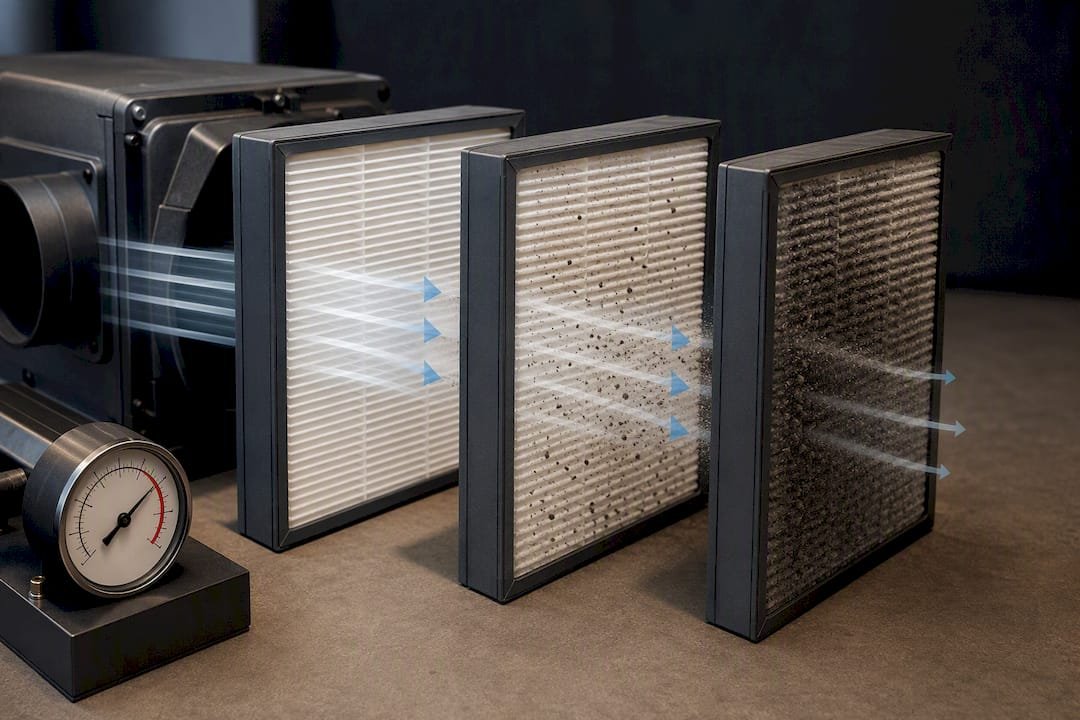
Watch for filter blinding, a gradual drop in airflow as dust loads the media, well before the filter stops working altogether. Schedule replacement on a fixed interval rather than waiting for visible signs, and keep backup filters on site so a mid-shift swap doesn’t cost hours. Manometer drift, even a slow one, means the seal has started to fail somewhere. Treat it as an immediate signal to inspect, reseal and retest, not something to monitor for another hour and see if it stabilises.
Common failure points worth checking first:
- Filter blinding from dry material generating excess dust load.
- Seal degradation at penetrations or airlock junctions, showing up as manometer drift.
- Duct disconnection or crushing reducing effective extraction volume.
- Loss of make-up air control, causing turbulent inflow at doorways.
Any of these calls for stopping work and bringing in the competent person before removal resumes. That’s not a formality, it’s the point where a documented decision either clears the enclosure to continue or forces a rebuild of the affected section.
What real-world capability backs this guidance?
Guidance on paper only means something when it’s been applied on live sites, under real time pressure, with real consequences for getting the sealing or the airflow wrong. A track record of building and monitoring negative pressure enclosures exists across residential, commercial and industrial licensed asbestos removals, working to the same OSHA and ARCA/HSE benchmarks covered above.
That track record includes licensed removal on projects ranging from single-garage strip-outs to larger commercial site clearances, each one requiring its own enclosure design, NPU sizing and monitoring schedule rather than a one-size template. Crews document every smoke test, manometer reading and corrective action as standard practice, not as an afterthought triggered by an audit. The full regulatory framework contractors need to plan against is covered in the NSW asbestos removal regulations guide.
What supervisors get wrong about enclosure priorities
The mistake I see repeated most often isn’t sealing failure, it’s supervisors chasing raw extraction volume as if a bigger NPU automatically means a safer enclosure. Volume matters, but a powerful unit pulling air through one badly placed inlet creates turbulence, not protection. Mixing beats horsepower every time.
Redundancy is the other thing worth treating as non-negotiable rather than a nice-to-have. A backup filter on site, a second NPU on anything beyond a small job, and a written threshold for when readings force a stop, all cost less than the alternative: a failed clearance test and a crew standing around while the enclosure gets rebuilt. Conservative monitoring isn’t caution for its own sake, it’s the cheapest insurance on the job.
— Tarek
Get licensed enclosure setup and removal done right
Expert services are available as an alternative to piecing together your own compliance approach project by project. Such services build and monitor negative pressure enclosures to the OSHA and ARCA/HSE benchmarks covered above, so site supervisors can receive documented smoke tests, manometer logs and corrective-action records without chasing the paperwork themselves.
Engagement runs in a straightforward sequence: site assessment and enclosure design, construction and sealing, NPU provisioning and pre-shift testing, then removal under continuous monitoring through to independent clearance testing before reoccupation. Every step is logged, matching the documentation standards covered in our compliance checklist.
If you’re planning a licensed removal and need an enclosure built and monitored properly the first time, get in touch through our asbestos removal services page for a site assessment.
Sources
For primary technical detail, see OSHA Appendix F, ARCA’s air-management guidance, and Kulmala et al.’s enclosure ventilation study. For related airflow and filtration background, see this indoor air quality guide.
- 1926.1101 App F – Work practices and engineering controls for Class I Asbestos Operations – non-mandatory | Occupational Safety and Health Administration
- Air management in asbestos enclosures (ARCA guidance)
FAQ
What is the 3-5-7 rule for asbestos sampling?
It’s a sampling guideline used to determine minimum sample counts based on the size of a homogeneous area: roughly three samples for smaller areas, up to five or seven as the area or material volume increases, though exact thresholds vary by jurisdiction and should be confirmed against local regulatory guidance.
What is a negative exposure assessment for asbestos?
A negative exposure assessment (NEA) is documented monitoring data confirming that exposures stay consistently below the permissible exposure limit under defined conditions. Running a negative pressure enclosure does not create an NEA automatically; it requires actual sampling and sign off from a competent person.
What is a negative air machine used for in asbestos removal?
A negative air machine, or NPU, draws air continuously from inside the enclosure through a HEPA filter and exhausts it outside, maintaining the pressure differential that keeps fibres from migrating beyond the containment area.
Which precautions require a negative pressure room?
Any licensed removal task involving friable or high-risk asbestos-containing material disturbed inside a sealed area calls for a negative pressure enclosure, built with sealed boundaries, continuous HEPA-filtered extraction, and verified manometer and airflow monitoring throughout the job.
