
A retail strip out removes the non-structural fit-out of a shop, such as fixtures, shopfront joinery, partitions, ceilings, flooring and services, and leaves a clean shell for the next tenant or the next fit-out. The process runs in a fixed order: read the lease, survey for asbestos, secure landlord and centre approvals, disconnect services, strip in the trading window you are given, document the waste and hand back. Most of the delay and cost comes from the first three steps, not the demolition itself.
This guide walks through each step as it applies in Australia, with a focus on NSW rules, and flags what you need in hand before a crew arrives.
TL;DR
- A strip out removes fixtures, fittings and non-structural elements. The building’s structure stays.
- Before any work, the person managing the workplace must supply an asbestos register. If it is missing or inadequate, a demolition or refurbishment survey is needed.
- Shopping centres set their own rules for hours, loading docks and vehicle sizes. Get the centre’s requirements before you fix a start date.
- Waste must be segregated and traceable from site to certified disposal. Keep the paperwork.
- Lease obligations decide the scope. Confirm what “make good” means in your lease before you price anything.
Table of Contents
- What a retail strip out covers (and what it does not)
- Step 1: Read the lease and fix the scope
- Step 2: Asbestos register and survey
- Step 3: Approvals, notifications and permits
- Step 4: Plan around the centre’s servicing rules
- Step 5: Disconnect and isolate services
- Step 6: The strip itself, usually out of hours
- Step 7: Waste, documentation and clean handover
- A realistic timeline
- Our perspective: where retail strip outs go wrong
- How we can help
- FAQ
- Sources
What a retail strip out covers (and what it does not)
A strip out is not a demolition. The aim is to take a tenancy back to a defined condition while the building’s structure stays intact. Depending on the lease and the next use, that can mean:
- Shopfront joinery, counters, shelving and display fixtures
- Signage and branding
- Partitions and stud walls
- Ceiling tiles, grids and lighting
- Floor coverings and sometimes screeds
- Mechanical, electrical and data services back to a nominated point
The words you will see for the same job vary: strip out, defit and make good. A defit usually means removing the tenant’s fit-out. Make good usually means restoring the premises to what the lease requires, which can be more or less than a bare shell. Our own explainer on what building strip outs involve in Australia covers the vocabulary and the asbestos check that sits behind it.
A full demolition goes further and takes out structural elements. If your plan touches load-bearing walls, slabs or the roof, you are in a different approval pathway, and the notification rules covered below start to matter.
Step 1: Read the lease and fix the scope
Start with the lease, not a contractor. The make-good clause tells you what condition the landlord expects at handover, and the design guidelines for a shopping centre tell you what you can touch.
Ask three questions:
- What exactly must be removed? Bare shell, original handover condition, or something in between.
- What must stay? Base-building services, fire systems, sprinkler heads and landlord-owned finishes are often off limits.
- Who approves the works and who signs off the handover?
Then walk the shop with a clipboard. Long-running tenancies often have informal replacements, unrecorded damage or missing fixtures. A pre-strip inventory check against your fit-out drawings or planograms, done before the crew arrives, prevents arguments about accountability and scope creep later. This advice comes from a retail strip-out planning guide and matches what we see on commercial jobs: scope disputes are cheaper to settle before the first partition comes down.
Step 2: Asbestos register and survey
This is the step that stops projects. In NSW, commercial premises built or renovated before 31 December 2003 fall under strict asbestos management duties in the Work Health and Safety Regulation 2017. Before work starts, the person with management or control of the workplace must give the demolition contractor the asbestos register. Where the register is inadequate or missing, a demolition or refurbishment survey by a competent person is required. The detail is in the Safe Work Australia model code of practice on managing asbestos in the workplace.
A few practical points for retail:
- Ceiling tiles, old vinyl floor tiles and their adhesives, wall sheeting behind shopfittings and pipe lagging in back-of-house areas are common places for older materials. Do not assume a recent fit-out means a clean building: the fit-out may sit over original materials.
- A refurbishment or demolition survey is intrusive. It needs the area to be unoccupied, so book it before the shop closes to the public or during a closure.
- If asbestos is found, the removal rules decide who can do the work. For friable asbestos of any amount, or more than 10 m² of bonded non-friable asbestos, NSW Planning guidance says you must engage a suitably licensed person.
A licensed removalist must also give written notice to SafeWork NSW at least five days before licensed asbestos removal starts, as set out in the NSW Asbestos Blueprint. We explain how that works in practice in our guide to SafeWork asbestos notification, and our NSW asbestos removal regulations guide covers the wider rule set. If you need testing first, we offer asbestos inspection and testing.
Treat this as the critical path. Asbestos found halfway through a strip, with no register and a lease deadline looming, is the most expensive way to learn about it.
Step 3: Approvals, notifications and permits
Most internal retail strip outs are modest in regulatory terms, but you should still check each of these before you set a start date.
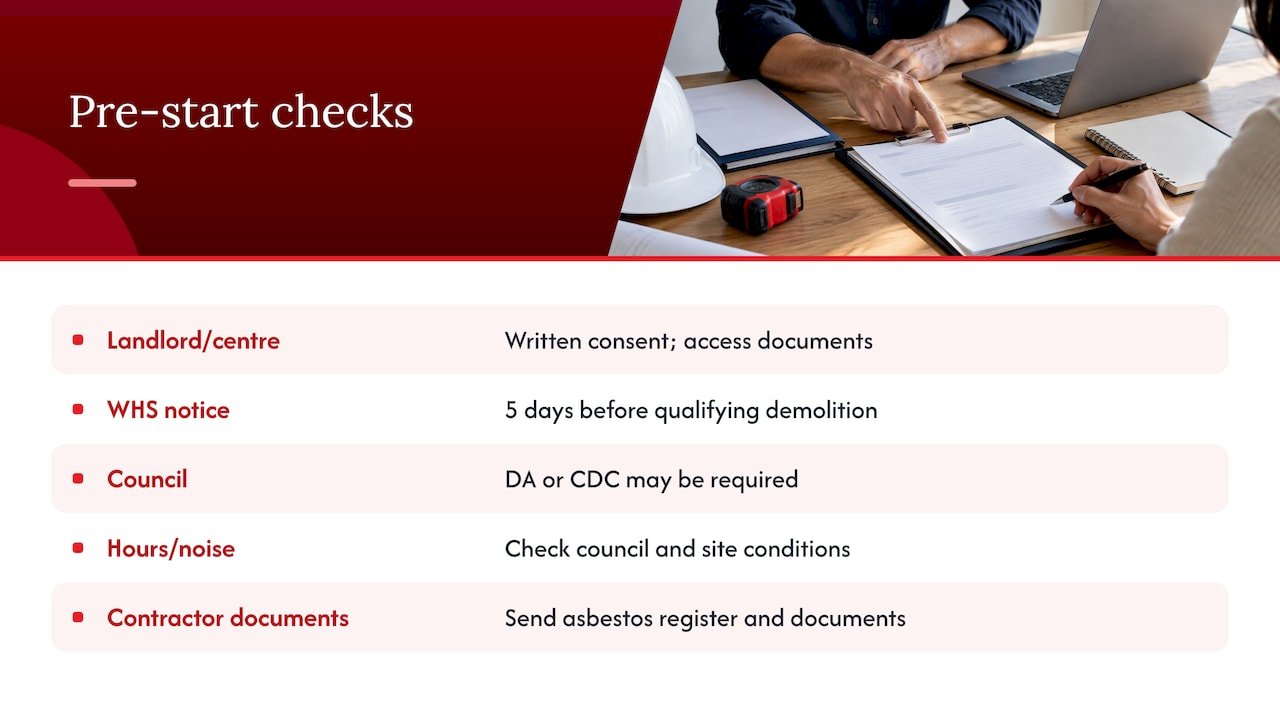
Landlord and centre approval. Almost every tenancy needs written landlord consent for the works, and shopping centres usually want contractor insurance certificates, a method statement and a nominated contact before they release access.
WHS regulator notification. Under the national guidance, notification is required five days before demolition work starts if it involves a structure or part of a structure at least 6 metres high, involves loading shifting machinery onto a suspended floor, or uses explosives. The Safe Work Australia demolition page sets out the duties, including that anyone doing demolition work must be skilled and capable of doing it safely. A typical shopfront strip will not trigger these, but a double-height store or heavy equipment on an upper level might.
Council approval. Depending on how far the works go, councils may require a development application or complying development certificate. Internal strip outs with no change of use are often simpler, but check with the council or a certifier. Our guide to demolition permits in Sydney lists what typically needs approval.
Hours and noise. Council and site conditions set when noisy work is allowed. Our notes on NSW demolition noise rules and working hours and stop-work risks are worth reading before you promise a landlord a schedule.
Failing to notify the regulator or using unlicensed workers can lead to shutdowns and penalties, so make sure all documents, including the asbestos register, reach the contractor before work begins.
Step 4: Plan around the centre’s servicing rules
In a shopping centre, the centre manager, not the contractor, controls your timetable. Centres commonly set delivery windows, mandatory service corridors and vehicle size limits. These rules can override the schedule you would prefer, and contractors who do not follow them get turned away at the dock, which costs a day and sometimes a booking fee. The same retail strip-out planning guide recommends getting the centre’s servicing handbook well ahead.
Before you commit to a date, find out:
| Question | Why it matters |
|---|---|
| Which loading dock and lift can we use? | Determines bin size and how much waste can leave per trip |
| What are the delivery and works windows? | Decides whether you work nights |
| Are vehicle height and length limited? | Limits skip bin and truck choices |
| Is a shopfront hoarding required? | Affects cost and lead time for the centre’s branded barrier |
| Who must be inducted, and when? | Avoids a crew standing at the door on day one |
Step 5: Disconnect and isolate services
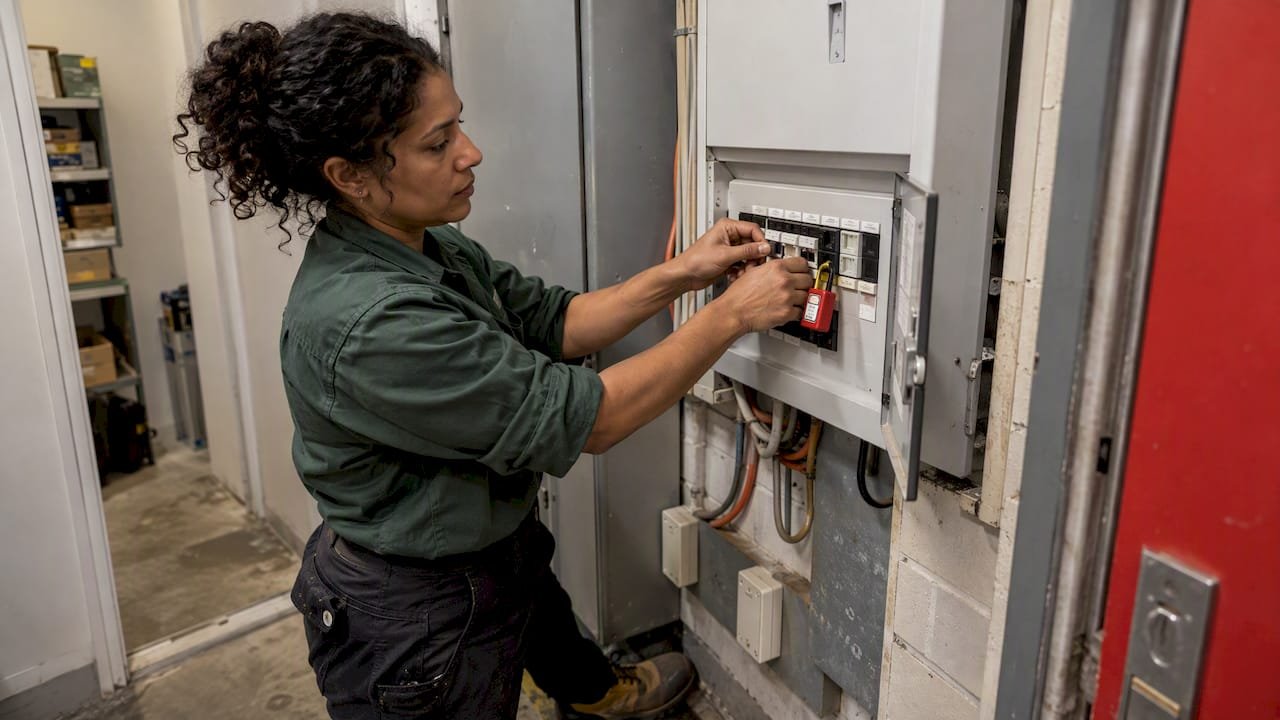
Electrical, hydraulic, data and fire services need to be isolated and made safe before any ceiling or wall comes down. In a retail tenancy that usually means a licensed electrician disconnecting tenancy circuits at the distribution board and a plumber capping water and drainage. In a centre, fire indicator panels and sprinkler isolation are often controlled by the landlord’s fire contractor, so book them early. Building-owned services are not yours to alter, which is why your lease scope matters.
This is also where a project manager earns their keep. Utility disconnections, approvals and waste handling are separate trades with separate lead times, and one late booking can push the whole handover back.
Step 6: The strip itself, usually out of hours
The order of work is fairly consistent:
- Protect and hoard. Barriers, floor protection in common areas and dust control.
- Soft strip. Remove stock, loose fixtures, signage, shelving and fittings.
- Remove ceilings, lighting and partitions.
- Remove floor coverings and adhesives as the lease demands.
- Cut back services to the agreed points and make them safe.
- Sweep, load out and clean.
In high-footfall centres, much of this happens overnight. Out-of-hours work is a specialist skill: the team must work quietly and with little supervision, load the waste, and leave the site in an acceptable state before trading resumes. One industry guide notes that using general demolition labour for these environments often means missing the handover deadline (source). It is a UK source, but the logic holds anywhere with trading-hour restrictions.
If your store is in a standalone building or strip, you have more freedom, but noise and working hours rules still apply. A short job in a small shop can be done in days, but allow for approvals and surveys in front of it, because those take longer than the strip.
Step 7: Waste, documentation and clean handover
A strip out generates a surprising amount of mixed waste: plasterboard, timber, metal, carpet, glass and sometimes hazardous materials. The compliance direction is toward tracking waste through the whole chain. NSW authorities are increasingly focused on illegal dumping and the unsafe disposal of renovation waste, and the NSW EPA’s guidance on asbestos recovered fines reflects that scrutiny. Practically, you should expect to keep:
- Segregation records for what was separated on site
- Weighbridge dockets and disposal receipts
- Asbestos disposal documentation from the licensed removalist, if applicable
The EPA has also announced a free household asbestos waste disposal trial, but that is for households, not commercial tenancies. A retailer cannot rely on it.
Finally, the handover. Landlords commonly inspect against the lease clause, so ask for a final clean and photographs of the finished shell. If you are preparing the space for the next occupant, it also helps to plan the post-works clean and ongoing hygiene up front: this overview of retail cleaning compliance and hygiene is a reasonable starting point for what owners should ask.
A realistic timeline
There is no single duration, because the works depend on size, asbestos findings and centre rules. The order of the lead items is what matters:
| Stage | What drives its length |
|---|---|
| Lease review and scoping | How quickly you can get lease documents and drawings |
| Asbestos register or survey | Access to an unoccupied tenancy, lab turnaround |
| Landlord and centre approvals | Their internal processes and insurance paperwork |
| Notifications (if triggered) | Five days’ notice before the relevant work |
| Strip and handover | Size, trading window, waste volume |
If you have a lease end date, work backwards from it, and leave a buffer for asbestos and approvals.
Our perspective: where retail strip outs go wrong
We see the same three problems repeatedly. The first is a start date set before the asbestos question is answered. The second is a scope based on what the tenant thinks the lease says rather than what it says. The third is a contractor chosen on a headline price without anyone checking whether they can work to the centre’s servicing rules and the handover deadline.
Our advice is to sort paperwork first. Get the register, get the lease clause, get the centre’s handbook, and only then talk dates. A strip out with those three documents on the table is predictable. Without them it becomes a series of surprises, and surprises on a retail tenancy cost trading days and rent.
We handle strip outs as a managed job: approvals, utility disconnections, hazardous waste handling and a final clean sit with one team, so you are not coordinating five trades yourself.
— Tarek
How we can help
If you are clearing a shop, tenancy or commercial space in Sydney, our interior strip out services cover removal of fit-outs, licensed asbestos work where it is found, waste handling and a clean finish. For wider projects, see our commercial and demolition services or get in touch through the main site to talk through your scope and timeline. We do not publish prices, because each job depends on its scope and site conditions.
FAQ
Do I need a licence to strip out a retail shop?
General strip out of fixtures does not carry a single dedicated licence, but anyone doing demolition work must be skilled and capable of doing it safely. Asbestos is different: friable asbestos of any amount, or more than 10 m² of bonded non-friable asbestos, needs a suitably licensed person.
Is an asbestos survey always required before a strip out?
In NSW, premises built or renovated before 31 December 2003 need an asbestos register, which the person managing the workplace must give the contractor. If the register is missing or inadequate, a demolition or refurbishment survey by a competent person is required.
Who pays for the strip out at the end of a lease?
The lease decides. Most commercial leases include a make-good clause that puts restoration on the tenant, but the scope varies. Read the clause, and ask the landlord or agent to confirm in writing what must be removed.
Can a strip out be done while the centre is trading?
Often yes, but usually out of hours, subject to the centre’s servicing rules and noise conditions. The centre will specify windows, loading docks and vehicle limits, so get those details before agreeing a handover date.
Sources
- Safe Work Australia: How to manage and control asbestos in the workplace
- Safe Work Australia: Demolition
- NSW Planning: Asbestos removal, exempt and complying development
- SafeWork NSW: NSW Asbestos Blueprint 2017
- NSW EPA: Management of asbestos recovered fines material
- NSW EPA: Making it free to dispose of household asbestos waste
- Retail strip-out planning guide
- Retail strip out overview