
A shop defit is the work of stripping out your fitout and returning the tenancy to the condition your lease requires. In practice it runs in a set order: read the lease and agree the scope with the landlord, check for asbestos, disconnect services, strip out, dispose of waste lawfully, make good, and hand back. Get the order wrong and you pay for it in holdover rent, rework or waste liability.
This guide walks through each stage the way a retail tenant, centre manager or project manager meets it. It covers who decides what, which rules apply, what slows a job down and what to check before you hand over the keys.
TL;DR
- A defit removes your shopfit and restores the tenancy to its lease condition. A shopfit does the opposite: it designs and builds.
- Agree the make-good scope in writing with the landlord before any work starts. Works normally need to finish by lease end, or holdover rent can follow.
- For buildings built before 31 December 2003, review the asbestos register first. Remove any identified asbestos before demolition or refurbishment work begins.
- Waste owners and transporters can both be liable if waste goes to a facility not authorised to take it, so check where your contractor sends it.
- Book early. Approvals, service disconnections and landlord inspections set the timeline more than the strip-out itself.
Table of Contents
- What a shop defit is, and how it differs from a fitout
- Stage 1: Read the lease and agree the scope
- Stage 2: Site inspection and planning
- Stage 3: Asbestos check before anything is touched
- Stage 4: Approvals and building rules
- Stage 5: Service disconnection
- Stage 6: Strip-out and removal
- Stage 7: Waste sorting and lawful disposal
- Stage 8: Make good
- Stage 9: Inspection and handover checklist
- How long a shop defit takes
- What affects the cost
- Our perspective: where defits go wrong
- Planning a shop defit in Sydney?
- FAQ
- Sources
What a shop defit is, and how it differs from a fitout
A defit (also called a strip-out or, at the end of a lease, make good) takes out what a tenant installed: shelving, counters, partitions, feature walls, lighting, signage, floor coverings and cabling. A fitout is the reverse. It designs and installs those elements for a business. If you are leaving a shop, you need a defit. If you are moving in, you need a fitout, and sometimes a partial defit of the previous tenant’s work first.
The two terms are often used loosely, so it helps to separate three jobs:
| Job | What it does | Typical trigger |
|---|---|---|
| Strip-out | Removes fixtures, fittings and finishes, partly or fully | Refurbishment, new tenant, demolition |
| Defit | Strips out and restores the space to base-building or lease condition | Lease end, relocation, closure |
| Make good | Repairs what is left: patching, painting, flooring, ceiling tiles | After strip-out, before handover |
The lease decides which of these you owe. Some leases ask for a bare shell, others for the original condition recorded at handover, and some let the landlord keep selected fitout items. Reading that clause is the first step, not the last.
Stage 1: Read the lease and agree the scope
Start with the make-good clause, any schedule of condition and any landlord consent requirements for works. The RICS Australia make good standard, published in October 2023, says landlord and tenant should agree the make-good scope before work starts. It also says works normally need to be complete by lease end, otherwise the tenant may pay holdover rent while they finish.
In practice, get these things in writing:
- Which items must be removed and which can stay (for example, ceiling grid, floor slab finishes, base-building lighting).
- The standard of reinstatement: bare slab, patched and painted walls, or as per a condition report.
- Landlord or centre rules: work hours, loading dock access, lift bookings, insurance certificates and bonds.
- The inspection process and who signs off.
A shopping centre will usually have its own tenancy coordinator and a set of design and works guidelines. A strip-shop landlord may have little more than the lease. Either way, a scope that exists only in a phone call is the most common source of disputes at handover.
Stage 2: Site inspection and planning
A contractor walks the tenancy to measure what is actually there, not what the plans say. They look at ceiling voids, concealed services, partition types, floor finishes, mezzanines, shopfronts and any signage fixed to the exterior. This is also where a defit quote becomes reliable: a price given without a site visit is a guess.
A sound plan after inspection includes:
- A scope list matched line by line to the lease.
- A programme with the order of trades, disconnection dates and waste pick-ups.
- A list of approvals or notifications needed.
- A hazardous materials plan, which brings us to the stage most tenants underestimate.
Stage 3: Asbestos check before anything is touched
Asbestos was widely used in Australian buildings until it was banned nationally from the end of 2003. Shops built or refurbished before then can contain it in ceiling sheeting, vinyl floor tiles and adhesives, wall linings, lagging and roof sheets.
Safe Work Australia’s code of practice on managing asbestos in the workplace says that before demolition or refurbishment of a structure built before 31 December 2003, the owner or manager must review the asbestos register. Any identified asbestos or asbestos-containing material should be removed, so far as is reasonably practicable, before the work starts.
For a tenant that means:
- Ask the landlord or building manager for the asbestos register early. If there is none, or it does not cover your tenancy, arrange an inspection. Our guide to what an asbestos survey involves explains what you receive.
- If suspect material sits in the area to be stripped, stop and have it sampled and assessed. Do not let a general strip-out crew break it up to see what it is.
- Use a licensed removalist where the work requires one. Safe Work Australia’s guidance on safe removal says licensed removalists must manage and label asbestos waste to GHS requirements.
Licensing and notification rules differ between states. If you work in New South Wales, see our NSW asbestos regulations guide. For the difference between the two licence classes, read Class A vs Class B asbestos. Property managers keeping records for several tenancies may find the asbestos register requirements audit useful.
This is the one stage where a delay is worth accepting. Disturbing asbestos mid-strip-out can halt the site, contaminate the tenancy and neighbouring shops, and cost far more than the inspection that would have caught it.
Stage 4: Approvals and building rules
Do not assume that a defit is exempt from approvals just because you are removing things. The RICS standard specifically warns that returning a tenancy to its former layout does not automatically make the reinstatement work exempt from a building permit. Check the following before you book trades:
- Landlord or centre consent for the works and the contractor.
- State or local approvals, including any exemptions that apply in your state and whether reinstating walls, exits or fire-rated elements needs approval.
- Fire and essential safety: sprinklers, detectors, exit signs and emergency lighting that must stay compliant while work happens.
- Structural elements: removing a mezzanine or cutting a slab opening needs proper assessment. Concrete cutting should be planned, not improvised.
- Planning or heritage controls if the shopfront or building is listed.
- Access and hours: many centres only permit noisy work overnight.
Ask your contractor which of these they handle and which stay with you. A full-service contractor typically manages approvals, utility disconnections, hazardous waste handling and final cleaning as one package, which cuts the number of parties you need to chase.
Stage 5: Service disconnection
Electrical, data, gas, water, hydraulic and fire services have to be isolated and, depending on your lease, capped or reinstated to base-building points before demolition starts. Licensed electricians and plumbers perform the disconnection, and cabling that serves other tenancies must not be cut. Confirm in writing which points the landlord wants the services returned to. Tenants often discover at inspection that capped-off is not the same as reinstated, and the gap becomes a late, expensive call-out.
Stage 6: Strip-out and removal
Once the area is cleared of hazardous materials and services are isolated, the physical strip-out follows a sensible sequence:
- Remove stock, loose furniture and equipment (your responsibility, before the contractor arrives).
- Dismantle point-of-sale fixtures, shelving, display systems and signage.
- Remove ceilings, lighting and partitions as the scope requires.
- Lift floor coverings and adhesives back to the specified substrate.
- Cut and remove any slab or structural elements covered by the approved scope.
Work top-down: ceilings and overhead services first, floors last. That keeps debris from damaging finishes you intend to retain. Protect the common areas, lift and loading dock, because damage there is charged back to you.
If you need an interior strip-out in Sydney, our interior strip-out service covers retail, office and commercial tenancies, and it can run as part of a wider demolition scope on our demolition services page.
Stage 7: Waste sorting and lawful disposal
A shop strip-out generates a surprising volume of mixed waste: plasterboard, timber, metal framing, carpet, glass, laminates, lighting, and cardboard from packing. The NSW EPA’s construction and demolition waste toolkit is clear that waste must be disposed of lawfully. Both the waste owner and the transporter can face significant penalties, including fines and criminal convictions, if waste goes to a facility not authorised to receive it. The same toolkit advises project managers and procurement officers to check how contractors manage and dispose of waste.
That is a practical point for tenants: you are the waste owner even though a contractor trucks it away. Ask for:
- The names of the facilities where each waste stream goes.
- Weighbridge dockets or disposal receipts after the job.
- Separate handling and documentation for asbestos waste.
Sorting on site also reduces tip costs and lets metals, timber and clean rubble be recycled. Retail tenants who generate a lot of packaging during the final trading weeks can reduce loads with cardboard compactors and balers, which turn bulky cardboard into dense bales that are easier to collect. For what is involved in lawful removal in Sydney, see our page on demolition waste removal.
Stage 8: Make good
After the strip-out, make good repairs what is left so the tenancy meets the lease standard. Typical items:
- Patching and repainting walls.
- Repairing or replacing ceiling tiles and grid sections.
- Floor preparation: removing adhesive, grinding, levelling or sealing the slab.
- Removing signage and decals and repairing fixings in the facade.
- Final clean, including glazing and the removal of all rubbish.
Leases vary on whether you must repaint, reinstate ceilings or leave a bare shell, so match the work to the agreed scope rather than a general idea of good condition.
Stage 9: Inspection and handover checklist
Before you ask the landlord to inspect, do your own walk-through with the scope in hand. Check:
- Every item on the agreed removal list is gone, including from ceiling voids and cupboards.
- Services are capped or reinstated at the points the landlord specified, and tagged where required.
- Walls, floors and ceiling are repaired to the lease standard, with no adhesive residue or unfilled fixings.
- Signage, decals and exterior fixings are removed and the facade repaired.
- Asbestos documentation, if any was handled, is on file with any clearance certificates.
- Waste dockets and disposal receipts are collected.
- Keys, access cards and remote controls are ready for return.
- The tenancy is clean and photographed from consistent angles, ideally with dated images.
Ask the landlord to list any defects in writing so you can rectify them promptly. Small defects found on the day are far cheaper to fix while the trades are still available than after demobilisation.
How long a shop defit takes
There is no standard duration, because it depends on the tenancy and the stage the paperwork is in. A small, simple shop with no hazardous materials is a much shorter job than a large store with mezzanines, heavy services and a long landlord approvals process. What moves the timeline most:
- Approvals and landlord sign-off. These often take longer than the physical work.
- Asbestos. Inspection, testing and licensed removal must happen before general strip-out in affected areas.
- Service disconnections. Utility providers and licensed trades have lead times.
- Access restrictions. Night-only work in a centre stretches the programme.
- Waste logistics. Limited dock space and lift access slow removals.
- Make-good scope. Reinstating floors and ceilings adds trades and curing or drying time.
Always book the defit so it finishes before lease end, with a buffer. Holdover rent is the cost of running over.
What affects the cost
We do not publish fixed prices because every tenancy differs, but the cost drivers are consistent:
- Floor area and the density of fixtures.
- Whether the scope is a partial strip-out or full defit with make good.
- Presence of asbestos or other hazardous materials.
- Structural work and concrete cutting.
- Waste volume and distance to authorised facilities.
- Access hours, such as after-hours or weekend work.
- Services reinstatement requirements.
The costs that surprise tenants are usually the ones left out of the quote: hazardous materials, after-hours access and make good beyond the basics. Ask for a scope that names each, so quotes can be compared like for like.
Our perspective: where defits go wrong
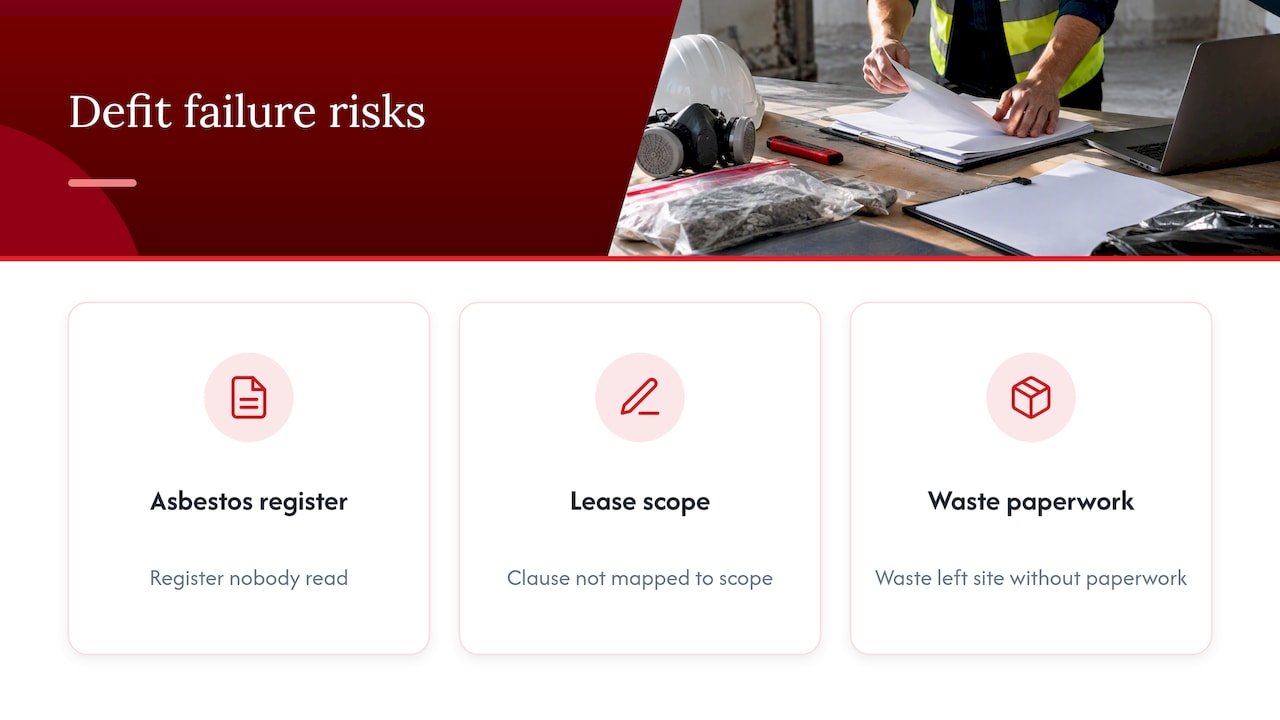
We plan a defit around the risks that cannot be undone, not the work that is visible. The strip-out itself is rarely the problem. The problems are an asbestos register nobody read, a lease clause that nobody mapped to the scope, and waste that left site without paperwork.
Our advice is simple. Read the lease before you request quotes. Ask for the asbestos register before you walk the site. Get the make-good scope agreed in writing with the landlord. And require that your contractor tells you where every waste stream goes. A contractor who can answer those four things clearly has usually done this before.
We handle demolition, licensed asbestos work, strip-outs, concrete cutting and site clearance, so approvals, disconnections, hazardous waste and final cleaning can sit under one project manager. That matters most when the timeline is tight and the lease end is fixed.
— Tarek
Planning a shop defit in Sydney?
If you are clearing a retail tenancy, tell us the lease end date and send the make-good clause. We will inspect the site, flag any asbestos questions up front and give you a scope you can show your landlord. Start on our demolition and strip-out services page or arrange an asbestos inspection and testing before work begins.
FAQ
What is the difference between a defit and a make good?
A defit removes the tenant’s fitout, while make good repairs the tenancy afterwards so it meets the lease standard. In practice the two are bundled in one job. Check your lease, because it defines exactly what condition you owe the landlord.
Do I need asbestos testing for a shop defit?
If the building was constructed before 31 December 2003, the asbestos register must be reviewed before demolition or refurbishment work starts, and identified asbestos should be removed where reasonably practicable. Where no register exists or it does not cover your tenancy, arrange an inspection by a competent person before strip-out begins.
Who is responsible for waste from the defit?
You are the waste owner, even if a contractor transports it. The NSW EPA states that both owners and transporters can be penalised if waste goes to a facility not authorised to accept it. Ask for disposal dockets and the names of the receiving facilities.
When should I start planning a defit?
Begin as soon as you know the lease will end, ideally several months ahead, because approvals, asbestos checks and service disconnections all have lead times. Running past lease end can trigger holdover rent under the lease.
Is reinstating the original layout exempt from a permit?
Not automatically. RICS Australia warns that returning a tenancy to its previous layout does not guarantee the work is permit-exempt. Confirm with your contractor or a building surveyor before work starts.
Sources
- RICS Australia, Make good Australia, 3rd edition (October 2023)
- Safe Work Australia, How to manage and control asbestos in the workplace (code of practice)
- Safe Work Australia, How to safely remove asbestos (code of practice)
- NSW EPA, Construction and demolition waste: a management toolkit