
Before any demolition in New South Wales, every essential service must be shut off, capped or otherwise controlled at or outside the building line, and that work needs to be documented. Use licensed tradespeople, notify the relevant utility agency for each service, and lodge a Before You Dig Australia enquiry early. Collect written approvals and inspection records before the demolition crew arrives on site.
TL;DR:
- Permanent disconnection of electricity requires written approval from the property owner and retailer, and site cannot draw power again until a new connection is approved.
- Water and sewer disconnection processes vary by authority, with internal water lines needing to be disconnected and sewer junctions capped, confirmed by inspections.
- Utility disconnections must be booked separately with each provider, and delays often occur if scheduling steps are not coordinated properly.
- A specialist demolition contractor can manage all disconnection steps, provide official approvals, and ensure records are complete, especially on complex sites.
- Proper documentation, including approvals, inspection records, and photographs, is essential for legal protection and compliance during and after demolition.
Table of Contents
- Which utilities need disconnecting before demolition in NSW
- Who’s responsible for disconnection approvals in NSW?
- How long does utility disconnection take before demolition?
- A step by step checklist for sequencing disconnection
- How a licensed demolition specialist manages disconnections
- Common pitfalls and quick remedies
- Get your utility disconnection and demolition managed properly
- Sources
- FAQ
Which utilities need disconnecting before demolition in NSW
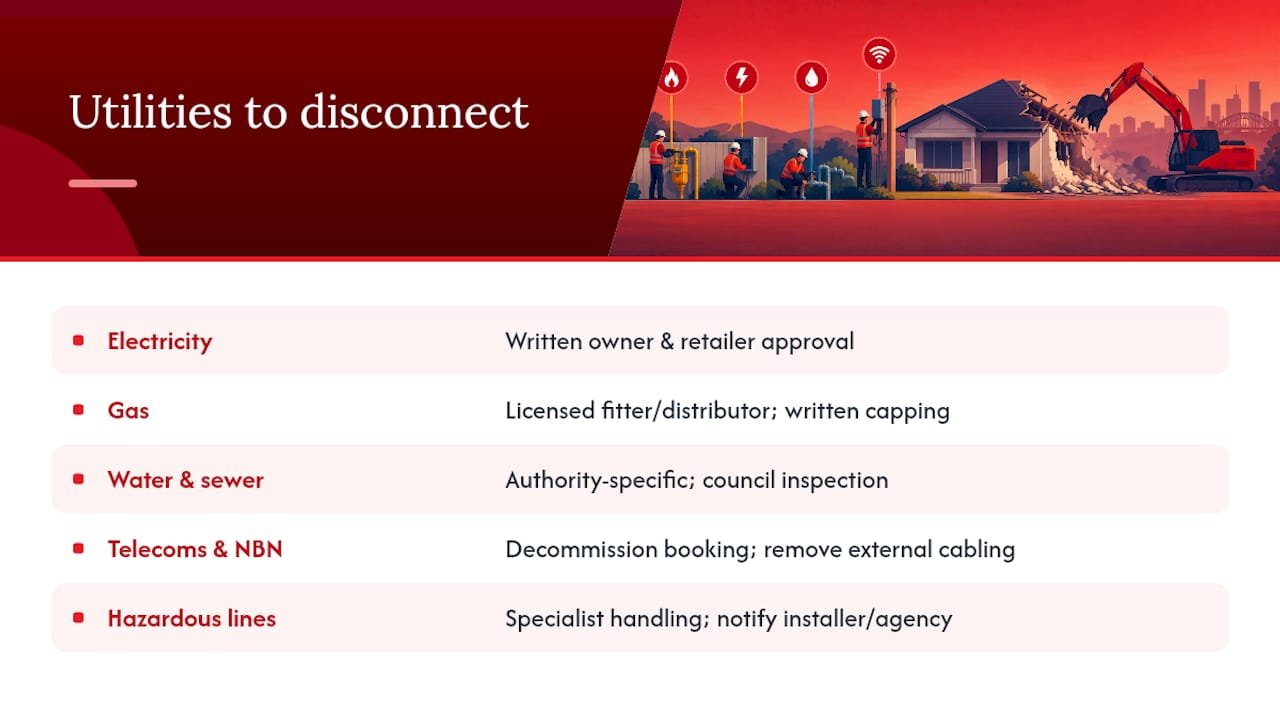
Every service line not required during demolition has to be shut off, capped or controlled at or outside the building line, according to SafeWork NSW’s demolition code. That single rule covers five separate service types, each with its own process and its own regulator.
Electricity is the one most people get wrong. Flicking off the switchboard is not disconnection. There’s a real difference between switching off, removing the meter, and permanently disconnecting a property. Permanent disconnection needs written approval from both the property owner (or their agent) and the electricity retailer, and once it’s done, Ausgrid confirms the site cannot draw or export power again until a fresh connection is approved. That has implications for the National Metering Identifier (NMI) tied to the address, so keep a record of the meter number and NMI before the retailer pulls the plug.
Gas disconnection has to go through a licensed gas fitter or the distributor, and you need written confirmation that the line has been capped, not just isolated at the meter.
Water and sewer work differs by authority. Sydney Water sites follow one process; regional sites follow another. Shoalhaven Water’s demolition guidance is a useful illustration: internal water lines must be disconnected and sewer junctions temporarily capped, with a council inspection confirming compliance before anything else proceeds. Don’t assume your local authority runs an identical process.
Telecommunications and NBN infrastructure needs a decommissioning booking with the provider, including removal of any external cabling that could snag equipment during demolition.
Hazardous lines, including LPG tanks, embedded network connections and private fuel lines, need specialist handling. These often sit outside the standard utility notification chain, so they need a separate call to the installer or a licensed gas fitter, plus notification to the relevant agency if the tank or line is registered.
Who’s responsible for disconnection approvals in NSW?
Responsibility splits three ways, and mixing them up is where most delays happen.
- The utility agency approves and physically executes the disconnection, whether that’s Ausgrid cutting power at the pole, a retailer signing off on account closure, or a water authority inspecting a capped line.
- Licensed tradespeople (electricians, gas fitters, plumbers) carry out the on site isolation work that the utility agency requires before it will action a disconnection.
- The demolition contractor or principal contractor coordinates the whole sequence, confirms every service is genuinely isolated, and holds the paperwork.
The regulatory backbone sits across two bodies. The NSW Planning Portal sets out development consent conditions tied to demolition, while SafeWork NSW governs the work health and safety side, including when a Safe Work Method Statement (SWMS) is mandatory for high risk work near energised or pressurised services. Certain demolition jobs also require a demolition licence issued through Service NSW, and larger or higher risk jobs require notification to SafeWork NSW at least five working days before work starts.
How long does utility disconnection take before demolition?
Budget more time than feels necessary, because the slowest provider sets your start date, not the fastest.
- Water authority inspections and electricity distributor confirmations are usually the longest lead items. Book them first.
- Gas and telecommunications disconnections tend to move faster once a job is lodged, but still need weeks, not days.
- Before You Dig Australia enquiries return results quickly, but translating those plans into marked, physically located services on site can add time if potholing is needed to confirm an unknown cable’s position, a step SafeWork NSW’s demolition code treats as standard practice for underground services.
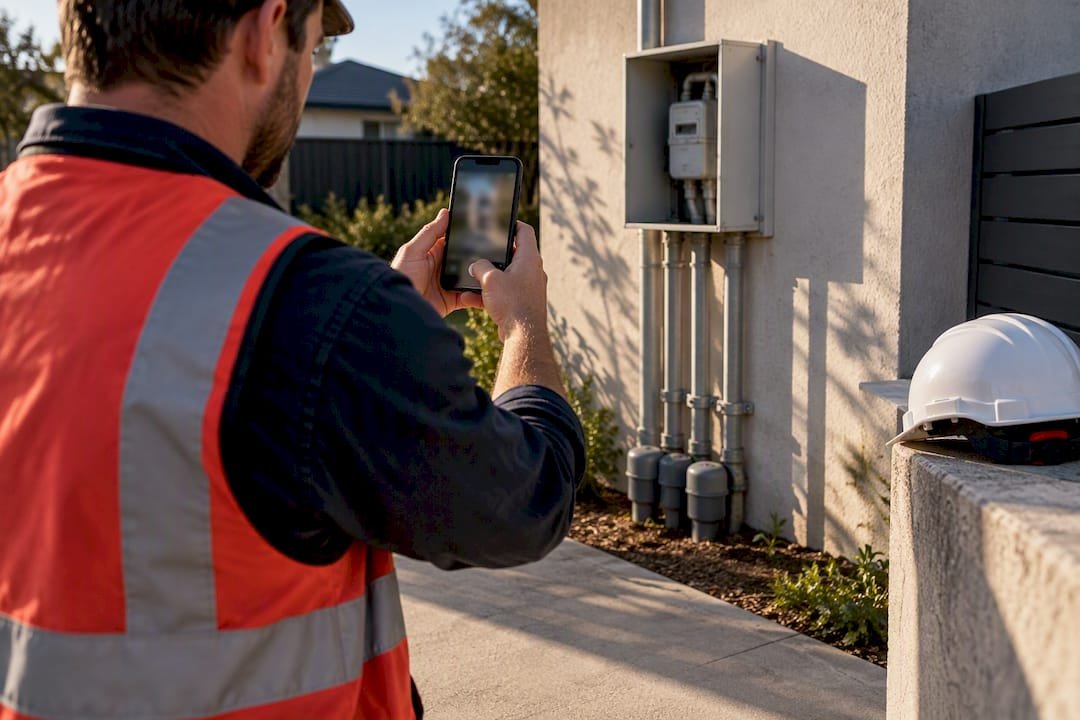
Your evidence pack should include the Before You Dig Australia plan and job number, written approvals from each utility, meter and NMI details, licensed trades certificates, water or sewer inspection records, and dated photographs of every capped or removed line.
Pro Tip: Do a physical walk of the site with your contractor the day before demolition starts and photograph every isolation point again. Paperwork can be weeks old by the time crews arrive, and a fresh photo record is what protects you if a regulator or insurer asks questions later.
A step by step checklist for sequencing disconnection
Sequencing matters more than most people expect. Miss a step and you either delay the job or, worse, start demolishing over a live service.
- Obtain your Development Application or Complying Development Certificate and read every condition tied to services and demolition.
- Appoint your principal contractor and nominate exactly who owns each disconnection task.
- Lodge a Before You Dig Australia enquiry and have every located service physically marked on site.
- Book disconnections with the electricity distributor, retailer, water authority and telecommunications provider, and get written confirmation of each.
- Verify isolation at a pre start walk through, finalise the SWMS, confirm asbestos controls are in place, then begin demolition.
How a licensed demolition specialist manages disconnections
A specialist contractor earns their fee here by removing the coordination burden entirely. A specialist demolition contractor can manage Before You Dig Australia enquiries, book licensed trades, coordinate utility confirmations, and handle licensed asbestos removal if needed, all as part of one project timeline rather than requiring multiple separate phone calls.
What you should expect back from any contractor doing this properly:
- Job numbers and confirmation records for every utility booking
- Written approvals from the distributor, retailer and water authority
- Inspection certificates and dated photographic evidence of capped or removed lines
- A pre start sign off confirming every service is genuinely isolated
Hiring a specialist matters most on complex sites: embedded or private services, asbestos containing materials, or projects where a compliance delay carries real financial cost.
Common pitfalls and quick remedies
The most common mistake is assuming an internal switch or meter reading means a service is isolated. It doesn’t. Ausgrid’s own guidance draws a clear line between switching off and true disconnection, and that distinction gets missed constantly on owner managed jobs. The second mistake is treating disconnection as one booking rather than four or five parallel ones, each running to its own timeline.
The fix is simple: nominate one coordinator, build the evidence pack as you go rather than after the fact, and schedule around whichever service authority moves slowest.
— Tarek
Get your utility disconnection and demolition managed properly
Mission Demolition is the alternative to juggling five separate utility calls yourself. Instead of chasing distributors, retailers and water authorities on your own timeline, one team runs the whole sequence, from the Before You Dig Australia enquiry through to the pre start sign off, and hands you the evidence pack at the end rather than leaving you to assemble it.

Whether you’re planning a residential demolition or managing a larger site with asbestos present, the deliverables stay the same: booking confirmations, written approvals, inspection attendance, and documented proof that every service was properly isolated before the first wall came down. That paperwork is what protects you if a regulator or your insurer ever asks questions later.
Get in touch through Mission Demolition for a quote or a site inspection, and get your disconnection sequence sorted before you lock in a demolition date.
Sources
- Demolish – MyHome Planner | NSW Planning Portal
- Code of Practice – Demolition work (SafeWork NSW)
- Disconnections | Ausgrid
- Demolition information | Shoalhaven Water
FAQ
How do I disconnect electricity before demolition in NSW?
You need written approval from both the property owner and the electricity retailer before a permanent disconnection, and Ausgrid’s process confirms the site cannot draw power again until a new connection is approved. A licensed electrician handles the physical isolation work.
What are the rules for electricity disconnection in NSW?
Switching off power at the switchboard is not the same as disconnection. Permanent disconnection requires written retailer and owner approval, and any temporary power kept on site during demolition must comply with AS/NZS 3012:2019, inspected and tested by a licensed electrical worker before energisation.
What are the requirements for demolishing a building in NSW?
You need development consent conditions satisfied through the NSW Planning Portal, a demolition licence where the work triggers one, and all essential services disconnected and documented before work starts. Some projects also require SafeWork NSW notification at least five working days ahead.
What standards apply to demolition of structures in NSW?
The core reference is the SafeWork NSW Code of Practice for demolition work, covering service isolation, SWMS requirements and high risk work near energised or pressurised lines. Temporary electrical installations on site must also meet AS/NZS 3012:2019.
Can a demolition contractor handle utility disconnection for me?
Yes. A specialist contractor can coordinate Before You Dig Australia enquiries, licensed trades and utility bookings, then supply the written approvals and inspection records as one complete package. Current pricing for demolition services is available directly through the site.
