Most demolition waste in Australia is recycled, but how much of your project’s waste is recovered depends on how it is sorted before it leaves the site. Nationally, about 23.2 Mt of the 27.4 Mt of building and demolition material generated in 2024–25 was recycled, a recovery rate of 86%, according to the Department of Climate Change, Energy, the Environment and Water (DCCEEW). Clean, separated loads of concrete, brick, metal and asphalt are the ones that get recovered. Mixed loads, and any load with asbestos in it, are where projects lose money and risk compliance problems. A demolition contractor that plans the waste stream before the first wall comes down, and handles approvals, hazardous waste and site cleaning as one job, is how owners and developers get the recycling result without managing it themselves.
TL;DR
- About 86% of Australia’s building and demolition material was recycled in 2024–25, the second highest recovery rate of any material category after metals.
- Concrete, brick, asphalt and metals have strong recycling markets. Mixed loads and anything containing asbestos do not, and asbestos must never enter a recycling stream.
- Smaller demolition jobs more often send mixed loads straight to landfill, while large projects usually recover most of their waste. Separation at the source decides which group you fall into.
- Asbestos is identified, removed and disposed of by licensed people at licensed facilities, before or alongside demolition.
- A contractor that manages the waste, utilities, approvals and final clean from the start keeps your project on the right side of both cost and compliance.
Table of Contents
- How much demolition waste does Australia recycle?
- What gets recycled, and into what
- Why small jobs recover less than big ones
- How to separate demolition waste so it can be recycled
- Asbestos: the material that must stay out of recycling
- Finding a facility that accepts your load
- What this means by project type
- Doing it right: our view
- Plan your demolition with the waste in mind
- FAQ
- Sources
How much demolition waste does Australia recycle?
Building and demolition waste is one of the largest waste streams in the country, and also one of the best performers. The national report states that in 2024–25 about 27.4 Mt was generated, around 1.0 tonne per person, and 23.2 Mt was recycled. The figure is published for that reporting year and is updated when the national report is next released, so check the latest edition for newer numbers.
The trend is upward. In 2022–23 the recovery rate was 84% (22.4 Mt of 26.8 Mt), up from 76% in 2016–17. The category is dominated by heavy materials such as concrete, bricks and rubble, which are cheap to crush and have ready buyers.
State figures show the same pattern with different starting points:
| State | Period | C&D recovery result |
|---|---|---|
| South Australia | 2022–23 | 97% recovered; metropolitan diversion 97.4% against a 2025 target of 95% |
| Queensland | 2024–25 | 85.0%, up from 50.9% in the 2017–18 baseline |
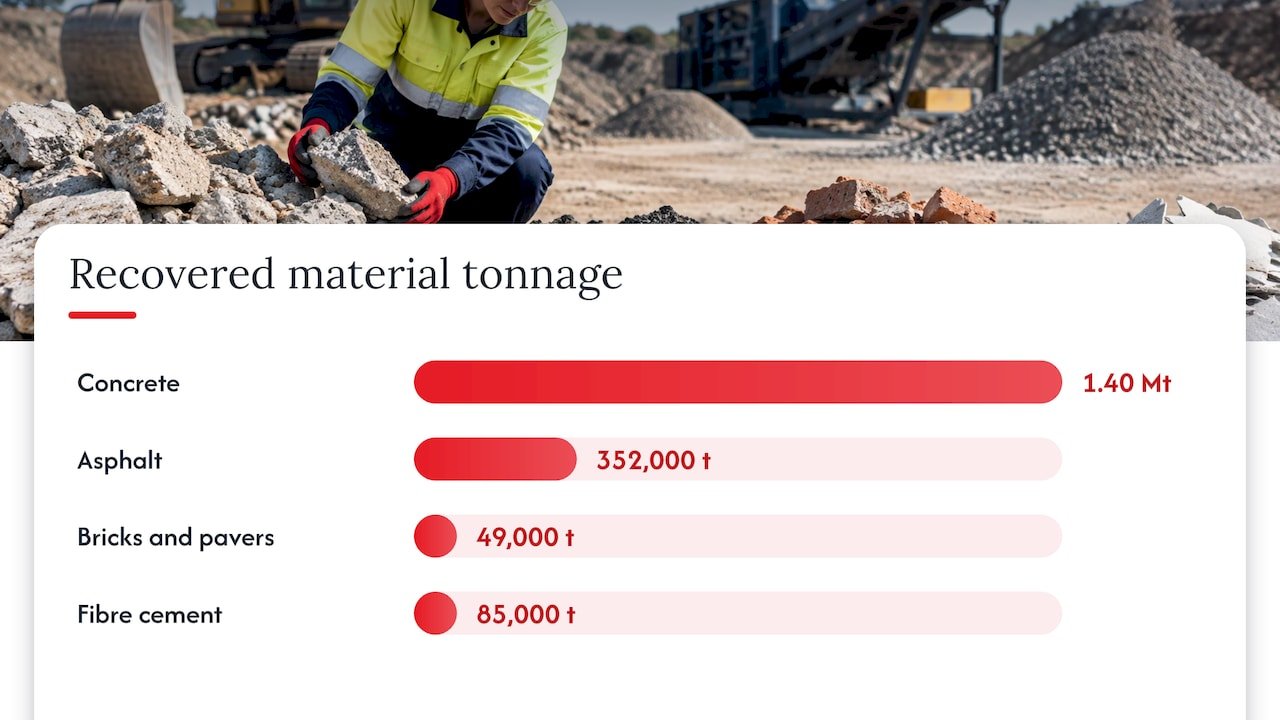
Queensland’s report also shows what is being recovered: about 1.40 million tonnes of concrete, roughly 352,000 t of asphalt, about 49,000 t of bricks and pavers and about 85,000 t of fibre cement in 2024–25. Concrete alone accounted for 48.1% of the C&D waste recovered.
What gets recycled, and into what
On a typical house, commercial or industrial job, the waste breaks into a handful of streams. Each has its own destination.
Concrete, brick and rubble
These make up the bulk of the tonnage. DCCEEW reports good markets for recycled concrete aggregate in road base, aggregates and hardstands, and good options for recycling bricks and asphalt. The federal C&D waste guide notes that crushed concrete and brick are used in all-weather surfaces and pavement sub-bases as a substitute for virgin crushed rock, and that recycled crushed concrete can offer 10–15% more product volume than equivalent crushed quarry rock.
Asphalt
Asphalt is potentially 100% recyclable. The same guide says Australian asphalt mixes generally contain 10–15% recycled content, and more where it is appropriately managed. This matters for site clearance jobs with driveways, car parks and hardstand.
Metals
Metals are the highest-value stream. The guide states that about 90% of metals recovered from the C&D sector come from commercial demolition, up to 95% of it steel, with the rest mostly aluminium, stainless steel and copper. It puts mixed steel scrap at around $250 per tonne, though that is a 2012 figure and scrap prices move with the market. Industrial and warehouse demolitions, with their structural steel, are where this stream matters most. If you are weighing a steel-heavy site, our guide to industrial demolition in Sydney explains how those jobs run.
Timber
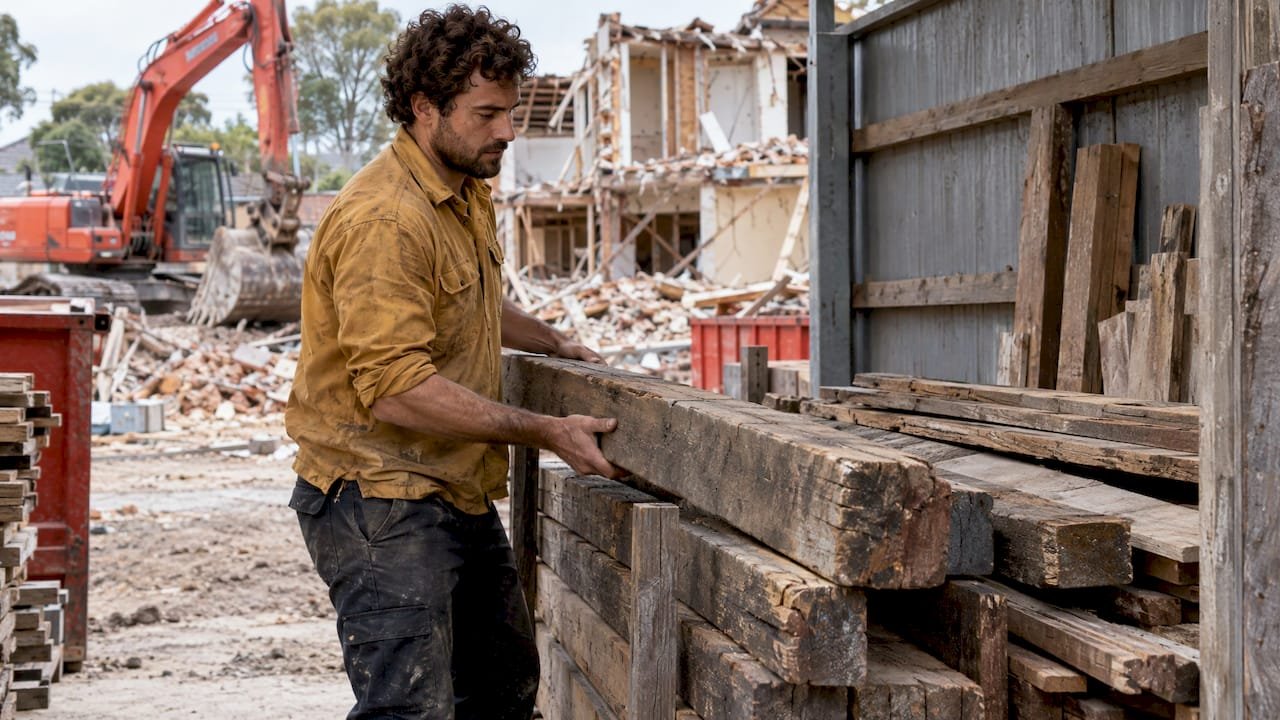
Timber splits into reusable and non-reusable. The same guide estimates the national timber re-use market at about 60,000 cubic metres, with high-grade Australian hardwoods fetching over $1,000 per cubic metre. Old hardwood beams and flooring are the pieces worth pulling out by hand before machines arrive. Lower-grade and treated timber goes to other uses, such as energy recovery in some states.
Plasterboard, glass, plastics and the rest
The Western Australian Waste Authority lists the wider C&D stream as including wallboard, glass, plastics, soil and other building products, with recycled outputs such as road base, drainage aggregate, clean fill and sand. It also notes energy recovery from wood and plastics, and glass used in brickmaking or asphalt. Availability of these outlets differs by state and by facility, so the receiving site’s acceptance list is what counts.
Why small jobs recover less than big ones
The national figure hides a gap. DCCEEW observes that smaller demolition projects often send mixed loads directly to landfill, while most large development projects recover their waste.
The reasons are practical:
- A single mixed skip is easy to order and hard to unpick. Once brick, timber, plasterboard and plastic are in one bin, a recycler either sorts it at a cost or sends it on to landfill.
- Large sites have space for separate stockpiles and bins. A suburban block may have room for one skip and a driveway.
- Where landfill fees and levies are high, recovery pays. The federal guide notes there is a strong incentive to recover the heavy components, and that in some metropolitan areas reprocessed products can compete commercially with quarry products. Queensland’s 2024–25 report notes its waste levy raised $459.9 million, which gives a sense of the cost of landfilling at scale.
For a homeowner clearing a block for a new build, this means the waste plan is a cost decision as well as an environmental one. Our residential demolition page covers what a full house job involves.
How to separate demolition waste so it can be recycled
Recycling rates are set at the source. The steps below are what a well-run site does, whether the project is a house, a warehouse or an interior strip out.
- Survey before you strip. Identify hazardous materials first, above all asbestos, then list what is reusable (hardwood, fittings, steel) and what is bulk waste (concrete, brick, roofing).
- Remove hazardous materials first. Asbestos comes out before general demolition, under the correct licence, so that dust and fragments never end up in the other streams.
- Salvage by hand. Reusable timber, fixtures and metals are taken off before machinery goes in, because machines break them and mix them.
- Separate at the source. University and industry guidelines recommend that waste be separated onsite into dedicated bins or areas, with metals collected by a contractor for recycling. Concrete and brick are kept free of timber, plasterboard and general rubbish.
- Send each stream to a facility that accepts it. Confirm what each site takes before the truck leaves, and keep the dockets.
- Finish with a clean site. Final clearing and cleaning closes out the job and leaves nothing behind to be dumped.
The weak points are steps 2 and 5. Asbestos found halfway through a job stops work, and a load turned away at a facility costs a truck run and a second tip fee. Our guide to sorting, recovering and disposing of materials on a demolition site goes into the sorting routine in more detail, and our page on environmentally responsible demolition waste disposal covers the disposal side.
Asbestos: the material that must stay out of recycling
Asbestos is the one material that turns a recyclable load into a hazardous one. The May 2024 communiqué from Australia’s work health and safety ministers notes that more than 4,000 Australians die each year from asbestos-related diseases, and that more than 6 million tonnes of asbestos material remain in the built environment, present in one in three Australian homes. A house built before the late 1980s should be treated as a possible asbestos site until it has been tested.
The rules at the receiving end are strict. Western Australia’s guideline for C&D recycling facilities, which is a useful example of how facilities operate, says loads are visually inspected. Suspect friable asbestos is isolated, kept wet and sent to an authorised facility, and loads with embedded suspect material that cannot be hand-removed are rejected. Asbestos must be separated, wrapped in plastic, clearly labelled and taken only to landfills or depots licensed to accept it. The same guideline notes that licences are required to remove friable asbestos and more than 10 m² of non-friable asbestos in WA. Other states set their own thresholds, so the rule for your site depends on its state or territory.
In practice, that means asbestos is never a skip-bin job. Test first, use a licensed remover for the removal, and use a licensed facility for the disposal. Delays are the main cost of getting it wrong, and this is covered well in advice on avoiding asbestos abatement delays on renovation projects. If you are not sure what is in your building, start with asbestos inspection and testing, and see our checklist for stopping asbestos and illegal dumping before demolition.
Finding a facility that accepts your load
Not every facility takes every material. Acceptance rules are set by each operator and by state regulators, and they change. As an example from NSW, one operator’s brochure states that small quantities of hand-unloaded asbestos are accepted only at two sites, Wetherill Park and Raymond Terrace, between 8am and 4pm on weekdays with minimum charges, and that mixed dry waste loads must not contain asbestos, food, plant matter or liquids. The brochure itself advises calling for the latest acceptance information, and that is the right habit for any facility.
Councils give a good picture of what a local site expects. Camden Council in NSW lists C&D waste as including excavated rock and soil, asphalt, bricks, concrete, plasterboard, timber and vegetation, and also asbestos and contaminated soil, which need separate handling. For the Sydney region, our overview of demolition waste removal in Sydney explains how loads are moved off site.
What this means by project type
| Project | Main waste streams | Where recovery is won or lost |
|---|---|---|
| House demolition | Brick, concrete, roofing, timber, possible asbestos sheeting | Asbestos testing first, then separating masonry from timber |
| Garage or structure removal | Concrete slab, cladding, roofing | Asbestos in cladding and roofing, clean concrete |
| Commercial strip out | Plasterboard, ceilings, carpet, services, metals | Separating fit-out waste, removing hazardous materials |
| Industrial and warehouse | Structural steel, concrete, sheeting | Metal recovery, clean slab crushing |
| Site clearance | Concrete, asphalt, soil, vegetation | Contaminated soil checks, asphalt and concrete recycling |
For interior jobs, see interior strip out services, and for sustainability planning across a whole site, our practical guide to sustainable demolition practices is a good next read.
Doing it right: our view
We run demolition and asbestos removal projects across Sydney and Australia, and the recycling question comes up on almost every brief. The honest answer is that recovery is decided in the first week, not at the tip.
The projects that go smoothly have the hazardous materials identified before demolition starts, the waste streams planned before the machines arrive, and one team responsible for approvals, utility disconnections, hazardous waste handling and the final site clean. That is how we structure full service project management, because the handovers between separate trades are where loads get mixed and dockets go missing.
Our approach combines modern technology with hands-on experience, with strict safety compliance and environmentally responsible waste disposal. For asbestos, we use licensed and insured removal. If you are a homeowner clearing a block, a builder needing a site cleared or a developer stripping out a floor, the waste plan should be part of the quote from day one.
Tarek
Plan your demolition with the waste in mind
Mission Demolition provides residential, commercial and industrial demolition, licensed asbestos removal, asbestos inspection and testing, asbestos disposal, strip outs, concrete cutting and site clearance, with project management that covers approvals, utility disconnections, hazardous waste handling and final site cleaning. If you want your project scoped with the waste stream planned from the start, talk to us about your demolition project.
For asbestos disposal, roof removal and concrete cutting, see our services page.
FAQ
Can all demolition waste be recycled?
No, but most of it can. Concrete, brick, asphalt and metals have strong markets, and the national recovery rate for building and demolition material was 86% in 2024–25. Asbestos, contaminated soil and heavily mixed loads need separate handling and are not recycled in the normal way.
Why does separating waste on site matter?
Clean streams of concrete, brick, timber and metal can go to recyclers, while mixed loads are often sent to landfill. National reporting shows smaller projects more often send mixed loads straight to landfill. Separation also avoids rejected loads and extra tip fees.
What happens if asbestos is found in a demolition waste load?
Facilities inspect loads, and suspect asbestos is isolated, kept wet and sent to an authorised facility, or the load is rejected. Asbestos must be wrapped, labelled and taken only to licensed sites. Test before demolition so removal is done by a licensed remover first.
Is demolition waste recycling cheaper than landfill?
Often, where landfill fees and levies are high. The federal guide notes a strong incentive to recover heavy materials in those areas, and that reprocessed products can compete with quarry products in some metropolitan locations. Costs vary by state, site and material, so ask for your waste plan to be included in the quote.
Sources
- National waste and resource recovery report 2026, DCCEEW
- Resource recovery and waste materials analysis, DCCEEW
- Construction and Demolition Waste Guide, DCCEEW
- Resource Recovery Report 2022-23, Green Industries SA
- Recycling and waste in Queensland report
- Waste Authority Position Statement, Western Australia
- Managing asbestos at construction and demolition waste recycling facilities, WA
- Work health and safety ministers communiqué, May 2024
- Construction and Demolition, Camden Council
- Waste Charges and Services brochure, NSW
- Construction and Demolition Waste Management Guideline, UNSW
- Avoid asbestos abatement delays