In Australia, asbestos has to be identified before demolition begins, and the asbestos that demolition is likely to disturb must be removed first, as far as is reasonably practicable. Removal is done by a licensed removalist, the waste goes only to an approved facility, and the demolition can then proceed under its council approval. This guide walks through each stage in order, so you know what to expect, what it affects and who is responsible.
TL;DR
- Under the model WHS rules, the person in control of the site must have asbestos identified by a competent person before demolition, and arrange removal of what will be disturbed.
- Any friable asbestos needs a Class A licensed removalist. Non-friable asbestos over 10 square metres needs a Class A or Class B licence.
- Asbestos waste is double-wrapped, labelled and taken only to a landfill licensed by the state or territory EPA. It never goes in a general skip bin.
- Council approval for demolition may carry conditions about asbestos, so settle the asbestos plan before you lodge or build your programme.
- Timing depends on the size of the site, the quantity of asbestos and how complex the materials are.
Table of Contents
- Why asbestos comes out before the machines arrive
- Step 1: Find out what is in the building
- Step 2: Work out which licence the job needs
- Step 3: What a licensed removal involves
- Step 4: Packaging, transport and disposal
- Step 5: Approvals before the demolition itself
- How long does it take, and what does it cost?
- Our perspective
- Getting the whole job handled together
- FAQ
- Sources
Why asbestos comes out before the machines arrive
Demolition breaks, crushes and scatters material. If that material contains asbestos, the fibres end up in dust, soil, neighbouring yards and the lungs of anyone nearby. Removing the asbestos first, in a controlled and contained way, is how the risk is kept away from workers, neighbours and the public.
The national position is set out in the Safe Work Australia model code of practice. It says that before demolition or refurbishment starts, the person with management or control of the workplace must ensure asbestos likely to be disturbed is identified and, so far as is reasonably practicable, removed. State and territory regulators apply their own versions of the rules, so the detail differs by jurisdiction. This article refers to the national model and to named state sources where they matter.
For a homeowner, that “person with management or control” is usually you, or the builder or project manager you have contracted to run the site. It is worth confirming in writing who holds that duty before work starts.
Step 1: Find out what is in the building
You cannot plan removal until you know what you are removing. The code of practice expects a competent person to identify asbestos or asbestos-containing material. It also expects all areas to be thoroughly inspected, and anything unidentified, uncertain or inaccessible to be assumed to contain asbestos.
In practice, an asbestos inspection before demolition means:
- A walk-through of the whole structure, including roof space, eaves, wall linings, wet areas, floor coverings, fences, sheds and detached garages.
- Sampling of suspect materials and laboratory analysis.
- A written register or report listing where asbestos is, what type it is, its condition and its approximate quantity.
That report drives everything else: the licence class, the price, the timeline and the notification requirements. If you want to know why this step catches so many owners out, we cover it in why asbestos inspection before demolition matters. For how testing works, see our explainer on asbestos testing methods for Australian properties. Our asbestos inspection and testing service covers this stage.
Where asbestos hides in older homes
Older houses often contain it in places owners do not think about: eave sheeting, bathroom and laundry wall linings, vinyl floor backing, roof sheets, fibro garages and sheds, and cement pipes. Garages and bathrooms are common trouble spots, and we have written separately about asbestos in garages and asbestos in pre-1990 bathrooms. Contaminated soil around a fibro building is another possibility, covered in our guide to asbestos in soil removal and the Class A and B thresholds.
The safe assumption for any house built before the 1990s is that something in it contains asbestos until a test says otherwise.
Step 2: Work out which licence the job needs
Not every asbestos job requires a licensed removalist, but demolition jobs usually do. The rules, as Queensland’s regulator describes them, are:
| Material | Who must remove it |
|---|---|
| Friable asbestos (any amount) | A business with a current Class A licence |
| Non-friable asbestos, more than 10 square metres | A business with a current Class A or Class B licence |
| Non-friable asbestos, 10 square metres or less | Licence not required under these rules, but a licensed contractor is encouraged by some councils |
The Class A and Class B thresholds are set out in the WorkSafe Queensland guidance on asbestos and demolition. Check the rules in your own state or territory, because some jurisdictions add requirements. Friable asbestos is the material that crumbles or turns to powder by hand pressure. Non-friable (bonded) asbestos is set in a cement or resin matrix, like fibro sheeting.
The agency responsible for asbestos safety and eradication explains why licensing matters. A licensed removalist has the training and equipment for safe handling, removal and disposal, and is comprehensively insured for incidents arising from asbestos work. It compares the work to specialised plumbing or electrical work: hazardous, and best left to trained professionals.
For a deeper look at how the classes differ and how to check a contractor’s credentials, read Class A vs Class B asbestos.
Checking a removalist before you sign
- Ask for the licence class and number, and confirm it covers the work in your inspection report.
- Ask for proof of insurance that covers asbestos work.
- Ask who will do the removal, who will supervise it and who will carry out air monitoring and clearance.
- Ask how and where the waste will be disposed of, and request the disposal documentation afterwards.
A quote that cannot answer these questions is a warning sign.
Step 3: What a licensed removal involves
Once the scope is fixed, a licensed removal follows a controlled sequence. The specific steps vary by asbestos type and state, but the safety framework has consistent features.
Risk assessment and planning. A risk assessment comes before make-safe or clean-up work, and a competent person such as an occupational hygienist should be engaged to carry it out. For demolition projects, the plan is usually written into a removal control plan.
Notification. Licensed removalists must notify the regulator before removal, display appropriate signage and ensure workers wear PPE. In NSW the notice period for removalists is set by SafeWork NSW, and we explain it in SafeWork asbestos notification and the five days’ notice.
Worker health. Removalists must also arrange medical checks for workers tasked with asbestos removal.
Containment and removal. Work areas are isolated, materials are kept wet to suppress dust, and sheeting is lifted rather than broken. Friable material needs enclosure and negative air pressure. This is why it is not a job to attempt with a hired ladder and a dust mask.
Clearance. After removal, the area is inspected and, for the higher-risk work, air monitoring and a clearance certificate confirm it is safe before other trades enter. Keep the certificate: your demolition contractor, your council and a future buyer may all ask for it.
Step 4: Packaging, transport and disposal
This is the stage where well-meaning owners and cheap operators cause the most trouble.
The model code of practice sets out that asbestos waste must be double-wrapped in 200-micrometre polythene, clearly labelled, and taken only to landfills licensed by the state or territory EPA. It is illegal to put asbestos in general waste systems, in skip bins for other materials, or to bury it on site. Material is kept wet and sealed with adhesive tape for disposal, and smaller items are double-bagged.
Two practical consequences follow:
- Do not let a general demolition crew load fibro sheets into the same bin as timber and bricks. The whole load becomes contaminated waste.
- Owners can be penalised too. The EPA can fine property owners for using a skip bin business that disposes of waste illegally.
In NSW the responsibilities are split: SafeWork regulates workplace asbestos, the EPA regulates transport and disposal of asbestos waste, and councils have roles in development assessment and waste management. Our guide to disposing of asbestos waste legally in Australia covers the paperwork trail, and the pre-demolition checklist on stopping asbestos and illegal dumping is useful to tick off before the crew arrives.
Step 5: Approvals before the demolition itself
Removing the asbestos does not mean you can start knocking the house down. Two more things usually apply.
First, the person doing the demolition may need a demolition licence, and specific demolition approval from the local council may also be required. Second, councils approve demolition and may attach consent conditions for the safe removal and disposal of asbestos. That means the asbestos report and disposal records you collect in the earlier steps are often what a council officer wants to see.
Utility disconnections, neighbour notification and tree protection also sit on the same critical path. For Sydney projects, see our guide to demolition permits in Sydney, and for the wider picture, building demolition in Australia.
The emergency exception
There is one narrow exception. Where a structure is unstable or collapse is imminent, emergency demolition may go ahead without first removing the asbestos, provided procedures are developed to reduce exposure and the regulator is notified. This is for fire-damaged, storm-damaged or structurally failing buildings, not for convenience or deadline pressure. If you are in that situation, our emergency demolition services team can assess it.
How long does it take, and what does it cost?
Timing is the question owners ask first, and the honest answer is that it depends. The factors are the size of the site, the amount of asbestos and the complexity of the materials, including whether any of it is friable. A small fibro garage can be a short job. A whole house with eaves, wall linings and a roof, or an industrial site with lagged pipes, is a different scale.
Plan for these time blocks in order, because they run one after the other:
- Inspection, sampling and report.
- Removal planning and any regulator notice period.
- Removal and clearance.
- Council or certifier sign-off and demolition.
Cost follows the same drivers: quantity, type, access, disposal and the number of sites. We do not publish a set price because two houses of the same size can have very different asbestos scopes. A written quote based on a proper inspection report is the only reliable number.
Our perspective
Most demolition delays we see are not caused by the demolition. They come from the asbestos question being asked too late: after the contract is signed, after the excavator is booked, sometimes after a neighbour has complained about dust.
We treat asbestos as the first stage of the demolition project, not a side job. That means inspection first, the removal scope agreed in writing, the right licensed team on the right material, and the waste traced to a licensed facility. Cutting corners here saves a little money at the start and can cost a great deal in stop-work orders, re-testing, clean-up and liability for the owner.
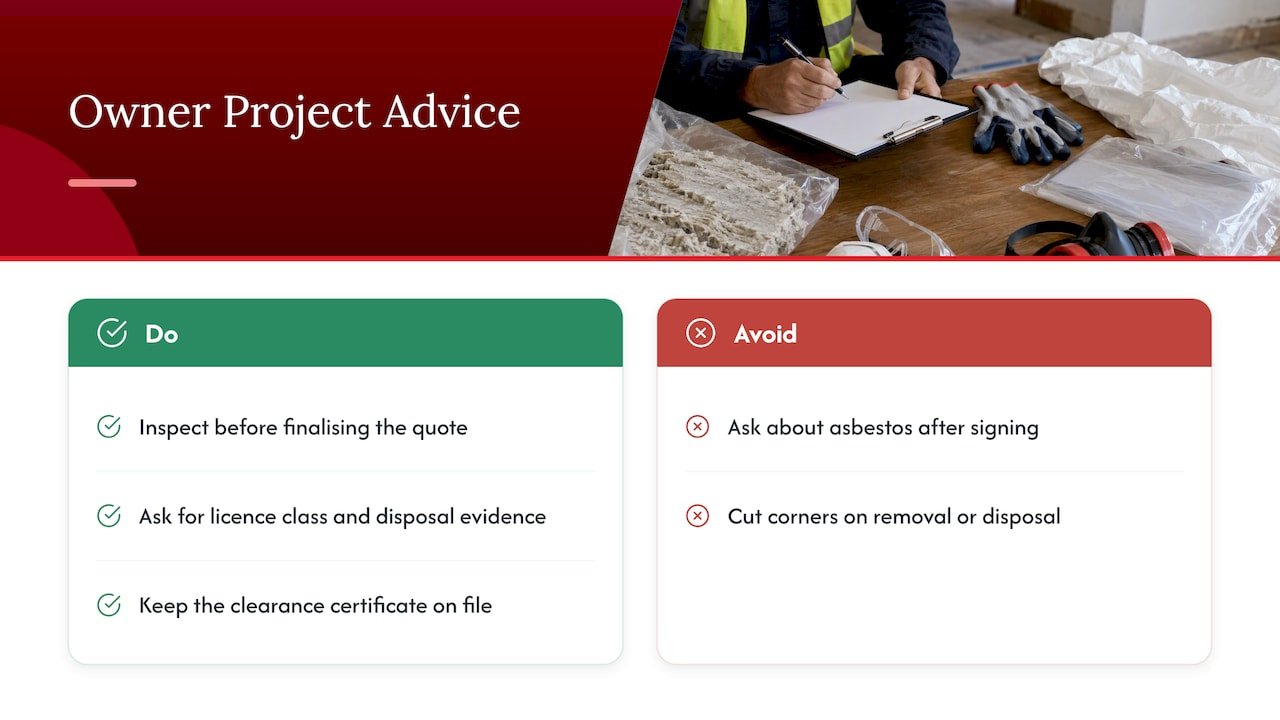
Our advice to owners and developers is simple. Get the inspection done before you finalise your demolition quote, so every bidder prices the same scope. Ask for the licence class and disposal evidence on every asbestos item. Keep the clearance certificate with your project file.
We handle this as one managed project: inspection, licensed removal, approvals support, utility disconnections, hazardous waste handling and a clean final site. That is not a promise that every job is quick or cheap. It is a promise that the order of work is right.
— Tarek
Getting the whole job handled together
If you want asbestos and demolition managed by one team, we cover asbestos removal in Sydney and residential demolition, as well as commercial and industrial work and strip-outs. Send us your address and any existing reports through the Mission Demolition website and we will tell you what the job is likely to involve.
FAQ
Can I remove asbestos myself before demolishing my house?
Sometimes small amounts of bonded asbestos can be handled by an owner under state rules, but friable asbestos and larger quantities of non-friable material need a licensed removalist. The thresholds are in the licence table above, and your state regulator has the final word. Because DIY removal is hazardous and can contaminate your property, most owners are better off hiring a licensed contractor.
Does the demolition contractor have to remove the asbestos first?
The asbestos likely to be disturbed must be identified and removed before demolition starts, as far as reasonably practicable. Whether your demolition contractor does it depends on their licence. Many demolition companies subcontract it to, or partner with, a licensed asbestos removalist, so ask for the licence details.
Where does asbestos waste from demolition go?
It is double-wrapped, labelled and taken only to a landfill licensed by the state or territory EPA. It cannot go into general waste or ordinary skip bins, and it cannot be buried on site. Ask your removalist for the disposal documentation.
Does demolition need council approval as well?
Often yes. Councils approve demolition and can attach conditions about asbestos removal and disposal, and a demolition licence may also be required. Check with your local council and your certifier before booking work.
Sources
- How to manage and control asbestos in the workplace (Safe Work Australia model code of practice)
- Asbestos identification, removal and disposal (Asbestos Safety and Eradication Agency)
- Asbestos and demolition (WorkSafe Queensland)
- Should your workers have an asbestos medical check? (WorkSafe Victoria)
- Bushfire recovery: Asbestos clean-up (WorkSafe Victoria)
- Don’t skip your bin hire responsibilities (City of Greater Geelong)
- A Guide to the Roles and Responsibilities of Government (SafeWork NSW)
- Asbestos policy (North Sydney Council)