Get a site assessment and confirm your permit requirements with council before a single branch comes down. That means engaging an AQF‑level arborist, running utility locates, and locking in a licensed site‑clearance contractor. Do those three things in the right order and you avoid the two most expensive mistakes in site preparation: illegal clearing and a stalled Development Application.
Here is what to do in the first 7–14 days:
Immediate steps (days 1–7):
- Contact your local council to confirm whether a permit or DA is required for your specific site, zone, and vegetation type
- Commission a site survey and arborist inspection before tendering to any contractor
- Run a Dial Before You Dig enquiry to identify underground services
- Check whether any trees on site appear on the council’s Significant Tree Register or are protected under a local DCP
- Confirm whether an ecological or flora/fauna assessment is required alongside the arborist report
First two weeks (days 7–14):
- Engage a qualified arborist (AQF Level 5) to prepare a tree survey and management plan
- Request a pre‑lodgement meeting with council to clarify permit conditions and documentation requirements
- Obtain written quotes from at least two licensed site‑clearance contractors, giving each the same documented scope
- Confirm asbestos inspection requirements for any existing structures on site
- Prepare your DA support package: arborist report, site plan, erosion control plan, and any ecology report council requires
Key takeaways
Compliant tree and vegetation removal site prep requires a permit check, an AQF Level 5 arborist report, and a licensed contractor engaged in that order — skipping any step creates legal and financial exposure that far exceeds the cost of doing it correctly.
| Point | Details |
|---|---|
| Permits come first | Contact council before any clearing; rules vary by state, zone, and DCP — no single national rule applies. |
| AQF Level 5 arborist is the standard | An arborist report prepared by a qualified professional is required for most permit applications and all risk‑based removals. |
| Asbestos must be assessed early | Any pre‑1990 structure on site requires an asbestos inspection before works begin; licensed removal is legally required for ACM above 10 m². |
| Cost and timeline vary widely | Urban tree removal ranges from around $290 to $6,900+ per tree; allow 8–16 weeks minimum from first council contact to cleared site. |
| Missiondemolition covers the full scope | Integrated permits, asbestos removal, site clearance, and waste documentation under one project manager across Sydney and Australia. |
Table of Contents
- When do you need approval for tree and vegetation removal?
- What does a site assessment and tree management plan need to cover?
- How do you apply for council permits and DA support for clearing?
- What clearing methods do contractors use on site?
- What are the health, safety, and hazardous materials requirements?
- How should you handle waste, recycling, and compensatory planting?
- What do tree and vegetation removal projects typically cost and how long do they take?
- How do you choose a contractor for compliant site clearance?
- What compliance pitfalls catch property owners and developers out?
- What do you do when soils or vegetation are contaminated?
- When do you need to consult with local Indigenous groups?
- How do you manage impacts on neighbouring properties and handle disputes?
- What good site prep actually looks like in practice
- Missiondemolition handles the full site clearance picture
- Sources
When do you need approval for tree and vegetation removal?
Australia has no single national rule for tree and vegetation removal site prep. What triggers a permit depends on your state, your council’s Development Control Plan (DCP), the zone your land sits in, and whether any trees are listed on a Significant Tree Register.
The key instrument in NSW is the Biodiversity Conservation SEPP (formerly the Vegetation SEPP), which sets a Biodiversity Offset Scheme (BOS) threshold. Clearing above that threshold requires a Biodiversity Development Assessment Report. Below the threshold, however, a council permit can still be required if the vegetation is regulated under a local DCP. Councils can use DCPs to regulate clearing of both native and non‑native vegetation, and those DCPs can include Significant Tree Registers and specific permit conditions such as compensatory planting.
In Victoria, the picture is different again. State regulations govern native vegetation removal with a dedicated NVR Map tool that helps you determine whether a permit is required and what your application must include. Queensland has its own development assessment framework through the state planning portal, and councils layer additional local rules on top.
Tree removal and protection rules vary by zone, and a protected tree can require approval regardless of its size or whether a DCP exemption appears to apply on the surface. Residential, rural, and commercial zones often carry different obligations even within the same council area.
Common exemptions — and their limits:
- Dead or dying trees: many councils accept this as an exemption, but increasingly require documented arborist evidence (photos and a written assessment) before the exemption applies
- Imminent risk to life or property: the NSW Unsafe Plants Code requires prior written confirmation from council even for risk‑based removals, and specifies that an AQF Level 5 arborist must carry out authorised removals with at least 72 hours’ notice to council
- Noxious weeds and declared pest plants: generally exempt, but check your state biosecurity legislation and confirm the species identification in writing
- Fire hazard clearing: some councils allow limited clearing within a specified setback from a dwelling, but conditions vary
Penalty risk: NSW draft planning proposals have signalled stronger penalties and fewer loopholes for illegal clearing, including mandatory replanting orders and expanded council powers to issue remediation notices. Clearing without a permit is not a minor administrative oversight — it can result in stop‑work orders, substantial fines, and orders to replace removed vegetation at your cost.
Pro Tip: Before you call a contractor, call your council’s duty planner. A five‑minute conversation can tell you whether your site needs a Minor Vegetation Works Permit, a Major Works Permit, or a full DA — saving weeks of rework.
What does a site assessment and tree management plan need to cover?
A tree management plan is the document that holds your permit application together. Without a credible one, councils will issue a Request for Further Information (RFI) that can add weeks to your timeline.
The plan is prepared by a qualified arborist — in NSW, the Unsafe Plants Code specifies AQF Level 5 as the minimum qualification for authorised removals, and most councils expect the same standard for any report that supports a permit application. For larger or ecologically sensitive sites, an independent ecological assessment from a suitably qualified ecologist runs alongside the arborist report.
What a tree survey must record for each tree:
- Species (common and scientific name), noting whether it is native, exotic, or listed as threatened
- Trunk diameter at breast height (DBH), typically measured at 1.3 m above ground
- Canopy spread and estimated height
- Presence of hollows, nesting boxes, or observable habitat features
- Structural condition and any defects (decay, included bark, root damage)
- Proximity to proposed structures, services, and site boundaries
- Retention or removal recommendation with justification
The ecological assessment covers a broader scope: flora and fauna surveys, threatened species screening, and whether the site falls within a mapped biodiversity corridor. Some councils require this for any Major Vegetation Works application; others trigger it based on site area or proximity to bushland.
Pro Tip: Commission the arborist survey before you go to tender. Contractors who quote without a survey scope will give you wildly different prices. A documented scope means comparable, itemised proposals — and far fewer variations once work starts.
Timing matters. Surveys should be completed before lodging any permit application, and ideally before you finalise the design layout. Finding a significant hollow‑bearing tree after the building footprint is locked in is an expensive problem. Flora and fauna surveys may also need to be conducted in specific seasons to detect breeding activity, so factor that into your programme.
| Report type | Who prepares it | When to commission |
|---|---|---|
| Tree survey and management plan | AQF Level 5 arborist | Before DA lodgement and contractor tender |
| Ecological / flora‑fauna assessment | Suitably qualified ecologist | Before DA lodgement; season‑dependent |
| Contamination / hazardous materials | Licensed assessor | Before any ground disturbance |
| Erosion and sediment control plan | Civil engineer or qualified consultant | Before permit lodgement |
How do you apply for council permits and DA support for clearing?
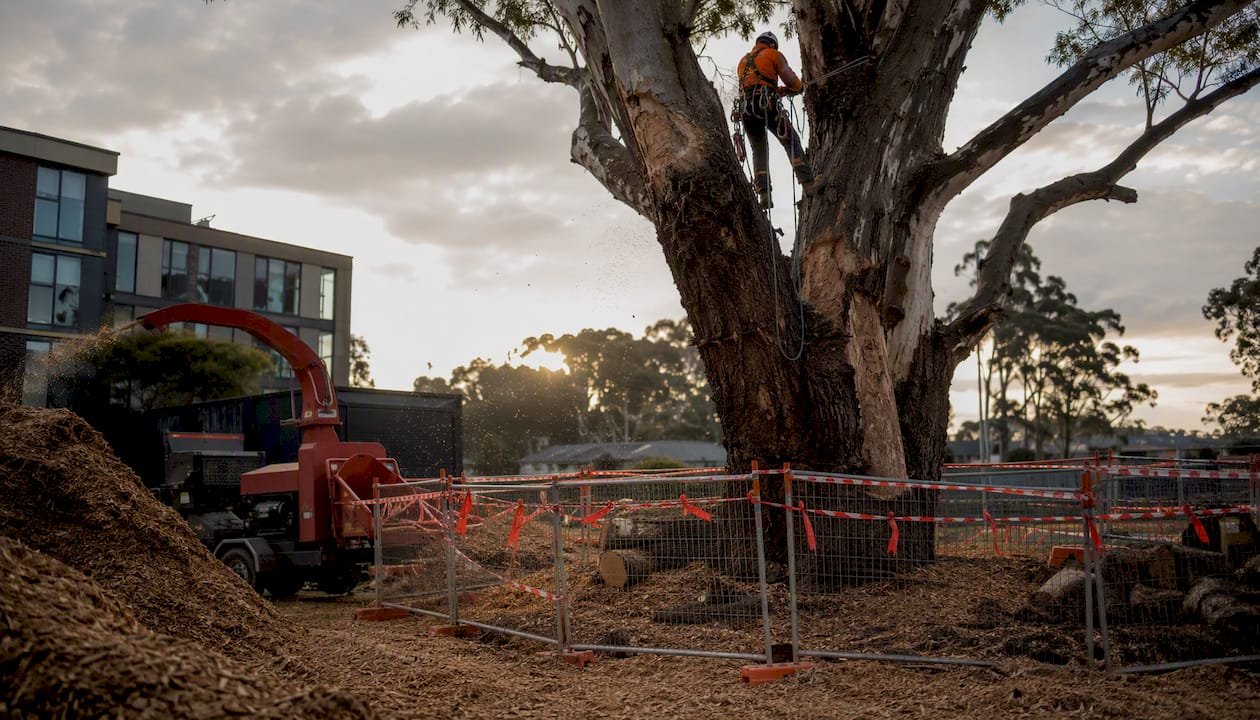
The application process differs between councils, but the underlying workflow is consistent enough to plan around. Getting it right the first time cuts weeks off your timeline.
Step‑by‑step application workflow:
- Pre‑lodgement enquiry: Contact the council’s duty planner or lodge a formal pre‑DA meeting request. Confirm the permit type required (Minor or Major Vegetation Works, or full DA), the applicable DCP chapter, and whether the site triggers any state‑level referrals.
- Prepare your document package: Assemble the arborist report, ecological assessment (if required), site plan showing trees to be retained and removed, erosion and sediment control plan, and any compensatory planting schedule.
- Complete council forms: Most councils use an online lodgement portal. Queensland applicants should check the state development assessment forms and templates for the correct application type.
- Lodge and pay fees: Fees vary by council and permit type. Keep a copy of the lodgement receipt and note the statutory assessment timeframe.
- Respond to RFIs promptly: Councils commonly request additional information on ecology, compensatory planting, or construction methodology. A fast, complete response keeps the clock running.
- Receive determination and note conditions: Read permit conditions carefully. Conditions often specify retained tree protection zones, replacement planting schedules, and inspection hold points.
Document checklist for a typical vegetation works application:
- Arborist report (AQF Level 5, dated within 12 months)
- Ecological assessment or threatened species screening (where required)
- Scaled site plan showing all trees with survey numbers, canopy drip lines, and proposed works
- Erosion and sediment control plan
- Compensatory or mitigation planting plan (species, numbers, monitoring period)
- Written landowner consent if the applicant is not the owner
- Photos of any trees claimed as dead, dying, or posing imminent risk
Central Coast Council’s DCP illustrates how permit types are classified in practice: Minor Vegetation Works covers up to five trees or 100 m², while Major Vegetation Works applies above those thresholds and typically requires an ecological assessment as part of the application package. Your council may use different thresholds, but the logic is the same.
The Gold Coast Council publishes a self‑assessment checklist that lets landowners confirm whether approval is required before lodging — a useful model for checking your own council’s equivalent resource.
Pro Tip: The single most common cause of RFIs is an incomplete arborist statement. Ask your arborist to confirm in writing that the report addresses every item in the relevant DCP chapter before you lodge.
What clearing methods do contractors use on site?
Method choice shapes cost, timeline, and what the site looks like when the contractor leaves. Understanding the options lets you evaluate proposals critically rather than just comparing day rates.
Sectional tree dismantling is used where a tree cannot be felled in one piece due to proximity to structures, fences, or retained vegetation. A climber or elevated work platform removes the tree in sections from the top down. It is slower and more expensive than straight felling but produces a controlled result in tight urban sites.
Selective clearing removes specified trees and understorey while retaining others. This is the standard approach on sites where the permit specifies retention of certain species or where a tree protection zone (TPZ) is required around retained trees. Exclusion fencing around TPZs must go up before any machinery enters the site.
Mulching and chipping converts removed material on site, reducing haulage costs and producing a usable product. Mulch can be spread as ground cover on retained garden areas or stockpiled for later use. It is not suitable for material from trees with known disease or for vegetation that may contain weed seed.
Stump grinding removes the stump to below ground level, typically 200–300 mm, which is sufficient for most landscaping but may need to go deeper for slab or footing areas. Stump grinding is almost always quoted separately from tree removal.
Mechanical clearing using excavators or mulching heads suits larger rural or semi‑rural sites where selective retention is not required. It is fast and cost‑effective per hectare but leaves the topsoil disturbed and requires immediate erosion controls.
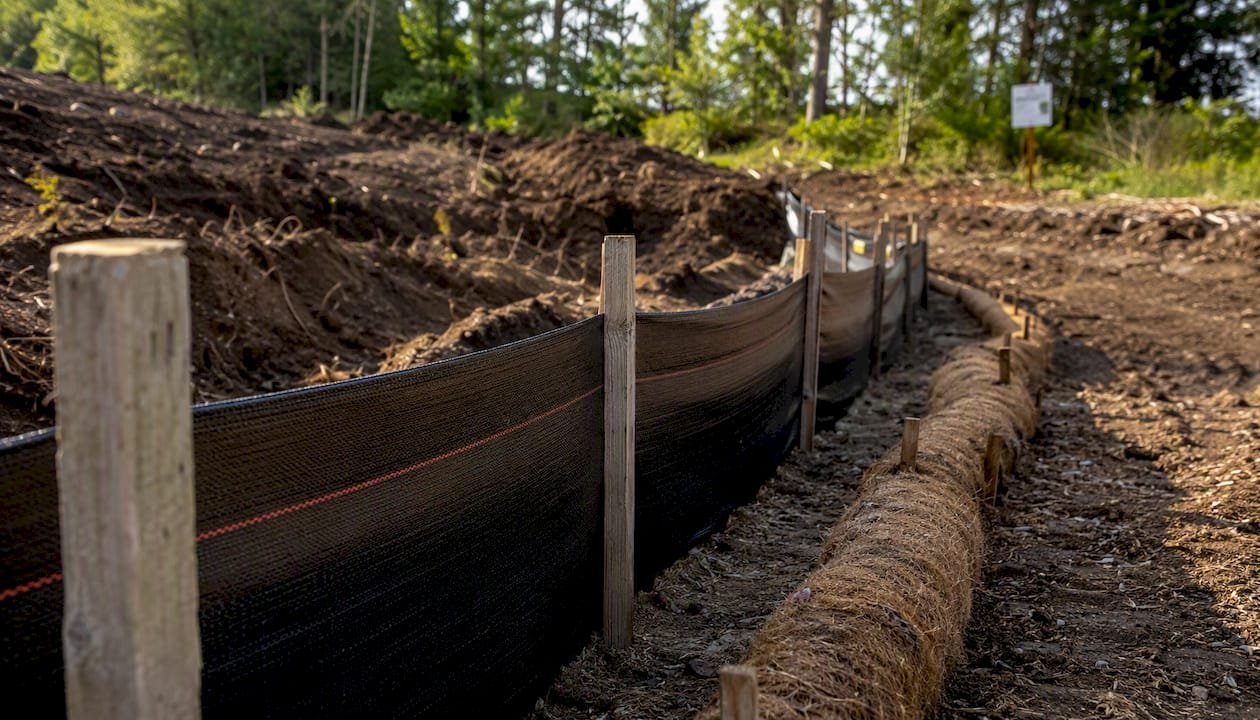
Environmental controls during clearing are not optional extras. Sediment fences, coir logs, and rock check dams protect drainage lines from the moment ground is disturbed. Staged clearing — working in defined sections rather than clearing the whole site at once — reduces exposed soil area and gives fauna time to relocate. Any hollow‑bearing trees scheduled for removal should be assessed for active nesting before work begins, and a fauna spotter‑catcher may be required on ecologically sensitive sites.
Pro Tip: Ask your contractor how they handle protecting retained plantings and garden areas during tree work. A contractor who cannot describe their TPZ fencing standard or root zone protection protocol is a contractor worth questioning further.
Method choices have downstream consequences. Mechanical clearing that removes topsoil creates a harder earthworks task. Leaving large root balls in the ground can cause subsidence under pavements. Stump grinding depth needs to match the structural requirements of whatever goes on top. These are conversations to have with your contractor before work starts, not after.
What are the health, safety, and hazardous materials requirements?
Tree and vegetation removal carries genuine physical risk, and the regulatory obligations around WHS, asbestos, and underground services are not areas where shortcuts pay off.
Asbestos:
Any structure built before 1990 — sheds, fences, eaves, fibro cladding — may contain asbestos‑containing material (ACM). Before any demolition or clearing work that involves disturbing built structures, an asbestos inspection by a licensed assessor is required. If ACM is identified, licensed asbestos removal is legally required for friable asbestos and for bonded ACM above 10 m² in most states. An asbestos waste manifest must accompany all ACM to a licensed disposal facility.
- Friable asbestos: Class A licensed removalist required
- Bonded (non‑friable) ACM above 10 m²: Class B licensed removalist required
- All ACM removal: site air monitoring, PPE, and a clearance inspection before re‑occupation
Underground and overhead services:
Lodge a Dial Before You Dig enquiry before any ground disturbance. This is a legal obligation in most states and identifies the location of gas, water, electricity, telecommunications, and sewer assets. Private asset locates (using a licensed cable locator on site) are required in addition to the DBYD response, particularly on older urban sites where as‑built records may be inaccurate. Overhead powerline clearances are governed by state electrical safety legislation — work within the exclusion zone requires written approval from the network operator.
WHS documentation:
Every contractor working on your site should provide:
- A Safe Work Method Statement (SWMS) covering high‑risk construction work, including tree removal and any work near live services
- Evidence of site induction completion for all workers
- A traffic management plan if work affects a public road or footpath
- Current public liability insurance (minimum $20 million is standard) and workers’ compensation cover
- Licences for any specialised work: electrical, asbestos removal, crane operation
A worksite safety checklist specific to tree removal covers the hazards that are easy to overlook: struck‑by risks from falling limbs, chainsaw kickback, chipper entanglement, and working at height. These are not theoretical risks — they are the most common causes of serious injury in arboricultural work.
Asbestos note: Properties built before 1990 should be treated as potentially containing ACM until a licensed inspection confirms otherwise. Never assume age alone rules it out — asbestos products were used in unexpected locations including soil stabilisation and pipe lagging.
How should you handle waste, recycling, and compensatory planting?
Clearing a site generates significant volumes of green waste, and councils increasingly treat waste disposal and compensatory planting as permit conditions rather than afterthoughts.
Green waste handling options:
- On‑site chipping and mulch reuse: the most cost‑effective option for clean vegetation. Mulch can be spread to a maximum depth of 100 mm on garden areas or used as temporary erosion control.
- Off‑site green waste recycling: licensed green waste facilities accept chipped material for composting. Confirm the facility holds the correct EPA licence for the material type.
- Contaminated vegetation: vegetation from sites with known soil contamination, or material mixed with construction waste, must be disposed of as contaminated waste at a licensed facility with a waste transport certificate.
- Weed material: declared noxious weeds must be disposed of in accordance with state biosecurity legislation — typically double‑bagged and sent to landfill, not composted.
Compensatory planting conditions:
Most councils attach compensatory planting conditions to vegetation works permits. These specify:
- The number and species of replacement trees (often a ratio such as 2:1 or 3:1 for significant trees)
- Minimum pot size or stem diameter at planting
- A monitoring period (commonly two to five years) with annual condition reports
- Replacement obligations if planted trees fail within the monitoring period
Keep records of every planted tree: species, location, planting date, and supplier. Councils may conduct site inspections during the monitoring period, and a post‑clearance land preparation plan that documents stabilisation and planting gives you a clear paper trail.
Records and manifests councils typically require:
| Document | Purpose | Who provides it |
|---|---|---|
| Waste transport certificate | Confirms lawful disposal of contaminated or regulated waste | Licensed waste transporter |
| Asbestos waste manifest | Tracks ACM from site to licensed disposal facility | Licensed asbestos removalist |
| Green waste disposal receipt | Confirms material went to a licensed facility | Contractor or owner |
| Compensatory planting record | Documents species, location, and condition of replacement planting | Owner or landscape contractor |
| Post‑clearing inspection report | Confirms erosion controls are in place and retained trees are undamaged | Arborist or site supervisor |
What do tree and vegetation removal projects typically cost and how long do they take?
Cost and timeline vary more than most owners expect, and the gap between a simple suburban tree removal and a full development site clearance is substantial.
Major cost drivers:
- Tree size, species, and structural condition (a 30 m eucalypt costs far more to remove than a 6 m ornamental)
- Site access: narrow lots, overhead powerlines, and proximity to structures all increase labour and equipment costs
- Permit and report fees: arborist reports, ecological assessments, and council application fees add to the pre‑clearance cost
- Traffic management: road closures or lane occupancy permits add cost and require advance notice to council
- Stump grinding depth: standard grinding to 200–300 mm is cheaper than grinding to footing depth
- Hazardous materials: asbestos inspection and licensed removal add cost and time to any project involving pre‑1990 structures
- Waste disposal: contaminated material costs significantly more to dispose of than clean green waste
Cost estimates for urban tree removal in Sydney illustrate the range: small trees from around $290, with complex large‑tree removals reaching $6,900 or more per job. Stump grinding is commonly quoted separately. Those figures cover individual trees; a full site clearance with multiple trees, understorey removal, and stump grinding will be priced on a project basis.
Pro Tip: Book planned clearances in autumn or winter when arborist demand is lower. Seasonal pricing pressure is real, and a scheduled project in the quieter months often attracts faster availability and more competitive rates.
| Project stage | Typical lead time |
|---|---|
| Arborist survey and report | 1–2 weeks from engagement |
| Ecological assessment (if required) | 2–6 weeks (season‑dependent) |
| Council permit assessment (minor works) | 2–4 weeks |
| Council DA assessment (major works) | 6–12 weeks or more |
| Contractor mobilisation after permit | 1–3 weeks |
| Clearing works (typical residential site) | 1–5 days on site |
| Post‑clearing stabilisation and inspection | 1–2 weeks |
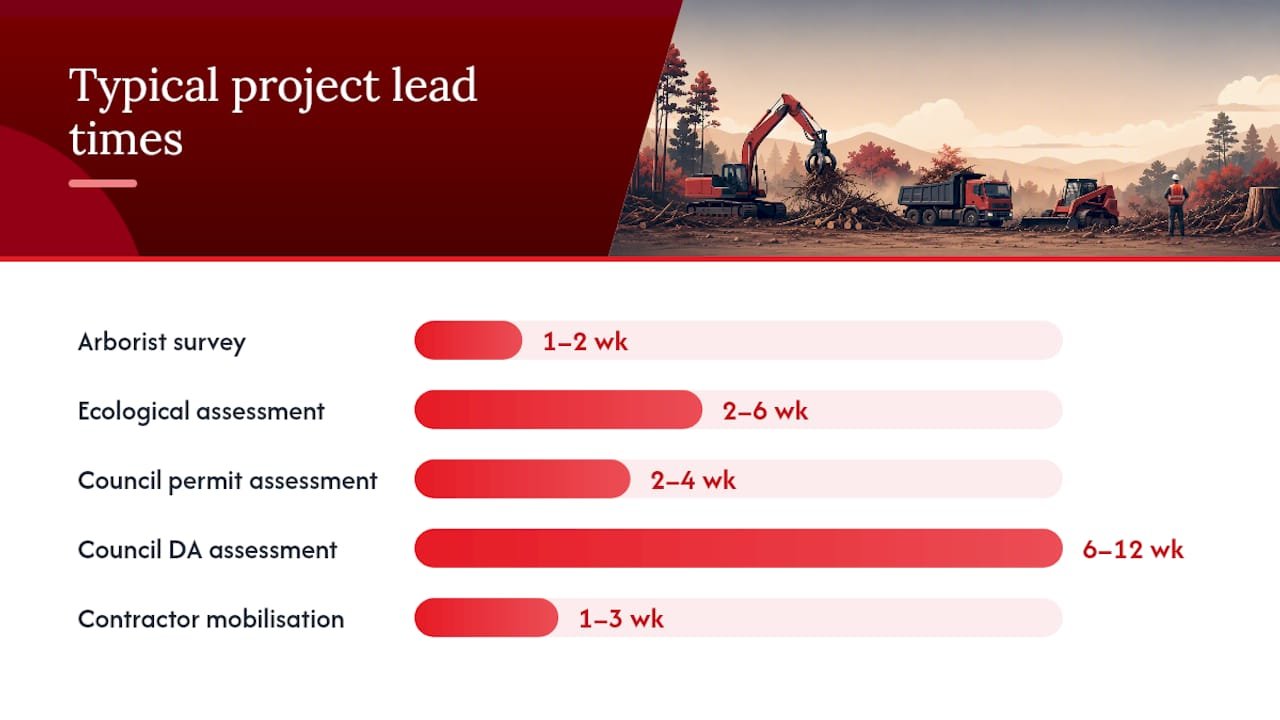
Total elapsed time from first council contact to cleared site: allow 8–16 weeks for a straightforward permit, and 16–26 weeks or more for a complex DA with ecological referrals.
How do you choose a contractor for compliant site clearance?
The cheapest quote is rarely the right quote for a project that carries permit conditions, hazardous materials risk, and council inspection hold points.
Essential credentials to verify:
- Current public liability insurance (minimum $20 million) and workers’ compensation
- Contractor’s licence for the relevant state (builder’s licence, demolition licence, or arborist accreditation depending on scope)
- AQF Level 5 arborist on staff or engaged as a subcontractor for any tree work requiring a qualified arborist
- Class A or Class B asbestos removal licence if ACM is present or suspected
- WHS management system: SWMS, site safety plan, and evidence of current inductions
Questions to ask before signing a contract:
- Who manages the permit application and council correspondence — you or the contractor?
- How is waste disposed of, and will you provide waste transport certificates and disposal receipts?
- What is the stump grinding depth, and is it included in the quoted price?
- How do you protect retained trees and garden areas during works?
- What happens if additional hazardous materials are found during clearing?
- Who is responsible for erosion controls and site stabilisation after clearing?
Contract inclusions to insist on:
- Itemised scope covering each tree, stump, and area of understorey
- Permit condition compliance obligations clearly assigned
- Waste disposal method and documentation requirements
- Variation process for unforeseen conditions
- Reinstatement obligations (erosion controls, site clean‑up)
For a detailed vetting framework, demolition contractor vetting criteria covers the insurance, licence, and WHS checks that apply to integrated site clearance projects.
Red flags in quotes and proposals:
- No site visit before quoting
- Lump‑sum price with no itemised breakdown
- No mention of permit conditions or waste disposal method
- Inability to provide licence numbers or insurance certificates on request
- Pressure to start before permits are issued
Pro Tip: Give every contractor the same written scope document when requesting quotes. Comparable itemised proposals are only possible when every contractor is pricing the same job. A contractor who refuses to quote against a written scope is telling you something important.
What compliance pitfalls catch property owners and developers out?
The most expensive mistakes in vegetation management are not the ones that happen on site. They happen in the planning phase, and they are almost always avoidable.
Misusing the dead/dying exemption without arborist evidence
Councils increasingly require documented evidence — photos and a written arborist assessment — before accepting a dead or dying claim. Removing a tree on the basis of a visual judgment, without an arborist report, exposes you to a compliance notice even if the tree genuinely was dead. The DCP guidance on vegetation management makes clear that unverified claims carry real compliance risk.
Failing to check Significant Tree Registers and BOS thresholds
A tree that looks unremarkable may be listed on a council’s Significant Tree Register, which triggers a permit requirement regardless of size or condition. Similarly, clearing that appears to fall below the BOS threshold may still require a council permit under the local DCP. Check both before any work starts.
Inadequate documentation at lodgement
Missing ecology reports, incomplete arborist statements, and site plans that do not show canopy drip lines are the three most common triggers for RFIs. Each RFI adds weeks to the assessment clock. The fix is straightforward: use the relevant DCP chapter as a checklist and confirm with your arborist that the report addresses every item before lodging.
Councils have the power to issue stop‑work orders, require full reinstatement of removed vegetation, and refer matters to the Land and Environment Court. NSW draft proposals signal that penalties for illegal clearing will increase, with clearer powers for councils to order remediation and mandatory replanting at the landowner’s cost. The financial exposure from clearing without a permit far exceeds the cost of getting the paperwork right.
Comparison: compliant vs non‑compliant clearing approach
| Factor | Compliant approach | Non‑compliant approach |
|---|---|---|
| Permit status | Permit obtained before works | Works proceed without permit |
| Arborist involvement | AQF Level 5 report prepared | No arborist engaged |
| Waste disposal | Licensed facility, receipts kept | Unlicensed disposal or burning |
| Outcome risk | Project proceeds; conditions met | Stop‑work order, fines, reinstatement order |
What do you do when soils or vegetation are contaminated?
Contaminated soils and hazardous vegetation are not rare on older urban sites, and discovering them mid‑project without a plan is one of the fastest ways to blow a budget and a timeline.
Soil contamination on development sites typically comes from previous land uses: fuel storage, chemical storage, industrial processes, or historical fill. Before any ground disturbance, a Phase 1 Environmental Site Assessment (desktop review of historical land use) is standard practice. If the Phase 1 flags a concern, a Phase 2 assessment involving soil sampling and laboratory analysis is required before clearing or earthworks proceed.
Contaminated soil cannot be disposed of as general fill. It must be classified, transported under a waste transport certificate, and taken to a licensed facility authorised to accept the specific contaminant type. The contractor must hold the appropriate EPA licence for handling and transporting contaminated material.
Hazardous vegetation includes plants treated with persistent herbicides, vegetation from sites with known heavy metal contamination, and certain declared noxious weeds. The disposal pathway depends on the contaminant. Material from herbicide‑treated areas may need to be composted at a facility with appropriate controls; noxious weed material must follow state biosecurity disposal requirements.
Asbestos in soil is a separate and serious issue. Asbestos‑contaminated soil is classified as hazardous waste in all Australian states. It requires excavation by a licensed asbestos removalist, transport under a waste manifest, and disposal at a licensed asbestos waste facility. The asbestos waste manifest process documents the chain of custody from excavation to disposal and is a legal requirement, not optional paperwork.
When do you need to consult with local Indigenous groups?
Consultation with Traditional Custodians is a legal and ethical obligation on many development sites in Australia, and the threshold for when it applies is lower than many developers expect.
Under the NSW Aboriginal Heritage Act 2006 (and equivalent legislation in other states), you must not harm, desecrate, or disturb an Aboriginal object or place. Vegetation clearing and ground disturbance can expose or damage Aboriginal cultural heritage, including scarred trees, stone artefacts, and burial sites. A scarred tree — one modified by Aboriginal people for bark canoes, shields, or possum hunting — is a protected Aboriginal object under NSW law, and its removal without an Aboriginal Heritage Impact Permit (AHIP) is an offence.
Before clearing, check the NSW Aboriginal Heritage Information Management System (AHIMS) or the equivalent state register for your jurisdiction. If the site is in an area with known or potential Aboriginal cultural heritage, you are required to carry out a due diligence assessment. For higher‑risk sites, a formal Aboriginal Cultural Heritage Assessment (ACHA) prepared in consultation with the relevant Local Aboriginal Land Council (LALC) or Registered Aboriginal Party (RAP) is required.
Consultation is not a box‑ticking exercise. Engaging the relevant LALC or RAP early — before the arborist survey if possible — gives Traditional Custodians the opportunity to identify culturally significant trees or areas that should be retained or treated with specific protocols. It also reduces the risk of discovering a protected object mid‑clearing, which triggers an immediate stop‑work obligation.
In Victoria, the Aboriginal Heritage Act 2006 (Vic) requires a Cultural Heritage Management Plan (CHMP) for high‑impact activities in areas of cultural heritage sensitivity. Check the Victorian Aboriginal Heritage Register and consult with the relevant Registered Aboriginal Party before lodging any planning application.
How do you manage impacts on neighbouring properties and handle disputes?
Neighbouring properties are affected by tree removal in ways that are easy to underestimate: root systems extend well beyond the canopy, falling debris can damage fences and gardens, and dust and noise from chipping operations affect amenity.
Before works start:
Notify adjoining owners in writing before any clearing begins. This is not always a legal requirement, but it is standard practice and prevents disputes. The notice should describe the scope of works, the expected duration, and a contact number for questions. If any tree roots or branches extend over the boundary, confirm the legal position with your solicitor before removing them — in most Australian states, a neighbour is entitled to remove encroaching branches and roots to the boundary line, but the rules around liability for damage vary.
If a retained tree on a neighbouring property is within the influence zone of your works, engage your arborist to assess the potential impact and document the tree’s pre‑works condition with photographs. This protects both parties.
During works:
- Erect temporary hoarding or shade cloth along shared boundaries to contain debris
- Schedule noisy operations (chipping, grinding) within council‑approved hours
- Keep site access clear and restore any damage to kerbs, footpaths, or verges promptly
- Protect neighbouring garden beds and root zones with exclusion fencing
Disputes:
If a neighbour objects to proposed works or claims damage, the first step is direct communication. Most disputes resolve at this stage. If a tree is protected under a DCP or Significant Tree Register, the council permit process provides a formal objection mechanism. For damage claims, your contractor’s public liability insurance should respond — confirm coverage before works start, not after.
The considerations for protecting gardens during tree removal include practical steps for containing the work zone and minimising impact on adjacent plantings, which is useful briefing material for your contractor.
What good site prep actually looks like in practice
The projects that run smoothly share one thing: the compliance work is done before the contractor arrives, not alongside it. When I see a site where the arborist report is complete, the permit conditions are printed and on the fence, and the exclusion zones are already fenced before the first machine rolls in — that project will finish on time. The ones that don’t follow that sequence spend the first week firefighting.
What owners often underestimate is how much the sequencing matters. An ecological assessment that gets commissioned after the DA is lodged adds weeks. A stump grinding depth that wasn’t specified in the contract creates a variation. An asbestos find that wasn’t anticipated in the programme stops everything. None of these are unforeseeable — they are the predictable consequences of skipping the front‑end work.
The other thing worth saying plainly: the permit system exists for good reasons. Significant trees provide canopy cover, habitat, and stormwater management that is genuinely hard to replace. Compensatory planting conditions are not bureaucratic friction — they are the mechanism by which development sites give something back. A contractor who treats permit conditions as obstacles to work around is not a contractor you want managing a project with council inspection hold points.
Missiondemolition’s approach — integrating permit support, hazardous materials handling, and site clearance under one project manager — reflects how these projects actually work when they go well. The permit, the asbestos check, and the clearing scope are not three separate engagements. They are one coordinated programme.
Missiondemolition handles the full site clearance picture
Site clearance for development is not just tree removal. It is permits, asbestos checks, utility locates, waste manifests, erosion controls, and a cleared, stabilised site ready for the next trade. Managing those moving parts across separate contractors is where projects lose time and money.
Missiondemolition provides integrated site clearance services in Sydney that cover the full scope: vegetation and tree removal, licensed asbestos inspection and removal, earthmoving, waste management with proper documentation, and permit support from pre‑lodgement through to final site clean‑up. The team works with your arborist and council to keep the project on the right side of every permit condition. For properties with suspected ACM, licensed asbestos removal is handled under a single project manager, with waste manifests and clearance certificates provided as standard. Get a site assessment and a written quote by contacting the Missiondemolition team directly.
Sources
These are the primary regulatory and guidance documents to check for your site. State and council sources carry different authority — always confirm which instrument applies to your specific zone and jurisdiction.
- Guidance for local government on managing vegetation with a Development Control Plan
- Tree removal and protection – NSW Planning Portal
- CHAPTER 3.5 TREE AND VEGETATION (Central Coast DCP 2022)
- Native vegetation removal regulations – Environment
This article is general information, not a substitute for advice from a qualified lawyer. Consult a qualified legal professional about your own circumstances before acting on anything here.

2 Responses